
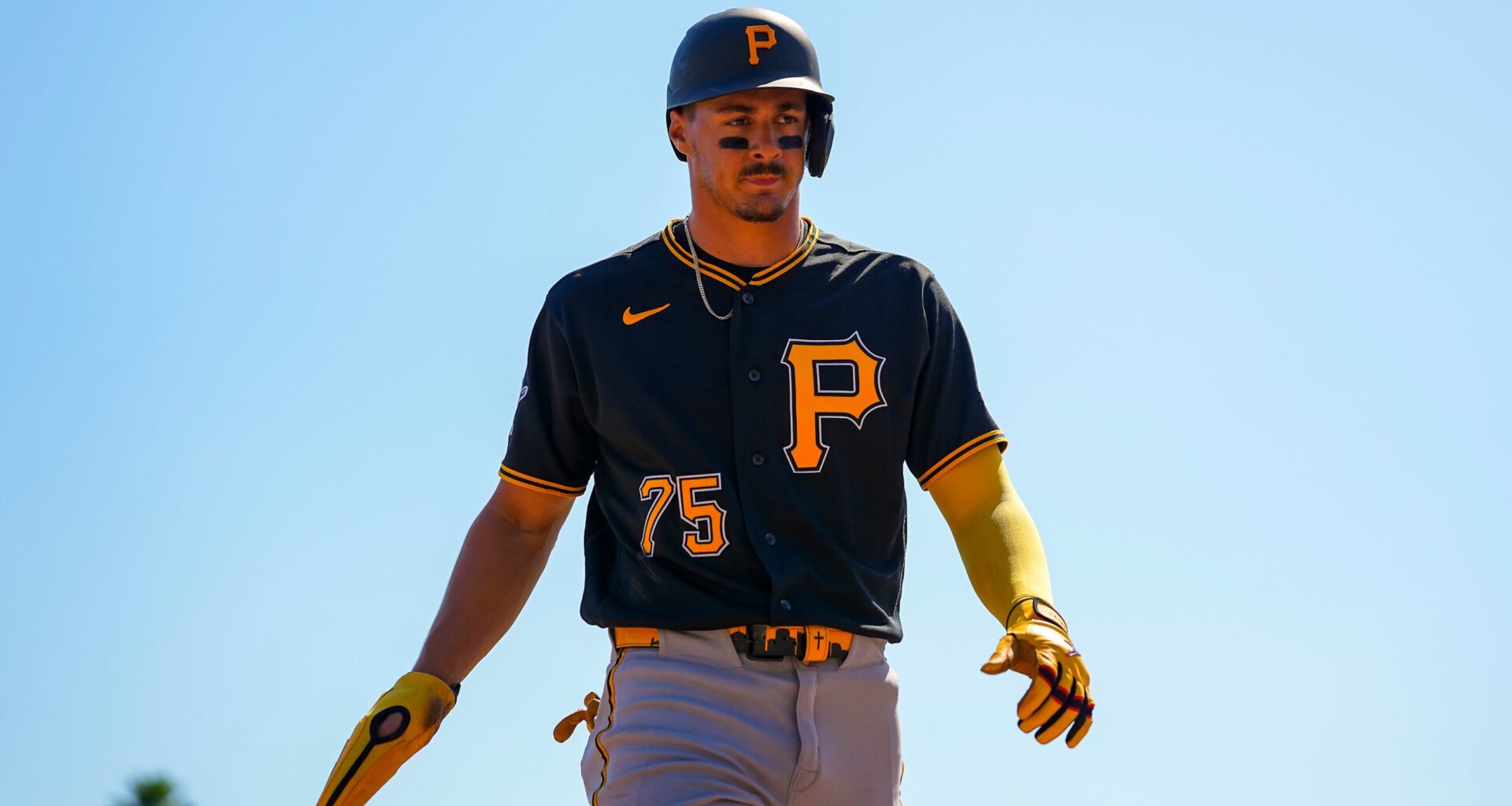
Image credit:
(Photo by Jay Biggerstaff/Getty Images)
The Pirates hit the jackpot in the 2024 draft.
Mississippi high school shortstop Konnor Griffin fell to them with the ninth pick. That’s not entirely fair to Griffin. Labeling him as “shortstop” is selling him short. He also was the ace pitcher for Jackson Prep School and had dabbled in center field.
He even won the BA High School Player of the Year award.
So how did eight teams pass on such a multi-dimensional talent as Griffin in the 2024 draft? It had to do with skepticism about his hit tool—skepticism that he quickly dispelled in a Minor League Player of the Year campaign in 2025 that culminated in him reaching Double-A for 21 games.
Griffin’s rapid progression in his first pro season positioned him not only as the No. 1 prospect in the game but also put him on track to make his MLB debut in 2026. The only question is when.
It could be sooner than anyone could have guessed on draft day in 2024.
That’s because some aspects of the Collective Bargaining Agreement incentivize the Pirates to debut Griffin sooner rather than later, potentially even on Opening Day. Let’s take a look at why the Pirates might break camp with Griffin as their starting shortstop—and why they might not.
Why The Pirates Might Carry Griffin On Opening Day
Historically speaking, Triple-A experience is not a requisite for MLB success for top overall prospects. That certainly applies to Griffin, the No. 1 prospect in the game, the same as it does for Tigers shortstop Kevin McGonigle, the No. 2 prospect.
Both players are vying to bypass Triple-A and make Opening Day rosters, Griffin in his age-20 season and McGonigle in his age-21 campaign.
It’s rare for a player 20 or younger to bat 500 times in a big league season. The last to do it was Jackson Chourio in 2024. Before that it was Vladimir Guerrero Jr. and Juan Soto in 2019. Before them it was Manny Machado in 2013 and Mike Trout and Bryce Harper in 2012.
Adrian Beltre, Alex Rodriguez and Ken Griffey Jr. also belong to this club.
As was the case with those future superstars, Griffin has the type of talent to emerge as a franchise player. If he plays in the big leagues this year as a 20-year-old, he will endure ups and downs of a typical young big leaguer, but his brilliance will shine through in spots as he acclimates.
Broadly, the three best reasons for the Pirates to carry Griffin on Opening Day are talent, competitive intent and future considerations.
Talent
Despite his youth, Griffin is the best shortstop in Pirates camp this spring. He has batted more than any other Pirates player and has manned shortstop more than any other player, a field that includes Jared Triolo and Nick Gonzales and non-roster players Alika Williams and Yordany De Los Santos.
Competition
The Pirates made offseason moves aimed at building a competitive team, one that could challenge for a National League wild card, if things break their way.
Pittsburgh traded for second baseman Brandon Lowe and signed right fielder Ryan O’Hearn and DH Marcell Ozuna. It acquired extra outfielders Jake Mangum and Jhostynxon Garcia and relievers Gregory Soto and Mason Montgomery. While none of these players is a marquee talent, all are contributing big leaguers, the kind the Pirates have not bothered to acquire in recent offseasons.
Rostering Griffin on Opening Day—and, therefore, playing their best 26 players from day one—maximizes the Pirates’ chances to compete in what will be a tight playoff race.
Future considerations
If Griffin spends a full season in the big leagues as a rookie, then he will qualify for Prospect Promotion Incentive eligibility. If he then wins NL Rookie of the Year or finishes top three for MVP in his second or third season, then the Pirates would add a draft pick after the first round that is valued at about $3 million.
This is the process by which the Royals gained an extra pick in the 2025 draft. Bobby Witt Jr. made Kansas City’s Opening Day roster in 2022, qualified for PPI and then yielded a draft pick when he finished runner-up for the AL MVP award in 2024. The Royals used that pick to select Josh Hammond in 2025.
The similarities between Witt and Griffin as physical, athletic, do-everything shortstops are obvious, but it is actually a different 2022 rookie whose case mirrors Griffin’s more closely.
Julio Rodriguez entered 2022 as the No. 2 prospect in the game. He reached the upper minors for the first time the year before, playing 46 games at Double-A in 2021. The year before that, Rodriguez had the entire minor league season wiped away by the pandemic.
It didn’t affect him. Rodriguez won AL Rookie of the Year in 2022, and the Mariners added a 2023 PPI draft pick.
With the best prospects, talent finds a way.
A Fourth Reason To Carry Griffin
A fourth reason for the Pirates to carry Griffin on Opening Day could be described as a Prospect Demotion Disincentive. Even if the Pirates hold Griffin back this spring and assign him to the minor leagues, he could still earn a full year of MLB service for 2026 if he finishes first or second for NL Rookie of the Year.
In other words, the Pirates would have to commit to keeping Griffin in the minors through late June to curtail his ROY chances. In recent seasons, players called up in May and June have won the ROY award, including Paul Skenes in 2024 (May 11 callup), Michael Harris II in 2022 (May 28) and Yordan Alvarez in 2019 (June 9).
Even if the Pirates open with Griffin in the minor leagues and don’t call him up until June, they still run the risk of being hit with a triple whammy of sorts.
If Griffin does not make the Opening Day roster and wins ROY or finishes second: (1) he gets a full year of service, (2) the Pirates miss out on the potential for a PPI draft pick, and (3) they potentially sacrifice wins that could help them play into October.
Why The Pirates Might Not Carry Griffin On Opening Day
Ultimately, the Pirates have to do what they feel is best for their top prospect—and their business interests.
Griffin’s readiness for MLB is an open question. He spent about a month at Double-A last year and has mixed good moments with bad in Grapefruit League play this spring. The Pirates could justifiably determine that Griffin is not quite ready to thrive in MLB.
However, given all the dimensions Griffin possesses beyond the batter’s box—fielding, throwing, speed, baserunning—he likely could survive in MLB as a 20-year-old, while gaining valuable experience that would help him later in the season, when the Pirates may be scrapping for a wild card.
The more compelling reasons for the Pirates to hold Griffin back on Opening Day are financial ones. If the Pirates wait until April 10 to call up Griffin, then he would not be able to accrue 172 service days this year, which would equate to one year of service for contractual purposes. (That is true unless he finishes first or second for NL Rookie of the Year. In that case, he receives a full year of service, regardless of callup date.)
If Griffin comes up this season but does not receive credit for a full season, then the Pirates would control his contract for seven seasons rather than six. That would make him free agent-eligible after the 2032 season rather than 2031.
If the Pirates hold Griffin down into June, then he would likely not qualify for Super 2 arbitration and thus would go through arbitration three times rather than four before qualifying as a free agent. This would save the Pirates millions of dollars.
However, the Pirates could hedge their bets by naming Griffin to the Opening Day roster and, if he struggles, still carry out service manipulation. That would require a demotion of 20 days to buy an extra year of control and 50 or more days to likely disqualify him for Super 2 arbitration after the 2028 season (using 2025 Super 2 estimates and assuming the same service rules govern arbitration in three seasons).
The caveat here is that a first- or second-place for NL Rookie of the Year nullifies all of these service-time suppression efforts.
The Pirates might also be planning to extend Griffin’s contract in conjunction with him making the Opening Day roster. If they go this route, they would have to wait until after he debuts to make the agreement official. Otherwise, they lose the chance at PPI eligibility, which extends only to rookies with no long-term contract in place at the time of MLB debut.