
Most
Valuable Promotions has stepped directly onto the UFC’s turf. | 📷:
Melina Pizano/Getty for Netflix
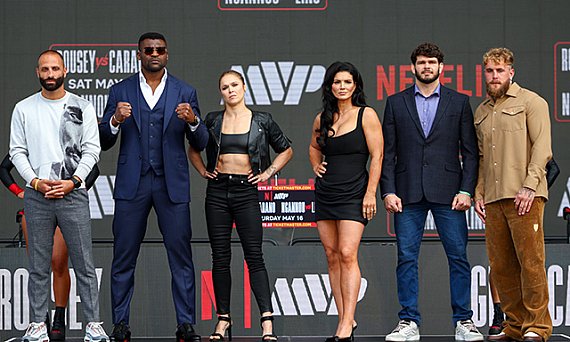
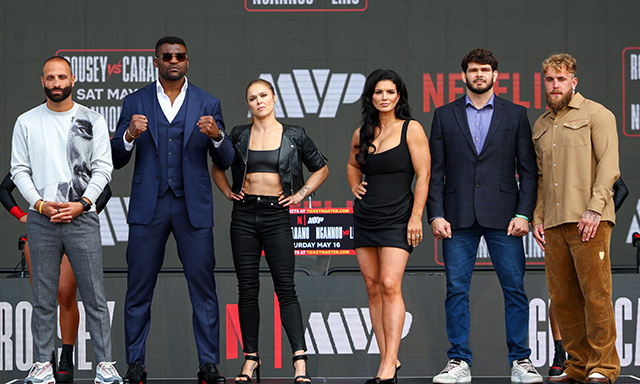
INGLEWOOD, California — Ronda
Rousey and Francis
Ngannou walk into the Intuit Dome.
That’s not meant to set up a punchline about Dana
White’s favorite and least favorite fighters, but as always in
mixed martial arts, only time will tell.
Rousey (friend) and Ngannou (foe) experienced polar opposite
relationships with White while they were under contract to the
Ultimate Fighting Championship. Now both are in the same camp,
dropping heavy artillery on the UFC CEO’s company after joining
forces for
MMA’s debut on Netflix on May 16, inside the newest
state-of-the-art arena in Los Angeles.
The event will be headlined by Rousey’s fantastical booking against
Gina
Carano under the Most Valuable Promotions banner, while Ngannou
will also have his second cage fight in four years. The current
lineal MMA heavyweight champion’s streak of seven straight wins and
a reputation for being the “Baddest Man on the Planet” are on the
line against unheralded Brazilian Philipe
Lins.
For Rousey, 39, lobbing verbal grenades is nothing new. Doing so
toward the UFC, however, represents a clear change, particularly
because her loud critiques of the ownership can’t be separated from
the talent agency that represents her interests as a client—they
have been one and the same since 2016.
Weeks after nailing down the particulars with MVP, Netflix and
Carano, Rousey has not heard one word from anyone at William Morris
Endeavor about her decision to lambaste the company’s stewardship
of the UFC, nor does she expect to.
“My success is their success, as well,” Rousey said. “Should I be
worried? The last thing you want is for me to be pissed off with
something to prove, as [UFC executive] Hunter Campbell is about to
learn with this fight eclipsing anything he’s ever done. We both
know that we’re much better allies than enemies.”
Rousey initially reached out to White about returning to the UFC
late in 2024 and let it be known that after the birth of her second
daughter, she wanted to fight the woman who motivated her to try
MMA to begin with. Nine months pregnant, Rousey saw an interview
with Carano and recognized that her MMA idol, whom she discovered
during a 2007 fight with Julie
Kedzie on Showtime, needed her help.
Carano, of course, transitioned from fighting to acting before
Rousey made her amateur MMA debut in 2010. She received high-impact
roles in feature films and big-budget streaming series, but all of
that quickly fell apart during the coronavirus pandemic when
controversial statements on social media cost Carano
everything.
“Once you come out of that dark place, things can’t touch you the
way they used to,” said Carano, who in 2022 married the man who
introduced her to fighting, muay thai pro Kevin Ross.
“And you’re just so grateful to be standing here—very flawed human
being, here—and talk to all of you. I’m so blessed because I was at
the bottom and I’m climbing back out.”
Carano doesn’t recall much from the fight that precipitated her
move into acting because the adrenaline dump she experienced
standing across from Cristiane
“Cris Cyborg” Justino in 2009 made it feel like her soul left
her body.
Rousey didn’t want to be in the cage the night she absorbed a
pounding in less than a minute against Amanda
Nunes, but she felt pressured to return 13 months following a
career-rattling loss to Holly Holm
that snapped her perfect MMA record and cost her the UFC belt.
Neither woman discussed these hard moments during the year they
worked together to find partners who would support their fight, yet
for both of them, a sense of coming back from the brink works as
the prevailing narrative for the event.
“Sometimes I think the one person who would understand what I’m
feeling right now is Ronda,” Carano, 43, said. “And I feel like she
probably feels the same way. We’ll see what happens in this fight,
but I think we’ll be fast friends after.
“I’ve had a tremendous amount of sympathy for her knowing what she
went through and was going through in all of her fights,” she
added. “I’ve felt that pressure. I felt that groundbreaking stuff,
but not on the level she was feeling it. And so every time I’d
watch her and people would be hating on her, I’d be like, ‘Why are
they hating on her? She’s carrying the weight of MMA on her
shoulders right now, not just women’s MMA.’ She carried that sport
for a second. So she’s always really respected me, and even in our
losses, I think that’s cool we have that in common.”
Rousey ventured to comeback against Carano on the final
pay-per-view of UFC’s ESPN deal last year. White offered the best
terms for which Rousey could have hoped, but Carano said she would
not have been ready to fight by then. A few months later, the bout
with Netflix and MVP gave the two famous women another moment to
make the most of their situation.
“It’s been such a journey,” said Rousey, a bronze medal-winning
Olympic judoka in 2008, who at her peak was arguably the most
influential fighter ever to step inside the Octagon. “So many
people tried to get in between us to insert their own agenda. We
went from barely knowing each other and respecting each other to
being like, ‘You know what? We’re going to fight one another.’ We
have been on a collision course ever since I sat on a couch
watching her on TV just in complete awe of what this woman was
doing.”
Jake
Paul Provides Drawing Power
Opportunity. Fate. Will. Whatever led Rousey and Carano to MVP and
Netflix, the spring spectacle should determine if it makes sense
for the world’s largest streamer to step into MMA without the UFC
as a partner. Should the answer turn out to be yes, Netflix’s 325
million subscribers could see an all-in move by MVP, a nearly
five-year-old promotional company that specializes in women’s
boxing and centers its major events around co-founder Jake
Paul.
After Netflix agreed in 2024 to make Paul’s boxing contest against
Mike Tyson the platform’s first-ever live sports broadcast, 125
million people streamed it worldwide. The YouTube sensation turned
combat sports mover and shaker can’t train or spar for anything
resembling a fight at the moment. He needs several more months to
recover from a second surgery on the broken jaw he suffered boxing
against Anthony
Joshua in December during MVP’s third card with Netflix. Unable
to appear on the streamer’s first MMA showcase, Paul will watch
from cageside with his partner, Nakisa Bidarian, as their venture
crosses into the UFC’s turf.
“If this does well, we 100% believe there will be more MMA with
Netflix,” Bidarian said.
Contenders/pretenders were repeatedly crushed in the
pay-per-view-driven MMA world of the past. Upstarts came and went
with next to no shot of convincing fans to fork over money for
their product. That seemed to be reserved exclusively for the UFC,
and attempts to prove otherwise usually ended face first on the
floor. But 10 years after Endeavor purchased the UFC from Frank and
Lorenzo Fertitta for $4 billion, the company has undergone a
massive shift away from the business model that drove hundreds of
millions of dollars into its coffers and acted like a force field
against competitors with big ambitions.
“I actually think [MMA is] more ripe for disruption than boxing in
many ways,” Bidarian said. “In boxing, you have an ecosystem of all
these phenomenal promoters that have existing fight rosters and
history and legacy that is meaningful to the sport. The UFC has
done a tremendous job of becoming the reference brand for the
sport, but they haven’t kept up with that brand in terms of how
they treat athletes and fighters. So I think if someone came in and
actually showed a path for fighters that really valued them first
and foremost and had the right distribution partner, which is a
critical component, then there’s an opportunity for a true No. 2 in
the marketplace.”
Streaming the next seven years on Paramount+ in exchange for $7.7
billion, the end of UFC’s PPV business quickly impacted what value
and leverage mean across the space.
“Once they moved to the streaming model, it’s not about putting on
the best fight possible anymore,” Rousey said. “Dana is legally
beholden to maximizing shareholder value, and unfortunately, now
that they’ve taken the reins of the company away from him, it’s
barely recognizable now.”
Compared to UFC’s stranglehold on PPV, if Netflix, the biggest dog
in the yard, likes what it sees and jumps into MMA in a real way,
Zuffa’s foothold over the streaming market suddenly seems less
entrenched—even if Paramount eventually merges with Warner Brothers
Discovery.
“MMA is in a weird position right now, and it’s the wild west,”
Paul said. “I believe we have a massive opportunity here to disrupt
the whole space and to put fighters first and get them the pay they
deserve, the platform that they deserve. I believe the UFC is
dying, and MVP is here to take over.”
Intending to step into a cage to fight someday soon, the novelty of
Paul’s MMA debut should attract viewers whenever that comes. “I
think me versus Francis would be massive,” said Paul, whose
backside Ngannou promised to beat if given the chance. MVP
originally approached Ngannou with a match against Dutch
heavyweight kickboxer Rico
Verhoeven. That failed to materialize when Verhoeven took a
page out of Ngannou’s book by challenging Oleksandr Usyk for the
boxing heavyweight championship of the world. Ngannou’s life after
the UFC includes two lucrative boxing bouts against Tyson Fury
and the aforementioned Joshua that earned him tens of millions of
dollars.
“You cannot go to the store or gas station or school and pay the
fee with legacy,” Ngannou said. “You have to understand that. That
is bulls— that promotions feed fighters, and they’re all there
fighting for legacy. Good for you. Keep your legacy, give me my
pay.”
His opportunity with Netflix comes shortly after walking away from
a deal with the
Professional Fighters League.
“That’s a privilege of being a free man,” the 6-foot-4 Cameroonian
said. “The good thing is when you have to do it, when you want to
do it, when you like to do it. It’s not like you’re obliged, you’re
forced to fight because you have to. It’s better to fight when you
want to fight, and that is the position that I am in right
now.”
Inclusion on the Netflix card makes plenty of sense, and not just
because Ngannou, 39, has taken a combative posture against the UFC
since he faced down White’s notorious ire during a protracted
behind-the-scenes battle that eventually ended with his desired
departure from the Octagon.
“We’re not employees, we’re independent contractors,” Ngannou said.
“We should be able to get what we deserve, and in case we don’t get
it, we should have the right to go look for another option.”
Anticipating the largest viewership for a mixed-rules card since at
least 1976, when 1.4 billion people around the world could access
Muhammad Ali’s attempt to wrassle Antonio Inoki on closed-circuit
television, “I really hope that the UFC sees that the writing is on
the wall and they’re going to lose the market share of the sport if
they don’t prioritize the fighters,” Rousey said. “UFC was the best
place you could come in combat sports and make a living, and now,
it’s one of the worst places to go. It’s why so many of their top
athletes are leaving to go and find pay elsewhere.”