

Listen to this article
Estimated 3 minutes
The audio version of this article is generated by AI-based technology. Mispronunciations can occur. We are working with our partners to continually review and improve the results.
N.B. Power has had a difficult financial year, but evidence presented at its ongoing rate hearing shows it may be posting even worse environmental results.
Updated generation information filed with the New Brunswick Energy and Utilities Board shows the utility has burned more fossil fuels to generate electricity in the past 12 months than it has in over a decade, almost certainly sending its annual greenhouse gas emissions above the three-million-tonnes threshold.
The increased reliance on burning coal, oil, petroleum coke and natural gas to generate electricity comes despite pledges by N.B. Power to transform itself into a “net-zero” utility by 2035.
“We recognize the threats of climate change and that there is still much more work to do to limit the effects,” it states on its website about plans to cut its emissions.
At its current hearing, N.B. Power is proposing to implement a special premium “net-zero” rate that customers can pay to receive only non-emitting energy at their location although details of how that will work have been limited.
 N.B. Power’s chief financial officer, Justin Urquhart, said tightening carbon charges on the utility imposed by the province to penalize the burning of fossil fuels will cost it $49 million in the coming year. (Roger Cosman/CBC)
Asked about the rate earlier this week, N.B. Power senior vice-president Darren Murphy acknowledged the utility is limited in how green it can be at the moment because of its continued practice of burning petroleum, coal and gas products to make electricity.
“If you looked at the generation assets of New Brunswick, then, you know, you would have still a fair amount of fossil generation,” he said.
The surge in emissions this year also comes despite tightening New Brunswick environmental penalties on fossil fuel use by industry.
WATCH | N.B. Power’s 3 million tonnes of greenhouse gas emissions:
Rate hearing shows utility having bad year financially, environmentally
According to testimony from the utility, N.B. Power relied more heavily on fossil fuels to generate power than it has in more than a decade.
Earlier this week, N.B. Power’s chief financial officer, Justin Urquhart, complained that provincial carbon penalties faced by the utility have been escalating and adding to its financial troubles.
“It wasn’t that long ago that N.B. Power had a carbon tax payment of $0,” said Urquhart.
“That is now approximately $49 million, and that is increasing to approximately $69.11 million by 2028-2029.”
 Craig Church, N.B. Power’s chief corporate modeler, produced a report for its rate hearing showing the utility generated more electricity from burning fossil fuels than it has in 16 years. (YouTube/EUB)
The generation update for the hearing was prepared by N.B. Power’s chief corporate modeler, Craig Church.
He noted the “increased coal and heavy fuel oil generation’ in actual results he documented into late 2025 and then projected out to the end of this March.
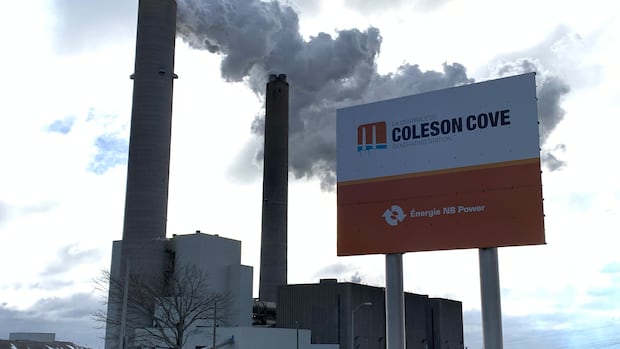
The biggest change is the expected incineration of an estimated 3.8 million barrels of heavy fuel oil at the Coleson Cove generating station in Saint John.
That’s 60 per cent more than last year.
In recent months, the plant has been pressed into service more regularly to generate power partly to help with downtime at the Point Lepreau nuclear station and partly to take advantage of spikes in export prices.
Between Coleson Cove, the coal and petroleum coke burning station in Belledune and natural gas generating station in Saint John, Church’s report showed N.B. Power would be producing 5.2 million megawatt hours of electricity from fossil fuels in the current year.
According to N.B. Power annual reports, that is the most “thermal” generation it has relied on in 16 years.