
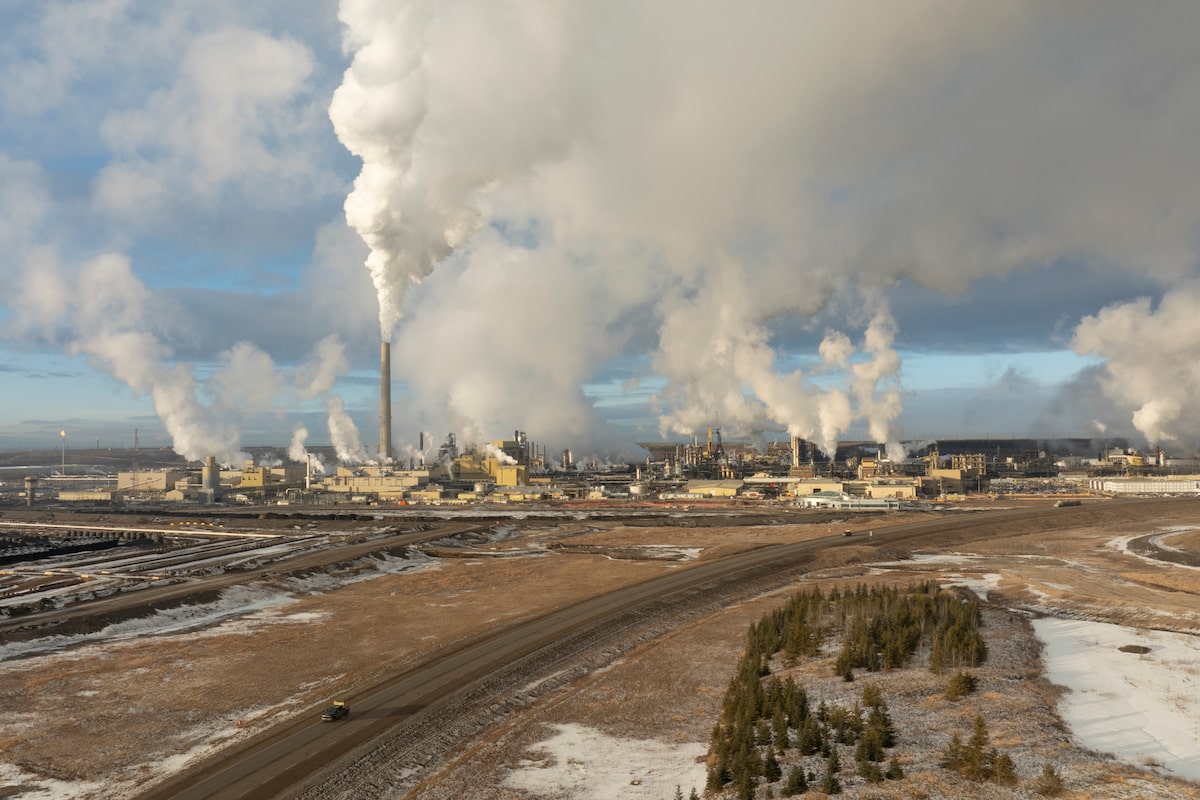
A Syncrude facility near Fort McMurray, Alberta, Nov. 24, 2025. Energy Minister Tim Hodgson says talks between Alberta and Ottawa may go past the MOU’s April 1 deadline for finalizing its policy agreements.PAT KANE/The New York Times
Ottawa is insisting that it won’t back down on core provisions of last fall’s deal with Alberta on energy policy, as it faces pressure to make further environmental compromises in the interest of getting more Canadian oil and gas to market.
Sitting down with The Globe and Mail recently, amid follow-up talks on the policy expectations set by the memorandum of understanding signed in November, Energy and Natural Resources Minister Tim Hodgson responded firmly to a question about two aspects in particular: a commitment by Alberta to make its industrial carbon price much more stringent, and a major oil-sands investment in carbon-capture being a prerequisite for a new oil pipeline.
“Look, the MOU is a comprehensive document. It’s not a pick and choose,” Mr. Hodgson said. “All of its topics, in their totality, are important.”
It’s a position that may disconcert corners of the fossil fuel sector while providing some relief to environmental groups, many of which were critical of Ottawa’s climate-related concessions in the MOU. Among those compomises were dropping a planned cap on oil-and-gas sectoral emissions, suspending federal electricity regulations, softening methane regulations in return for carbon pricing and opening the door to changing a ban on large oil tankers off B.C.’s northern coast.
But particularly with Mr. Hodgson acknowledging that the talks may go past the MOU’s April 1 deadline for finalizing its policy agreements, Ottawa’s determination to attach strong conditions to oil-and-gas sectoral expansion – to strike a long-term balance between conventional energy and the global transition to a low-carbon economy – is being tested more with each passing day.
Since the MOU, Alberta’s separatist movement has continued to gain steam (possibly culminating in a sovereignty question being put to Albertans next fall), causing nervousness in Ottawa about intergovernmental friction.
And with Prime Minister Mark Carney having expressed a desire to ship more energy overseas as part of trade diversification efforts, fossil-fuel producers have pushed back against even scaled-down federal regulations. That recently included oil-sands giant Canada Natural Resources Ltd. arguing for an end to industrial carbon pricing altogether while pausing the planned expansion of its Jackpine mine in northern Alberta.
Alberta-Ottawa MOU talks should address renewables roadblocks, think tank says
Now, the talks are also taking place in the shadow of the Iran war and ensuing global oil and gas crises, which have led to calls for Canada to prioritize capitalizing upon importers’ need for more reliable long-term trade partners.
Although the industry and aligned commentators have increasingly advocated for unfettered growth, Alberta Premier Danielle Smith has not publicly joined them in questioning the MOU’s terms.
And while both governments have been circumspect about how much progress has been made at the table, stakeholders following the talks believe that some MOU components requiring follow-up have been more or less resolved. That includes how the province will administer methane rules, mostly relevant to natural gas and conventional oil producers.
Carbon pricing and carbon capture are a different story, with a common perception among both industry and environmental groups that the governments are still some distance apart on both.
On industrial pricing, the overarching question is how to make good on the MOU’s commitment to put Alberta’s program – known as the Technology Innovation and Emissions Reduction system, or TIER – on track for an eventual “minimum effective credit price” price of $130 per tonne of emissions.
That refers not to the nominal price that companies are charged for their emissions (currently $95), but rather the price (more like $20) at which credits are actually trading on TIER’s credit market, which allows companies that have not met their emissions-reduction targets to buy credits from those that have surpassed them.
Negotiations toward that goal involve a complex set of measures that could fix an oversupply of credits and increase demand. Among them are how much to increase the share of each facility’s emissions that are priced (because most are currently exempted for international competitiveness reasons) and whether to tighten criteria for how credits are earned.
Climate activists and segments of the industry that see economic opportunity in decarbonization, however, have not generally been cheered by developments since the MOU was signed. Among their causes for concern was Alberta moving in the opposite direction when it proceeded with changes to TIER that make credits easier to generate than before.
Even the most optimistic among them are skeptical that Ottawa can achieve both a reversal of those changes and enough new stringency to get to the $130 effective price in the foreseeable future.
But few seem to have a clear sense of whether federal negotiators will dig in enough to put carbon-credit values on a sufficiently upward trajectory to fulfill their intended purpose of making investments in emissions-reducing technologies financially viable. (By most estimates, that would at least require ultimately getting toward $100.)
How the pricing policy turns out is correlated with the discussions around carbon capture, which is the most prominent example of that sort of technology.
Per the MOU, a new oil pipeline to the west coast can’t move forward without the advancement of the Pathways project, a potential series of carbon-capture investments by a group of five companies that comprise most oil-sands production. But of the two projects, the pipeline currently has greater visible momentum with industry advocates and within the national discourse.
No private-sector proponent has yet stepped forward to build the pipeline, but Ms. Smith’s government plans to submit an application for it to the federal Major Projects Office by summer.
Meanwhile, Pathways has been stalled by a financing gap likely exceeding $10-billion, even with both governments already offering capital subsidies. That’s because carbon capture has high operating costs and little revenue certainty.
Oil Sands Alliance president Kendall Dilling recently told The Globe that his organization, which represents the five would-be Pathways proponents, remains in “active discussions” with both governments around finding a fiscal framework for that challenge.
That would most likely involve the governments providing financing tools to de-risk carbon-capture investments by guaranteeing minimum carbon credit values to companies making them.
But there is some doubt, among other organizations tracking the negotiations, about that sort of mechanism having yet gotten much traction at the table. Clean Prosperity president Michael Bernstein, a prominent advocate for this form of policy, told The Globe he’s “concerned there hasn’t been more focus on landing the financial mechanism that the MOU rightly highlights as necessary to give investors certainty to spend big on decarbonization.”
Contributing to skepticism is the fact that the oil-sands giants have increasingly opposed the industrial pricing system whose credits the governments would theoretically backstop – and without which, potential revenue models become harder to fathom. It might also be telling that the Oil Sands Alliance recently changed its named from the Pathways Alliance, dropping the reference to the project that had been its namesake.
All of that may align with the broader public mood. Polls suggest that Canadians’ support for pipelines has grown during the fallout from U.S. President Donald Trump’s trade wars, while addressing climate change has slipped down the priority list.
Nevertheless, Mr. Hodgson’s comments reflect a view by Mr. Carney’s government – which includes a significant number of environmentally-minded Liberal MPs uneasy with the initial MOU concessions – that there is a need to show some headway being made on Pathways before the end of negotiations.
Mr. Hodgson spoke optimistically about the potential for that progress, describing negotiations continuing in good faith, which he also invoked apropos the talks possibly going past April 1.
“If we need another day, another week … If the federal government and the Alberta government are engaging the way they’re engaging today, I’m highly confident we’ll put our heads down and grind it out and get it done,” he said.
That still places the governments in the final stage of the follow-up negotiations, nearly four months after the MOU was unveiled. How closely the next deal resembles that document remains an open question across the sectors that stand to be affected.
With a report from Emma Graney