
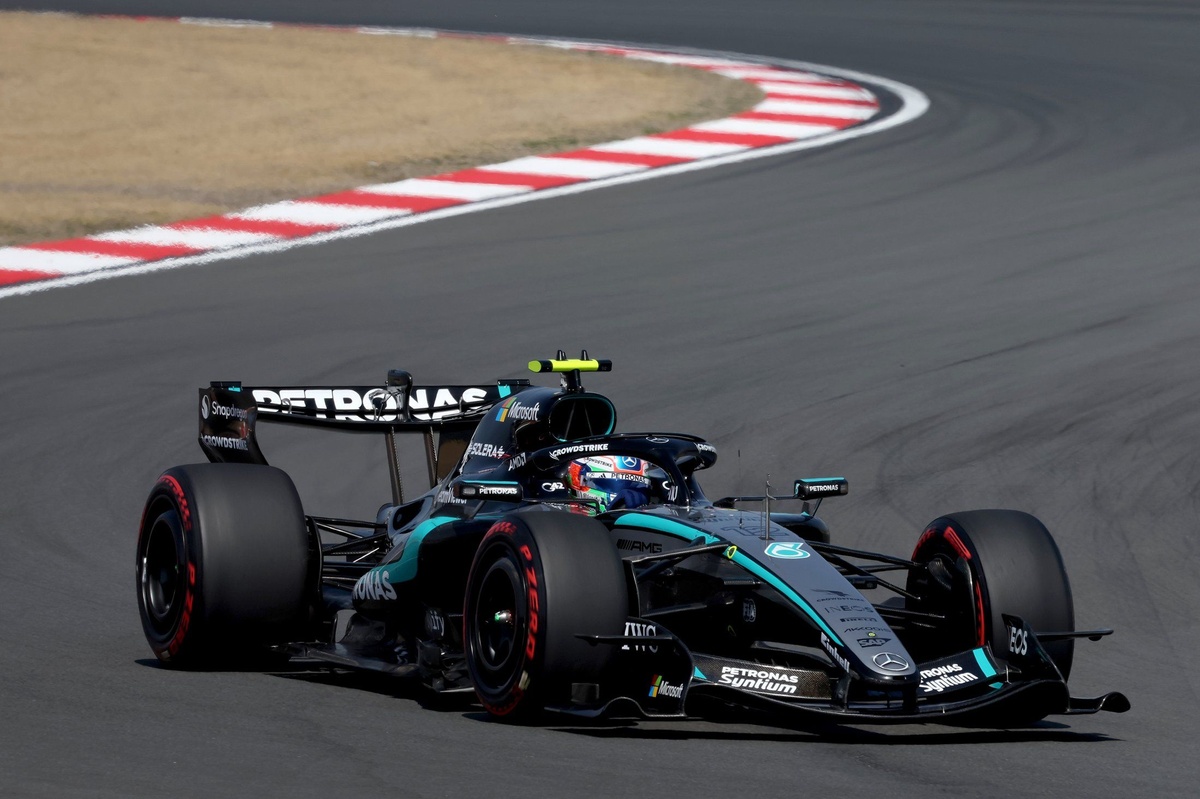
Mercedes team principal Toto Wolff could be forgiven for performing the I-was-right dance after his protege Kimi Antonelli became the youngest polesitter in world championship history. There were those who questioned the wisdom of promoting Antonelli from F2 after just one up-and-down season in 2024, and his rookie year with Mercedes was also eventful.
Antonelli is nothing if not exciting to watch, but he puts his burgeoning coterie of fans – and those tempted to place wagers on his results – through something of a rollercoaster ride. That harum-scarum trajectory has continued into this season, where he crashed heavily in FP3 in Australia, qualified second, then had to fight his way back there after dropping to seventh on the opening lap. The sprint race in China was similarly eventful as he picked up a penalty for clonking into Isack Hadjar’s Red Bull in the process of recovering to fifth after dropping from second to eighth place at the start.
In qualifying for the grand prix, he looked assured as Russell’s side of the garage entered panic mode when the other Mercedes suffered a mysterious control-systems glitch – but he still had to step up and deliver a better lap at the second time of asking to secure pole position over his team-mate.
“You have to imagine when you’re thrown into Formula 1 at 18 and then all that pressure comes,” said Wolff afterwards.
“The whole world is watching you, everyone wants something from you, and they also drop you very quickly again if the performance isn’t there. And last year, there were so many critics who said he’s too young and whether Mercedes should really have dared this experiment. And now you can see he’s starting to show real performance and deserves this seat.”
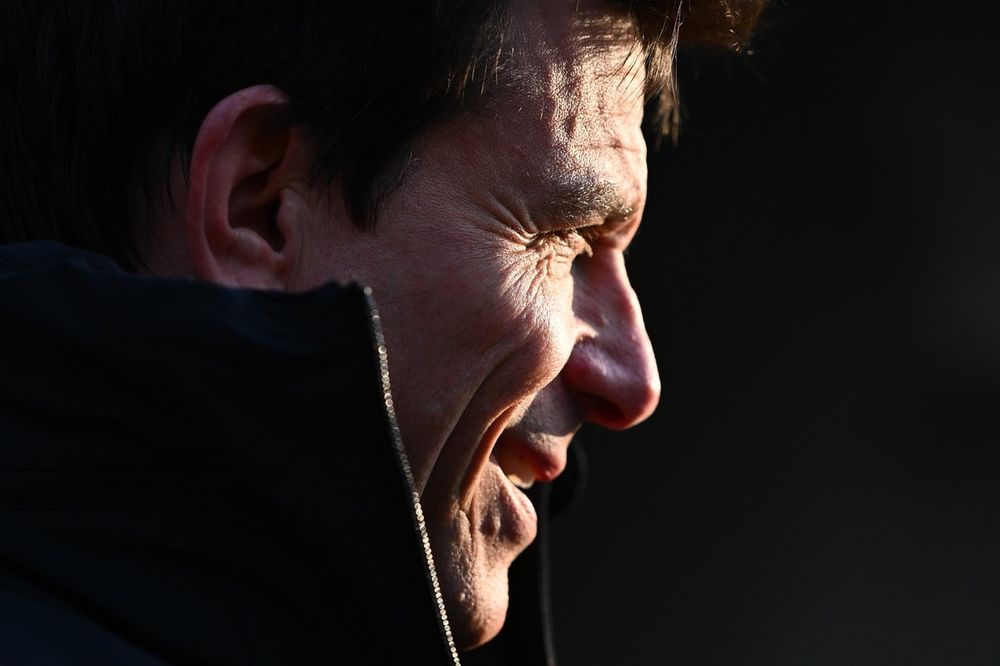
Merc boss Wolff says his faith in Antonelli has been vindicated
Photo by: Guido De Bortoli / LAT Images via Getty Images
Engine mode mystery
There’s no doubt Ferrari got closer to Mercedes in Shanghai qualifying than it did in Melbourne, though this is chiefly a factor of better execution. Team boss Frederic Vasseur admitted last weekend that qualifying could have gone better.
Here, both Ferrari drivers were at their closest in Q2, where Charles Leclerc split the Mercedes to go second, just 0.043s off Antonelli’s 1m.32.443s benchmark. Sprint race winner George Russell felt there was something wrong with his Mercedes’ front wing which, after some debate with his team, proved to be correct. Lewis Hamilton was fourth with a 1m32.567s, which was a tantalising 0.124s off Antonelli.
Then in Q3 Mercedes seemed to find another gear (luckily for Russell, who spent much of the session stuck in first). There had been some debate about this earlier in the day, which must have received a mixed response from Mercedes management, having spent the preceding few weeks parrying suggestions that the company hadn’t been quite as candid as it could have been with its customers in terms of data sharing.
“I was with Mercedes for a long, long time, so I know how it works there,” said Hamilton after finishing third in the sprint race.
“In qualifying they have another mode that they’re able to go to, a bit like a ‘party mode’ back in the day, and once they get to Q2 they switch that on, and we don’t have that.
“And then in the race they obviously don’t have that mode, so they still obviously have an advantage overall. We’ve got to figure out what that is, but there’s something more they’re able to extract, particularly in Q2.
“You see in Q1 we’re not that far away, and then all of a sudden it’s like a huge step. A tenth in Q1 behind, I think it was, and then all of a sudden it’s seven-tenths or another half a second. It’s a big step.”
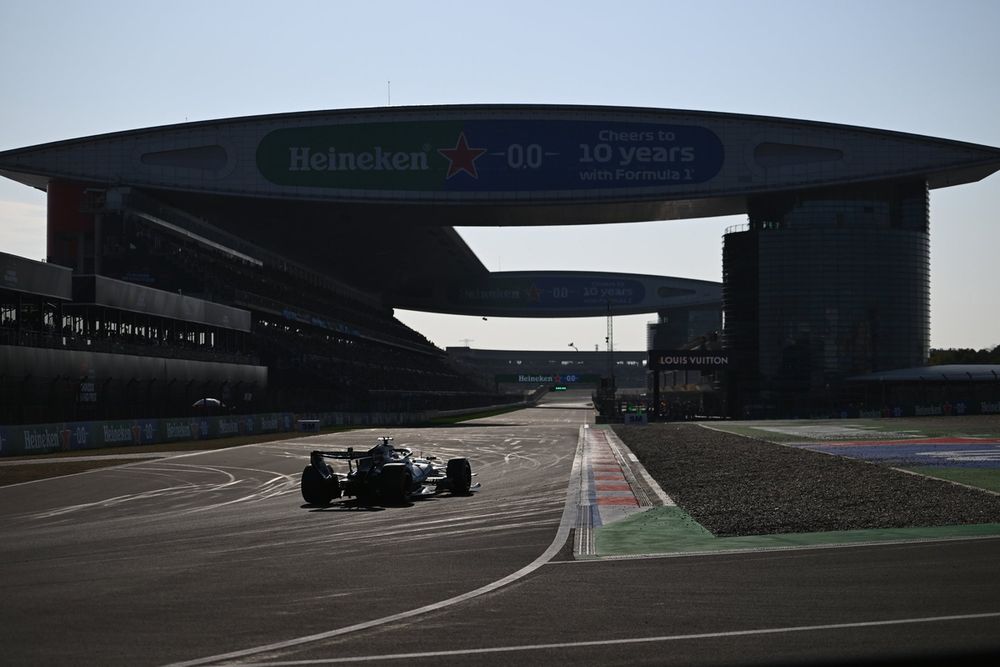
Last Q3 lap was decisive for Antonelli
Photo by: Guido De Bortoli / LAT Images via Getty Images
Actually, the way it panned out in Shanghai was Leclerc went fastest in Q1, then the gap between Antonelli in P1 and Hamilton in P4 during Q2 was 0.124s, then in Q3 the gap from Antonelli’s pole to the fastest Ferrari was 0.351s. But this doesn’t invalidate the nub of Hamilton’s assertion, that Mercedes has something in hand it can switch on when required.
Or does it? Lando Norris was unequivocal when asked if his McLaren’s Mercedes power unit granted him access to such a mode.
“No,” he said. “We don’t have that. Maybe he’s used to his old days when they had it back then. Sometimes when you’re a bit off you create things in your head…”
Cold tyres, low battery do it for Russell
Antonelli’s first Q3 lap was 1m32.322s – respectable, but not a massive improvement on his Q2 performance. And Russell, despite spending several moments marooned on track before limping back to the pits, stuck in first gear, managed to emerge with two minutes to spare and pop in a 1m32.286s.
The Italian found more on his second lap to take pole position with 1m32.064s, 0.222s quicker than Russell and three tenths up on Hamilton’s best.
Telemetry from Shanghai has been prone to glitches through the weekend – those watching on TV may have noticed some strange quirks in the timing data and illustration of such niceties as battery levels during the sprint race – and Autosport’s usual data source has been similarly afflicted. Nevertheless, it’s possible to pick out some general trends throughout the occasional noise.
It’s clear Antonelli picked up significant early momentum by carrying more speed than either Hamilton or Russell into Turn 1, a tightening-radius right-hander that puts a huge initial spike of energy through the front-left tyre. That gave him almost half a second in hand over Hamilton straight away, and three tenths on Russell, who only had his out-lap from the pits to prepare his tyres and build some battery charge.
But Antonelli was slightly less aggressive on the throttle at the exit of Turn 3, where the initial complex of curves opens out onto the kinked ‘straight’ which follows. Both Hamilton and Russell recouped time there, but Hamilton remained over a tenth in arrears.
Antonelli was last on the brakes and carried more speed into the hairpin at Turn 6. Here, while the gap to Hamilton remained just over a tenth off, Russell fell away – again consistent with being less confident in how much outright tyre grip he had at his disposal.
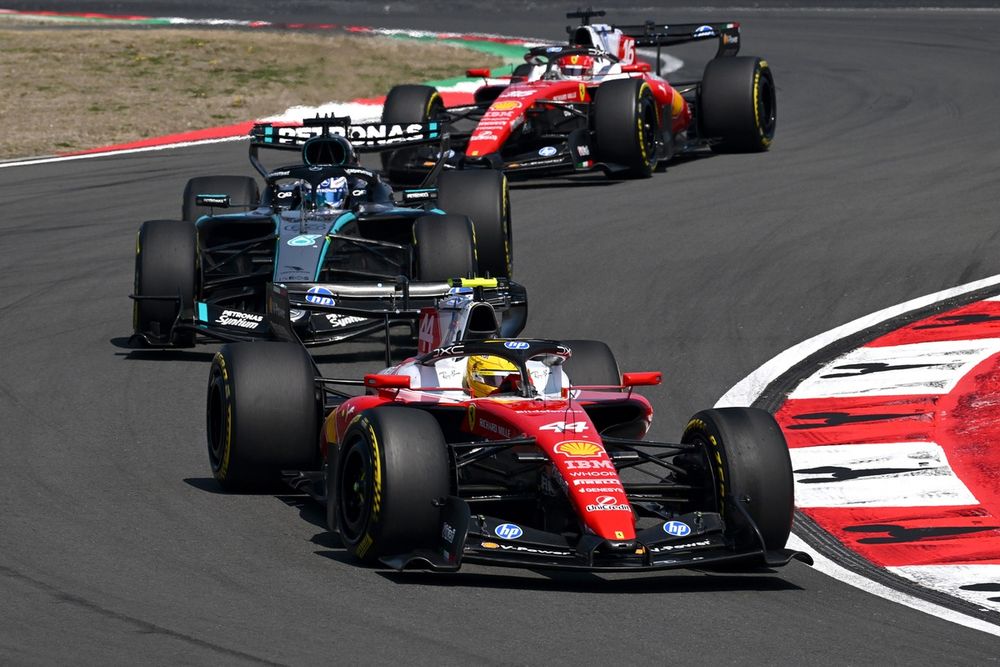
Ferraris of Hamilton and Leclerc had given Russell something to think about early on in the sprint race
Photo by: Mark Sutton / Formula 1 via Getty Images
Through sector two, Russell closed in to within two tenths while Hamilton fell back to just over that, until they reached the fiddly Turns 11-12-13 where the track goes sharply to the left, then bends wide at a decreasing radius, with positive camber, onto the back straight. Again, Antonelli picked up a couple of tenths by carrying more speed into Turn 11, likely enjoying a greater energy harvest.
Under the initial acceleration phase out of Turn 12, Hamilton enjoyed a greater punch, perhaps because of the Ferrari’s smaller turbo having less inertia, and he closed to within two tenths before that margin began to open again. All along the back straight the two Mercedes enjoyed virtually equivalent performance while the Ferrari gradually drifted back by hundredths of a second, a process which accelerated as all three cars suffered the loss of electrical energy half way down the straight, dropping from a peak of 333km/h (for the Mercedes at least) to 305km/h before they got on the brakes for Turn 14.
Here, Antonelli tried to carry a fraction too much speed and had to hold on the brakes for longer, enabling Hamilton to regain some of the deficit that had built up on the back straight. Afterwards, the first Italian to sit on pole position for a grand prix since Giancarlo Fisichella in 2009 was curiously modest.
“Of course, George had an issue in Q3, so probably it could have been a different story,” he said.
“But I’m happy with the lap I did, to be fair, and really happy to be starting on pole for my first time.”
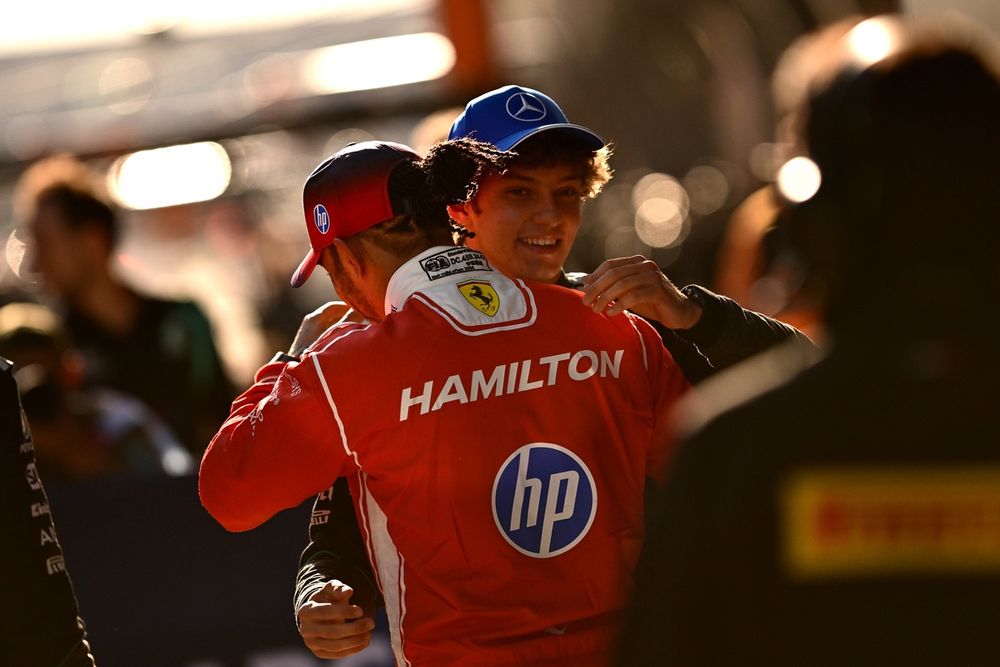
Hamilton was genuinely delighted by Antonelli’s achievement
Photo by: Mario Renzi / Formula 1 via Getty Images
Hamilton alluded to a “tricky” session in which he made “quite a lot of mistakes”, perhaps leaving a couple of tenths on the table. That would have made the battle for pole closer still – and there is nothing in the data to suggest the ‘smoking gun’ of a special power unit mode.
Indeed, Hamilton’s Ferrari appeared to have more punch out of several corners, while both Mercs built the majority of their pace advantage through higher apex speeds. Only in Turn 8 was the Ferrari decisively faster mid-corner. Nevertheless, Lewis wasn’t giving up.
“It’s hard to know what that [the pace deficit] is,” he said. “Maybe they didn’t turn the mode they had on – I don’t know, so we’ll take it with a pinch of salt…”
Read Also:
We want to hear from you!
Let us know what you would like to see from us in the future.
– The Autosport.com Team