
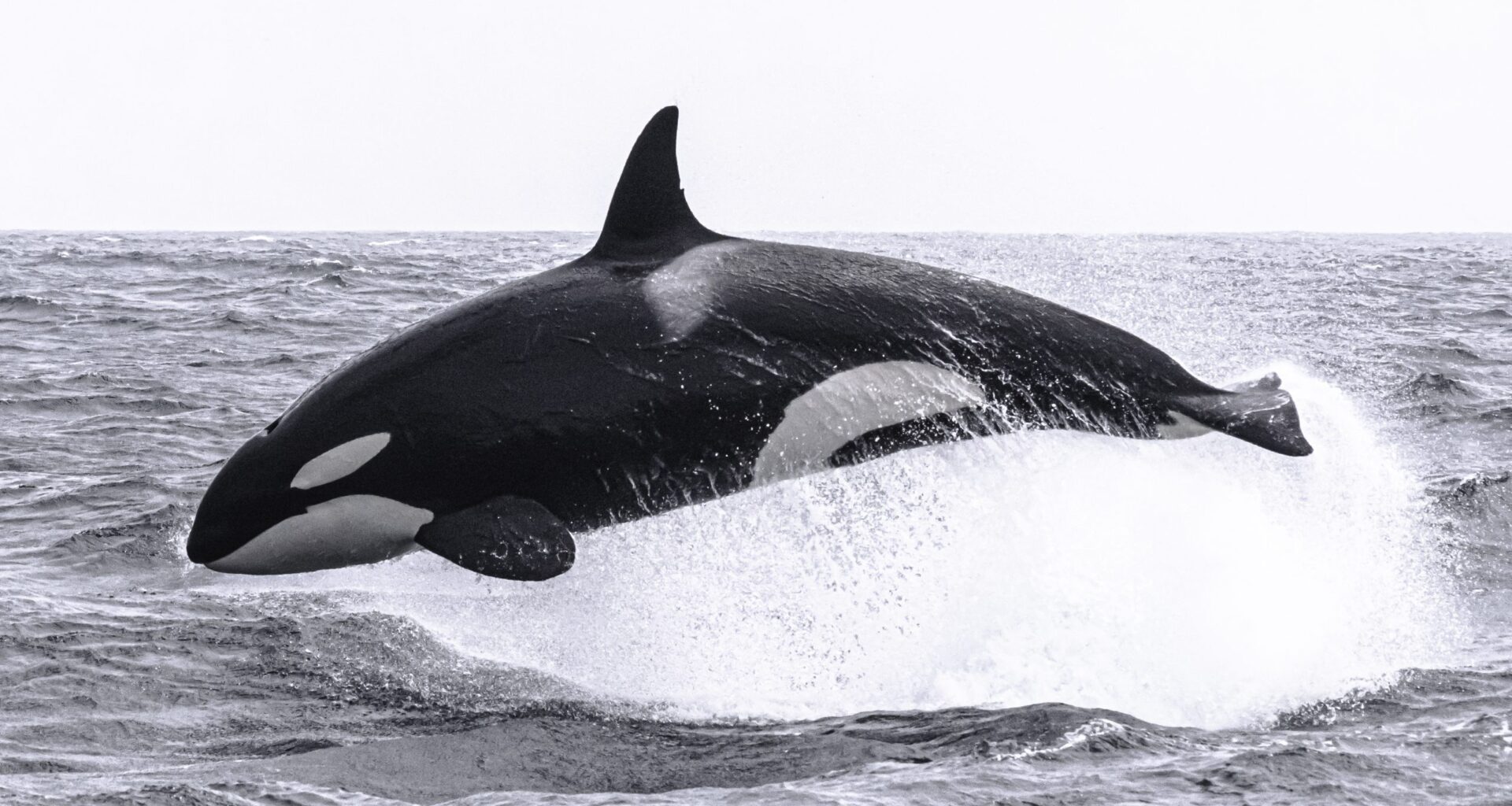
A trio of mysterious killer whales spotted in Vancouver Harbour last week has sparked excitement among marine researchers after the animals failed to match any known photo identification catalogues in the region.
The sighting was first reported by members of the public and shared online, prompting researchers to begin tracking the whales through photographs posted by wildlife watchers.
According to the U.S.-based Orca Behavior Institute, high-quality images taken in Vancouver by Alex Cole and shared in a wildlife sightings Facebook group helped researchers connect the whales to an earlier sighting in Anchorage, Alaska in March 2025.
The discovery was made after photos posted to the marine wildlife database Happywhale were matched by researchers, revealing the same animals had been documented much farther north a year earlier.
More recently, photographs shared by a whale watcher near Seattle confirmed the orcas had also been seen there, marking at least three locations where the whales have now appeared.
Researchers say the animals do not appear to belong to the well-documented West Coast transient killer whale population that commonly travels through the Salish Sea.
Instead, based on clues such as physical markings and the location of their earlier sighting, scientists believe the whales may originate from a population found in the Gulf of Alaska, Aleutian Islands and Bering Sea.
That population of mammal-hunting killer whales is not well studied, particularly individuals from the more western parts of its range.
Because the whales did not initially match existing catalogues, they have now been given new identification numbers — T419, T420 and T421 — through a database maintained by researchers studying transient killer whales along the west coast.
Transient killer whales, also known as Bigg’s killer whales, are distinct from the better-known southern resident orcas that feed primarily on fish.
Instead, they specialize in hunting marine mammals such as seals and sea lions, using stealth and coordination to approach their prey.
These whales typically travel in small family groups of three to seven animals, often centered around a matriarch and her offspring.
Along the Pacific Northwest coast, the West Coast Bigg’s killer whale population is estimated at about 400 individuals, ranging from Alaska to Northern California.
Researchers say sightings like this highlight how citizen scientists and wildlife watchers play an increasingly important role in tracking marine life.
For now, scientists say they hope the three whales remain in the region long enough for researchers to gather additional data, potentially including acoustic recordings or DNA samples, that could help confirm their origins.