
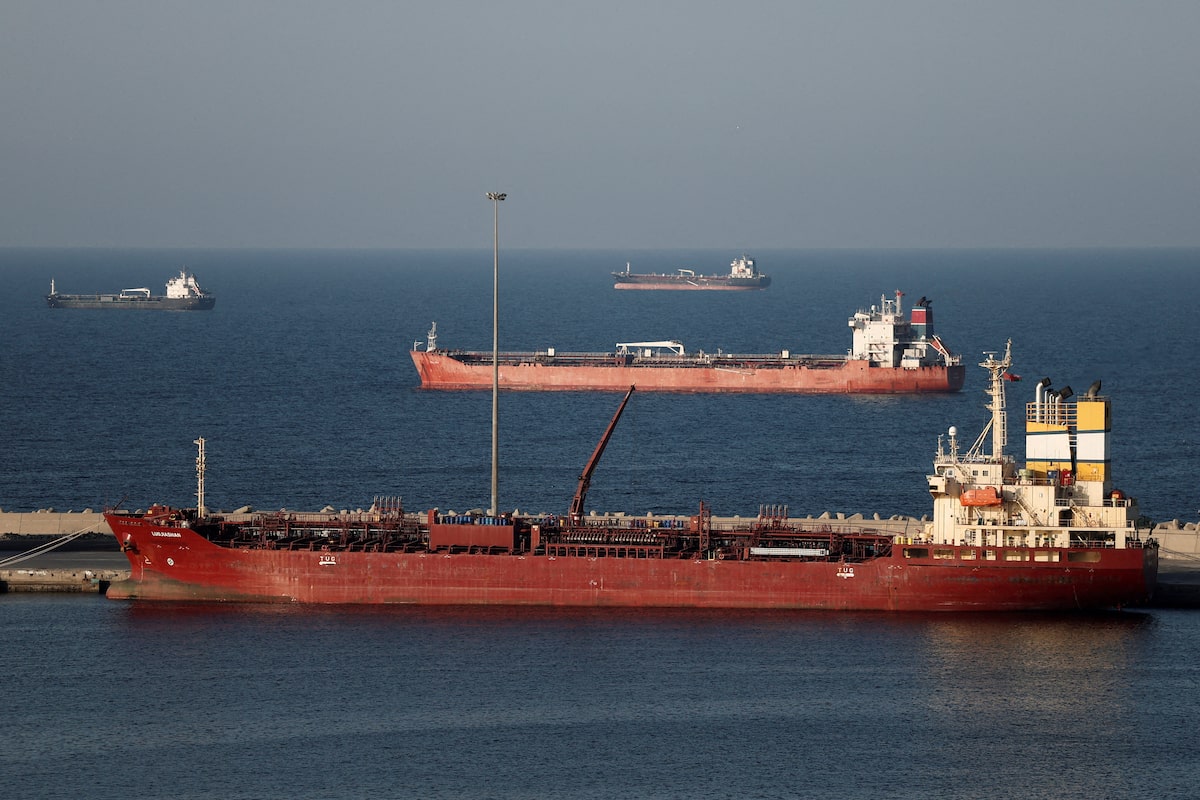
A tanker sits anchored in Muscat, Oman, on March 7.Benoit Tessier/Reuters
Mission creep: Oil will continue to be key for the markets as we enter the third week of the war in Iran. The Strait of Hormuz remains effectively closed and oil prices are up 50 per cent since the war broke out. “If the Strait of Hormuz stays closed for another 60 days, I think we get to all-time high oil and gas prices,” said energy investor Josh Young of Bison Insights on my podcast this week. As a refresher, the record high was in 2008 at US$146 per barrel for West Texas Intermediate. “Mission creep” may be emerging in Washington according to noted commodity strategist Helima Croft of RBC. “It seems that the Trump White House had planned for a short-duration conflict with minimal economic fallout, bolstered by the Venezuela success … ” Ms. Croft said in a note to clients last week, “However, at the moment, the White House apparently is considering sending in some ground troops … Such an operation would be complex and carry a casualty risk.” Her view is the longer this drags out, the more likely we see record-high prices.
Credit where it’s due: Energy prices aren’t the only source of market anxiety. Private credit funds are also being hit by a wave of redemptions. Asset managers like KKR KKR-N, Blackstone BX-N and Blue Owl OWL-N are down more than 30 per cent this year. This is linked to the sell-off in software on fears that AI will disrupt these business and concerns that loans are therefore at risk. Just last week Morgan Stanley MS-N and Cliffwater capped redemptions from their respective private credit funds. Is this a problem for the Canadian banks? The market doesn’t think so. Canadian banks are outperforming U.S. banks. While Canadian banks may not be directly exposed, they could have exposure via lending to the same companies as the private credit funds. The head of OSFI – Canada’s banking regulator – will be addressing this on the podcast this week. “What we worry about is individual types of transactions between banks and non-bank intermediaries that might have risks that we don’t fully appreciate or the institutions we regulate don’t fully appreciate,” said Peter Routledge. “Those are the types of questions we’re prying into. Those are the sorts of things that could create unexpected losses.” OSFI will put out its annual risk outlook on April 14 and Mr. Routledge hinted this could be one of them.
Rock and a hard place: The Bank of Canada makes its trend-setting rate decision on Wednesday morning against a messy backdrop. Inflation expectations have soared in the past two weeks owing to higher oil prices, and the market started to price in the chance of a rate hike at the end of the year. But Friday’s jobs report showed the economy might not be able to withstand that. Canada shed 84,000 jobs in February in the worst month for job losses in four years. This came a few days after data revealed Canadian exports plunged 4.7 per cent from December to January. How will the Bank of Canada address these stagflationary (stagnant growth combined with inflation) forces? Right now the market is still pricing in the chance of a hike, albeit lower odds after the jobs report. “To put it mildly, we believe that a rate hike this year would be an extraordinarily bad policy decision,” wrote BMO’s Doug Porter in a preview of the Bank of Canada rate decision. Stagnant job growth, sluggish GDP and the pending renegotiation of a trade agreement with the United States are all reasons the Bank of Canada should avoid a rate hike, Mr. Porter argued.
Halfway out the door: The U.S. Federal Reserve will also make a rate decision on Wednesday in what will be Jerome Powell’s second-last meeting as chair. No change is expected but given how dramatically things have shifted for the American economy since the beginning of the war, investors will be closely watching how the central bank balances slowing job growth with rising inflation pressures. “We are revising our Fed call and do not expect another rate cut until September as the Fed assesses the recent developments in Iran and waits for further inflation normalization,” wrote TD’s Global Rates team. “With inflation still running above target, and the labour market in better balance vs. last year, the Fed finds itself with the luxury to observe how the oil shock is absorbed by the real economy.”
Downward dog: Lululemon LULU-Q is set to report Tuesday after the bell. The athletic apparel maker has been languishing around seven-year lows amid disappointing sales, the departure of its CEO and founder Chip Wilson loudly agitating for board change. Activist investor Elliott Management is also reportedly playing a role in selecting a new CEO. Sales are expected to fall nearly 1 per cent, which would be the worst pace of growth since 2020. If you are a sucker for a low-PE beaten up stock, this may be tempting. “ LULU remains a show-me story without a clear signal that we’ve reached a bottom for downward estimate revisions,” wrote Rick Patel of Raymond James, who advises against jumping in here. “LULU expects innovation to be a turnaround catalyst, but the same plan didn’t work in spring ’25… Quality control issues are an overhang.”
Sign up now for the second season of Trade Off, The Globe and Mail’s free, online stock-picking contest. Demonstrate your market mastery and compete for a $5,000 grand prize.