
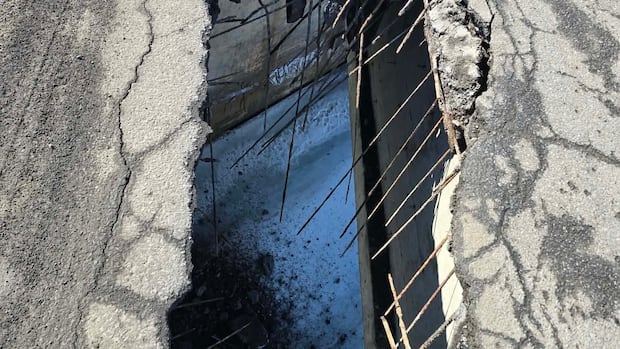
A massive hole that opened up in a Châteauguay, Que., bridge earlier this month has reignited calls for Quebec to better invest in its aging road infrastructure, with several groups saying the incident should be a wake-up call for the province.
The Sauvagine Bridge, a reinforced concrete beam bridge, was built in the 1960s, like much of Quebec’s major road network and structures.
Ahead of the partial deck collapse, the mayor of Châteauguay said Quebec’s Transport Ministry had plans to demolish the bridge in 2025 and rebuild it, but ended up postponing it.
Calling the project “complex,” a spokesperson for the ministry says work is now scheduled to begin in 2028.
Days after the incident, the president of the Quebec Order of Engineers said the Sauvagine Bridge is not the only piece of the province’s infrastructure in trouble.
“We were surprised that something like that would happen, but at the same time, we’re not surprised because there’s a big deficit in our infrastructure in Quebec,” Sophie Larivière-Mantha told CBC Montreal’s Daybreak.
Public documents show the province’s road infrastructure network currently needs more than $22.5 billion worth of repairs, as a significant portion is considered to be at the end of its useful life.
In its 2025-26 infrastructure investment plan, the Transport Ministry blames the extent of the needs on a lack of proper investment between 1980 and 2000, adding that only 58 per cent of its network is considered to be in good condition.
Experts say this winter’s repeated freeze-thaw patterns have also taken a toll on the network.
Quebec’s infrastructure in ‘crisis’
A 2025 report by the Order of Engineers suggests that decisions made in more recent years haven’t helped the situation. The order says officials are more interested in building brand new projects than maintaining existing infrastructure.
“We are facing a big crisis,” Larivière-Mantha said. “We need to put more money in the maintenance of the infrastructure that we already have instead of constructing new ones.”
Several organizations involved in infrastructure construction in Quebec are raising similar concerns, saying the province’s road network has been in dire need of attention for decades.
“It’s always sexier to cut a ribbon for a new library, a swimming pool,” said Caroline Amireault, the general director of the Association des constructeurs de routes et grands travaux du Québec (ACRGTQ), which represents road construction companies.
WATCH | Experts explain how Quebec roads ended up in such a bad state: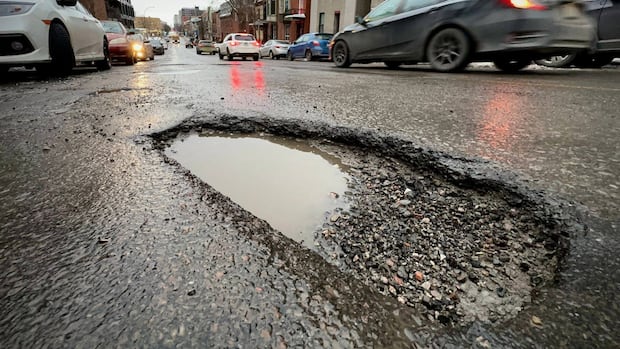
How did Quebec roads get so bad? Experts say it’s more than just the harsh climate
Quebec roads have long had a bad reputation. The oscillating temperatures in the winter may make things worse, but experts say road infrastructure has been in dire need of attention for decades — in more ways than one.
Along with several other groups, like CAA-Québec and the Conseil du patronat du Québec, the ACRGTQ submitted joint recommendations to the Coalition Avenir Québec government ahead of this week’s provincial budget.
They’re calling for the government to set up dedicated maintenance funds that can’t be moved to other projects and are protected from changing political cycles.
“We draw a parallel with condo associations. For several years now, the government has required these associations to keep reserve funds, a small budget set aside if any work needs to be done. We should implement the same mechanisms with the government,” Amireault argued.
Louis Lévesque, Chair of the Public Policy Committee for the Association of Quebec Economists, agrees. A longtime former public servant, including as federal deputy transportation minister, Lévesque says a maintenance budget should be attached to any new project.
“Once you decide to build something, the cost of maintaining that should not be optional. [It] should be embedded in your budget,” he said.
Lévesque says his group is also asking the province to prioritize infrastructure maintenance over building new, adding he worries the government won’t act “until something really bad happens.”
Not the first wake-up call
In 2006, the De la Concorde overpass in Laval, Que., collapsed, killing five members of the same family and injuring six others.
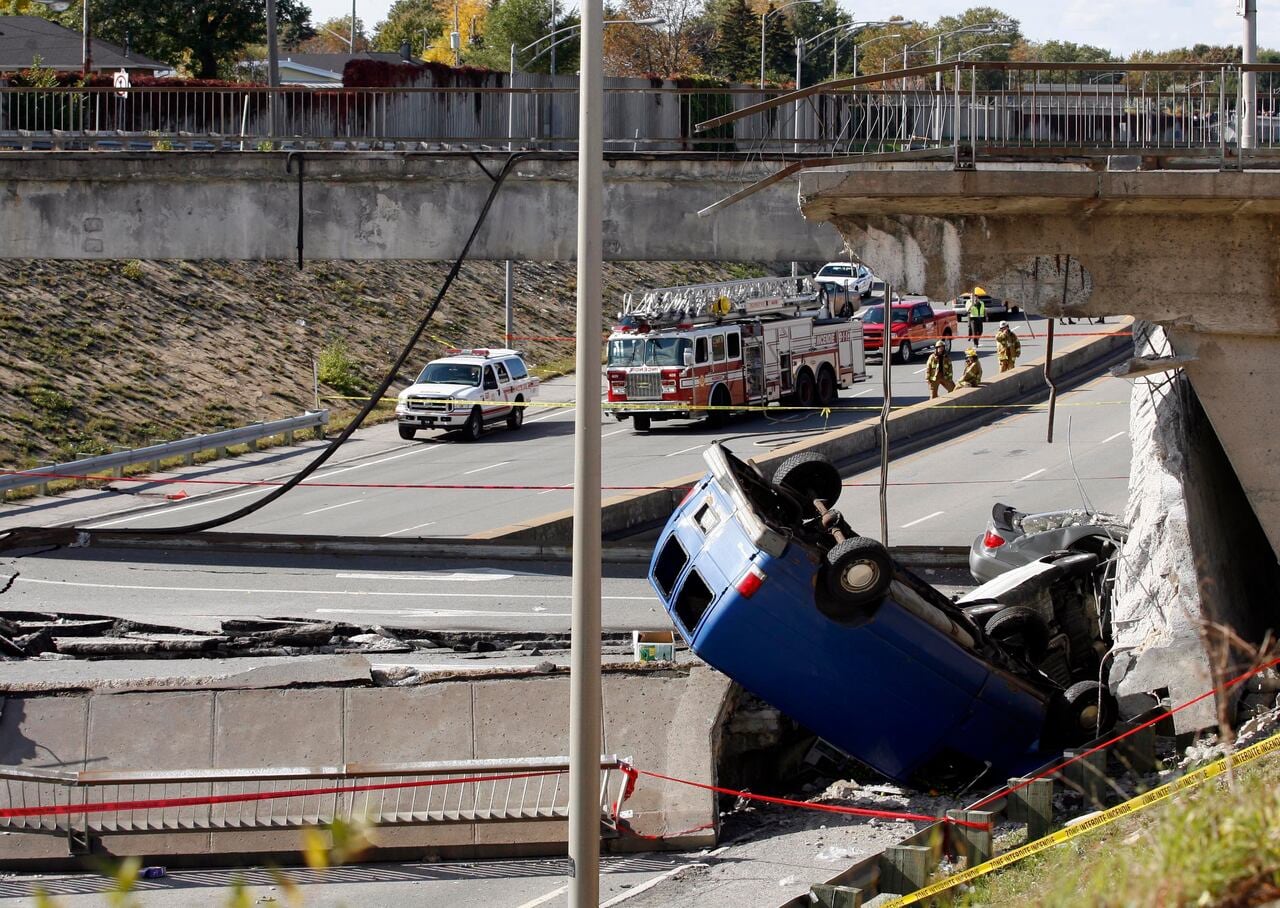 The De la Concorde overpass collapsed onto Highway 19 in Laval, Que., on Sept. 30, 2006. (Ryan Remiorz/CP)
A public inquiry blamed several factors, including design flaws, faulty construction and poor quality materials, but also neglected maintenance and lack of proper oversight. It led to recommendations, including calls for stable long-term funding for road infrastructure maintenance and repairs.
Lévesque says given the scope of the incident, he is surprised that maintenance, in his opinion, is still not a priority.
“We tend to forget things very rapidly. It’s funny, because the motto of Quebec is ‘I remember.’ And my sense is it should be renamed to ‘I remember not-long-enough.’ You have to go back to 2006,” he said.
In more recent years, the province has found better ways to replace roads that have reached their end of life. For example, it’s gradually been moving toward using longer-lasting concrete to pave some highways, instead of asphalt, according to Radio-Canada.
Meanwhile, Quebec Finance Minister Eric Girard promised to table what he described as a “sober and targeted” budget on Wednesday, which he said would include investment in infrastructure spending.
“We fully agree … that maintaining our infrastructure is important,” he told CBC Montreal’s Daybreak days after the Châteauguay bridge incident. “At the same time, a lot of our infrastructure was built in the 1960s and the 1970s and therefore they need to be replaced entirely.”
In a statement to CBC News, Quebec’s transport minister said that in the province’s 10-year infrastructure plan, 85 per cent of funds are earmarked for maintenance projects, amounting to more than $30 billion over the next decade.