
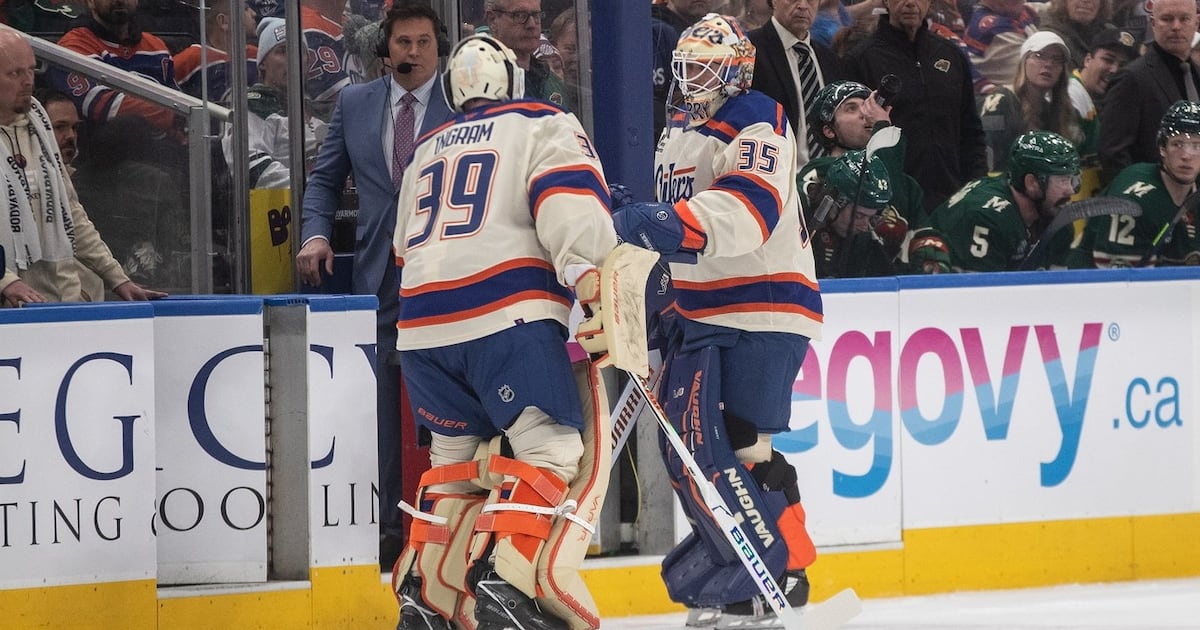
The Edmonton Oilers pushed the goaltending panic button on Dec. 12, shipping the disappointing Stuart Skinner to Pittsburgh (along with defenceman Brett Kulak and a second-round pick) in exchange for Tristan Jarry.
The shakeup at the position was a gamble, but Skinner’s performance had been so underwhelming that it was cause for concern. Couple that with the fact that Edmonton’s Stanley Cup contention window is now, and the Oilers couldn’t afford to sit on their hands.
The challenge for general manager Stan Bowman and Edmonton’s front office: goaltenders are scarcely available to begin with, especially those who perform at the NHL level. Acquiring a goaltender mid-season usually means finding a potential reclamation project and hoping a change in environment can spur a reversal in play. That’s how Edmonton landed on Jarry.
But the trade, at least so far, has not worked out for the Oilers.
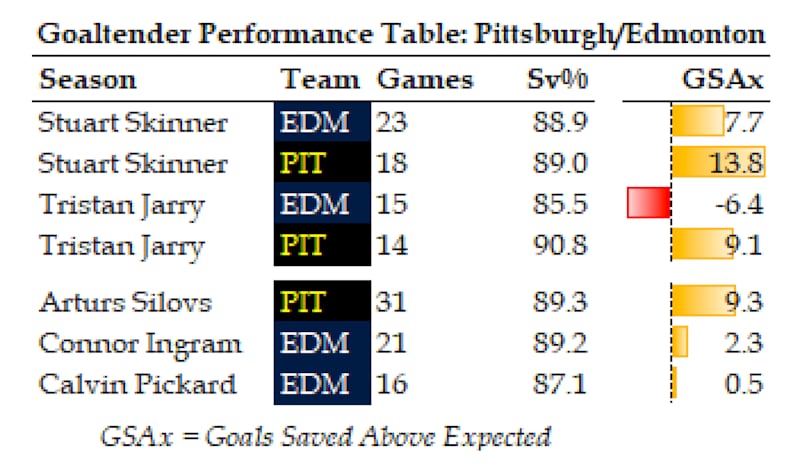
Not only has Jarry looked shockingly bad in 15 starts with his new team, Skinner has played exceptionally well in Pittsburgh in a tandem with Arturs Silovs. The change in environment has been a performance tailwind for Skinner; for Jarry, it’s meant a continuance of poor play that had Penguins fans talking about a contract buyout before his December trade:
 Yost: Penguins vs. Oilers goaltending (TSN)
Skinner’s save percentage is only marginally up, but he’s also been under siege in Pittsburgh. It may be hard to believe, considering the state of the Oilers defence, but the shot profile Skinner has faced in Pittsburgh has been slightly more difficult than what he dealt with in Edmonton.
But Jarry is an entirely different story. His save percentage has slipped more than five percentage points since being dealt from Pittsburgh, and he’s more than six goals worse than a replacement-level goaltender would have performed in the same situation in Edmonton, based on the shot profile faced.
That’s alarmingly poor – in fact, only St. Louis’ Jordan Binnington (-16 goals saved versus expected) and Ottawa’s Leevi Merilainen (-14 goals saved versus expected) have shown worse this season.
Jarry’s play has been so poor that head coach Kris Knoblauch decided to make a change to the goaltender depth chart over the weekend, announcing that Connor Ingram would receive the majority of the starts down the stretch as the Oilers chase down a playoff berth.
It’s a huge bet on a journeyman goalie like Ingram; the 28-year-old did put together a nice season with the now-defunct Arizona Coyotes in 2023-24 (90.7 per cent stop rate), but he doesn’t exactly have the resume of a goalie you go all-in on with a Stanley Cup-contending team. But that may speak to just how disappointing Jarry has been more than anything else.
Knoblauch’s made his coaching decision for now, but a broader roster decision is around the corner. The Oilers had Skinner on an expiring deal (and on a cheaper cap hit, at $2.6 million AAV); they now have a struggling Jarry on a $5.4 million AAV cap hit through the 2027-28 season. So, if Jarry’s game can’t be rediscovered in Edmonton soon, the Oilers have a bigger contract problem on their hands to solve.
There’s an old saying at NASA: “There is no problem so bad you can’t make it worse.” I fear Edmonton did just that by swapping Skinner for Jarry, and if Ingram does solidify himself as the starter over the next month of the season, the Oilers are going to need to figure out what to do with Jarry and his contract in a hurry.
Data via Natural Stat Trick, NHL.com, Evolving Hockey