
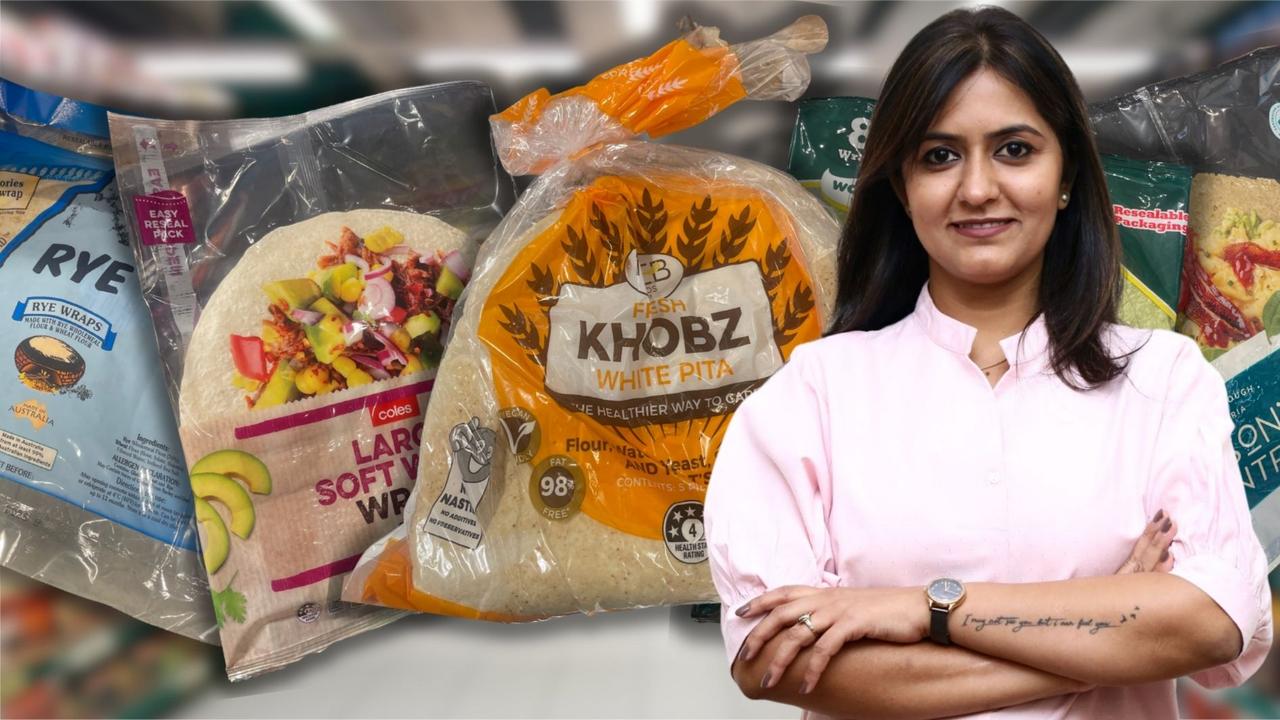
Find it hard to wrap your head around all the wraps in the supermarket?
With an array of options like wheat tortillas or multigrain, spinach and rye wraps stocked on shelves, it can be tricky to decipher which to pick.
This week on Shopping Swaps, experts have ranked the healthiest and least healthy wraps, giving you their top recommendations on what to buy.
Dietitian Liz Radicevic at RadNutrition warned wraps can be more processed than bread.
Meanwhile the colourful ‘vegetable’ wraps actually have no advantage over plain options.
See why below.
Wholegrain:
Coming in at number one on the list, wholegrain wraps offer a slightly greater portion of fibre compared to wholemeal options but it is important to check the ingredients, experts say.
Most wholegrain wraps were high in fibre with at least six or seven grams per 100g best, Ms Radicevic said.
“Fibre keeps you fuller for longer and helps prevent colorectal and bowel cancers,” she said.
Diet Yumm founder Purva Gulyani said a sodium content of about 120mg per 100g was also a benefit and anything above 400mg was considered high.
She recommended the Simpsons pantry mixed wholegrain wraps because they were low in sodium (261mg per wrap) and had 4.2g of fibre.
Ms Radicevic said the Woolworths soft wholegrain option was her recommended pick.
It had a good 6g of fibre per 100g and a moderate 333mg of sodium.
Wholemeal:
While you can’t see the grains in wholemeal options, the benefits are still there.
When made with wholemeal flour, the wraps have a good level of fibre.
However, generally fibre is lower when compared to wholegrain – although there are exceptions!
Accredited practising dietitian Erika Hung said to watch out for salt.
“Wholemeal flour has been processed and milled down … the fibre is still going to be there but not in its whole form,” she said.
“I like to pick the highest fibre option but always check salt.”
Mrs Gulyani recommended the Mission Low GI Wholemeal because it had around 7.2g of fibre per 100g and less than 400mg of sodium (377mg).
Low‑carb/high‑protein:
You might think low carb sounds healthier, but dietitians aren’t convinced.
“People forget that when they are looking at a wrap or a bread, it is a carb option,” Ms Radicevic said.
She said wraps that were modified to have added protein and less carbs often lacked fibre.
“Low carb is not always the best option and a lot of the time those modified options are not as high in fibre,” Ms Radicevic said.
However, Mrs Gulyani said they were good for people who wanted to maintain their blood sugar and control their appetite.
She recommended the Simpsons Pantry low carb keto wraps which had 21.4g of fibre and 21.3g of protein per 100g.
But they were above the 400mg sodium mark (430mg).
Rye:
Rye is great for digestion but not suitable to anyone with a gluten intolerance.
“They’re easily digestible for people who have gut issues,” Mrs Gulyani said.
But depending on the brand, they could be high GI (a rating of how much a food raises blood sugar), Ms Radicevic said.
“Rye tends to be on the higher GI side … but higher fibre options would be better,” she said.
Mrs Gulyani said it was important not to mistake it for gluten free.
“It is not good for people who have coeliac and someone FODMAP sensitive or with IBS,” she said.
Ms Radicevic recommended the Mountain Rye Wraps because it had four simple ingredients.
However, Mrs Gulyani said this brand of wraps were easily breakable because they were thin and, unlike other rye products, lacked fibre (2.8g per 100g).
“They’re paper thin, tortilla style breads,” she said.
“It can be less filling because it does not have a lot of fibre in it … so we want to make sure that we would fill it up with more protein and vegetables,” Mrs Gulyani said.
Lebanese/pita bread:
Made with simple ingredients this middle eastern staple is considered a clean choice.
“They could be made with wheat flour, but they could even be made with something different, rye or rice flour,” Mrs Gulyani said.
While white options were common, wholemeal was the better choice because it increased fibre contents, Mrs Gulyani said.
She recommended MEB Food Khobs wholemeal pitta which had 206mg of salt per 100g and 6.4g of fibre.
“The serving size is large (100g), the fibre is good (6.4g) and the protein is pretty good (11.1),” she said.
Wheat/white:
White flour wraps are generally low in fibre and high in salt, experts say.
Although white wraps are cheaper and can be a preferred taste option, a refined flour base lowered fibre contents, Ms Radicevic said.
However, Ms Hung said in certain circumstances, they could be useful for a quick spike of energy because carbohydrates can be broken down fast into fuel for your body to use.
“For anyone who’s an athlete and they need a quick fuel top up beforehand, a white, low fibre wrap can actually be really helpful,” she said.
And some brands actually had a decent fibre portion.
She recommended several homebrands including Woolworths, Coles and Aldi.
“They’re not too bad in terms of fibre and sodium,” she said.
Coles large soft white wraps had 4g of fibre and 370mg of sodium per 100g.
Corn tortillas:
Corn tortillas are usually high in sodium, experts warn.
Ms Radicevic said high salt content was her biggest issue with corn wraps as most brands generally had large levels.
They were also typically lower in fibre than wholegrain options, Mrs Gulyani said.
Ms Radicevic recommended the Old El Paso White corn tortilla which were also gluten free.
It had a decent 5g of fibre but because it did not have oil, the salt content went up to 1030mg per 100g.
However, per wrap it was just 216mg.
Gluten‑free:
Gluten-free wraps are usually low in fibre and only for those who really need them, experts say.
“They’re required if you have coeliac but not something to rush for if you don’t,” Ms Radicevic said.
Because some were lower in fibre, they were higher GI, making them not the best for blood sugar.
Mrs Gulyani said consumers normally thought gluten-free meant it was healthier.
“On the contrary, the carbs and fibre are worse in gluten-free than in multigrain options,” she said.
But for those who need it, the BFree Wholegrain gluten free wraps were recommended.
Flavoured/veggie:
While they might look healthier by resembling vegetables, wraps with colour actually have no advantage over regular options, experts say.
Ms Hung said generally, manufacturers added vegetable powders, which only incorporated a small amount of veggies.
“Those added veggies are usually present in very small amounts and so they definitely shouldn’t replace an actual veg inside the filling,” she said.
But, they were great for parents with picky eaters.
“If you’ve got a fussy eater, having some colour to the meal encourages them to try the food,” MsHung said.
“But you wouldn’t use it as a way to get any extra benefits out of the vegetable powders added.”
She recommended Mission Spinach and Herb or Simpsons Garden Herb wraps for visual appeal.
Roti:
Best when made from scratch, the nutritional value of roti is dependent on the flour used.
Mrs Gulyani said she often made them herself.
“Rotis are the best if you make them from home,” she said.
But because oil is added to roti, it raised the fat contents.
“Commercially made, they will have flour, salt, water and the less healthy fats like palm oils,” Ms Hung said.
Whole-wheat flour would be the best option and could help raise fibre contents, Mrs Gulyani said.
The Master Deli Style Wholemeal Roti was recommended because it had 4.9g of fibre.
While the sodium content was high at 440mg, it was lower than other roti breads.