
Things haven’t felt this good in the NBA’s Eastern Conference for quite a while. The conference very briefly had a better record than the West this season before some concerted tanking by the bottom three teams and a couple other unlikely setbacks pushed it back under .500. (Cleveland: How do you lose at home to Dallas? Woof!)
The East’s middle of the pack has suddenly roared to life, with the Atlanta Hawks and Orlando Magic entering their meeting on Monday with a combined 16-game win streak, Miami’s Bam Adebayo conjuring up an 83-point fever dream amid the Heat’s recent revival and the Charlotte Hornets being one of the hottest teams in the league since Christmas.
Jayson Tatum is back, James Harden has returned to the East and the conference is deep enough that not one but two teams with .500 or better records may miss the East playoffs entirely, something that’s happened twice since 2000.
And yet, at the top, it feels like the same story: All the superstar power is in the West. If you were waiting for Steph Curry’s and LeBron James’ aging to move the center of gravity back East, think again. The most illustrative example of that is it may require a technicality for anyone in the East to make the All-NBA First Team.
By virtually any metric, Shai Gilgeous-Alexander, Nikola Jokić, Victor Wembanyama, Luka Dončić and Kawhi Leonard have been the five best players in the league, doing whatever they want on a nightly basis while mere mortals in the rest of the Association try and fail to match them. (Exception: Adebayo!) The MVP race is once again between Jokić and Gilgeous-Alexander, but the other three guys have played at an MVP level that would have them deep in the discussion in most other seasons.
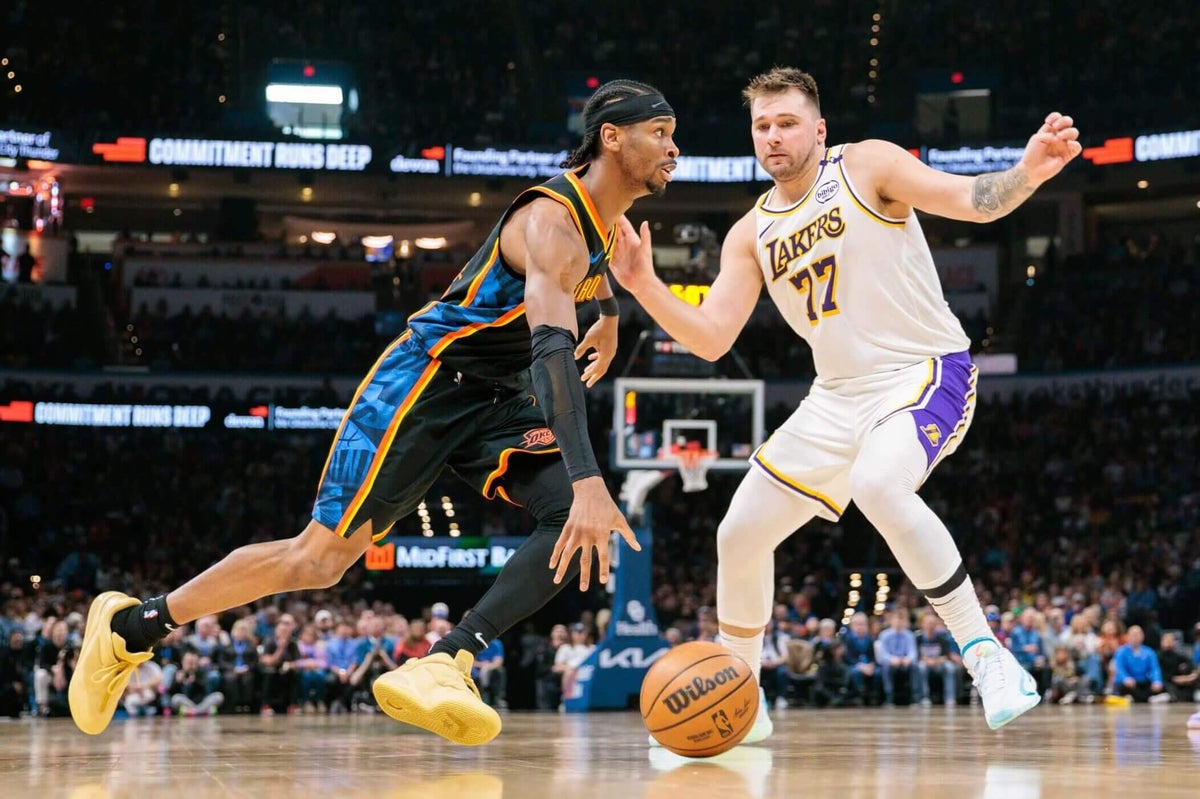
Dončić leads the league in 3s and free-throw attempts per game — a seemingly impossible combo — while dragging a meh Lakers roster to third place in the West. Wembanyama is possibly the unanimous Defensive Player of the Year who leads the league in blocked shot rate and defensive rebound rate. But somehow, at 7-foot-4, he’s morphing into a point-of-attack ballhandler. Leonard is shooting 57 percent on 2s despite hardly ever shooting at the rim, summoning midrange death darts at will while also defending at a level reminiscent of his heyday.
Since the calendar turned to March, Wembanyama had a game with 38 points, 16 rebounds, five blocks, three assists and zero turnovers; Dončić hung 51 on the Chicago Bulls and bracketed it with triple-doubles in wins against his team’s two biggest rivals for playoff position, Denver and Minnesota; and Leonard needed just 31 minutes to score 45 points on 15-of-20 shooting against the Wolves.
Those are the extremes, but they’re putting up crazy box scores nearly every night and seemingly gaining steam as the season winds down.
As a result, the distance between the West’s “Fab Five” (we’re bringing the name back since Michigan is a No. 1 seed in the NCAA Tournament) and everyone else has become a jaw-dropping chasm. Look at the PER leaderboard, for instance, and after Dončić’s 27.6, you quickly descend the ladder to Jalen Duren at 25.7 and Zion Williamson at 23.3. The five West stars are off on their own continent.
The same five players top the leaderboard in BPM, too, and by a similar margin. After Leonard’s fifth-place 8.2, we swan dive to sixth-ranked Cade Cunnigham at 6.4 and the rest of the mortals.
I don’t think this bifurcation is getting quite enough attention; it’s one thing when one or two players are head and shoulders above the league, but pretty remarkable when it’s an exact quintet. It also brings up two questions going forward.
First, what does the future look like for the top of the East if the elite of the elite are always in the other conference? The West keeps winning the important lotteries (Cooper Flagg, Victor Wembanyama, Anthony Edwards — though Minnesota may be in the East in 2028 if and when the league expands). As players like Leonard and Jokić age out of the top five, others can step right in, much as those two did when LeBron and Steph descended toward Earth.
Meanwhile, the East’s two best chances at cracking that list — Tatum and Tyrese Haliburton — each suffered Achilles tendon tears in last spring’s playoffs. That disparity gets even more dire if Giannis Antetokounmpo ends up in the West this summer or if the West once again ends up with the top four picks in a loaded draft as it did in 2018. (The odds favor the East, as Eastern teams own the league’s three worst records as of today, but we’ve heard that one before.)
That lack of elite star power doesn’t preclude the East from having good teams; three of the league’s top five records are in the East, and 10 teams are .500 or better. It doesn’t even preclude the East from having champions, such as Tatum’s Celtics that defeated Dončić’s Mavs in 2024.
Nonetheless, the balance of power in the league seems nothing like what the win-loss records say. Instead of balancing evenly on the scale, it feels like somebody threw a giant kettlebell into the middle of the Nevada desert and tipped the whole thing 90 degrees. And I’m not sure how that gets any better in the next two or three seasons.
But we’ll table future discussion of that matter until the summer to deal with a more immediate issue related to the dominance of the five players I mentioned above: The fact that an arbitrary endpoint may ultimately prevent a fair recounting of the story of this season.
The NBA’s 65-game rule, a feature of the 2023 collective bargaining agreement (CBA), makes anyone who falls short of playing 65 games ineligible for several league honors, including MVP, Defensive Player of the Year and All-NBA. That’s a pretty wild decision, because that line plucked out of thin air and drawn in the sand could be a major factor in things like supermax contracts.
With a month of the season left, we are 21 games away from having this entire “Fab Five” be ineligible for any postseason awards. Enjoy that Donovan Mitchell vs. Cade Cunningham MVP debate, everyone!
Even if it’s unlikely that all five get knocked off the list, it’s distressing to think one or more of these five great seasons wouldn’t even merit a third-team selection because of the 65-game rule. It’s basically the NBA saying, “Sure, Nikola, you were good this year, but you were no Julius Randle.”
All five players are in at least some jeopardy of falling short:
Leonard has been amazing, but he’s played in 53 games and recently sprained his ankle. After missing Monday night’s game in San Antonio, he can only miss two more before he’s eligible for any of the three All-NBA teams.
Wembanyama has played in 53 games through Monday, plus the uncounted NBA Cup final. He can only miss three more games, or he won’t be eligible for All-NBA, a likely third-place finish in the MVP vote or the Defensive Player of the Year award that he otherwise would win by a simple voice vote.
Dončić has played in 56 games, giving him a bit more leeway. If he missed six more, he wouldn’t be eligible for First Team All-NBA, although he still would win the scoring title as long as he plays in two more. That’s good news, because a technical foul suspension (he’s one away from a mandatory suspension) seems almost sure to cost him at least one game at some point. The veteran move would be to mouth off at the refs at the end of next Monday’s game in Detroit, then fly home and skip the last game of a six-game road slog in Indiana.
Gilgeous Alexander, like Dončić, can miss five more games and remain award-eligible and is at no risk of missing any contests because of technical foul accumulation. However, that still leaves him one turned ankle away from seeing his quest for a second consecutive scoring title go by the wayside.
And finally, the most ridiculous of these cases is Jokić. If he misses two more games, he wouldn’t make any of the three All-NBA teams despite having the best PER of all time. He is also just unconcerned enough with personal awards to imagine that he might actually stop at 64 games.
The one saving grace in all of this is that the players know there’s a 65-game threshold. It will shock nobody if we see guys limp through exactly 20 minutes or use one of their two “grace games” between 15 and 20, to maintain eligibility. (Wembanyama, Jokić and Dončić have already used one grace game.)
Nonetheless, we’re already seeing the logical holes in the argument for a hard-and-fast 65-game rule for award eligibility. These five historic campaigns deserve to be hailed in the present and noted for the future; whether they played 64 games or 66 shouldn’t be the determining factor in whether that happens. Regardless, the West’s top-heaviness in stars remains the defining difference in conferences, even as the standings look even in other ways.