

As the province doubled down on its “tough on crime” measures and calls for federal bail reform this week, rates of violence across Ontario jails — both inmate-on-inmate and inmate-on-staff assaults — are rising, according to an analysis of data shared with CBC News by the Ontario Public Service Employees Union (OPSEU).
Latest numbers from 2025 show that for every 100 inmates, around 11 staff were assaulted. That’s up from around nine in 2024. Nine staff were also assaulted in 2019 before the pandemic.
The data for 2025 also shows that for every 100 inmates, 67 were assaulted by another inmate, which is up from around 60 in 2023 and 66 in 2019.
The numbers back up the experiences faced by staff on the job, said Adam Cygler, who represents correctional workers with OPSEU and is a member of the employee relations committee for corrections in Ontario.
“Things are getting more violent largely because of capacity issues and bed space issues,” he said.
“We’ve got a significant increase in the number of inmates being housed in provincial correctional facilities in the same space with the same number of staff,” Cygler said.
An Ontario ombudsman report last June found that correctional institutions faced “chronic staff shortages,” with some “operating at over 150 per cent of their capacity.”
CBC News calculated the rate of assault based on numbers provided by OPSEU and an average of monthly jail population numbers obtained from the Ministry of the Solicitor General through a freedom of information request. CBC averaged the monthly population numbers for each year except 2025. The average jail population for that year was calculated based on the first six months available.
Ombudsman warned of ‘growing crisis’ in jails
The issues that Cygler points out — capacity and staffing — are not new.
In his 2024-25 report, Ontario Ombudsman Paul Dubé warned about the “growing crisis in Ontario jails.” His report identified five areas of concern:
Overcrowding, including three inmates in cells made for two.Frequent lockdowns.Inadequate health care.Indigenous inmates with no access to a native inmate liaison officer.Inmates with mental health issues being placed in segregation.
Dubé’s report also mentioned that most people held in Ontario jails are waiting for a trial, meaning they’re legally presumed innocent.
“When we fail to uphold the basic dignity of people in custody, we do more than inflict harm — we erode public trust, degrade working conditions for staff and weaken the very foundations of our justice system,” the report said.
A CBC News investigation previously found that more than 80 per cent of all people in Ontario jails were awaiting trial.
On Monday, Premier Doug Ford and Ontario Solicitor General Michael Kerzner announced plans for a new jail in Brockville. Ford said the development is part of the government’s plan to add 1,436 new correctional beds across the province by 2032.
“For the safety of the public, offenders — particularly repeat and violent offenders — belong in one place: behind bars and in jail,” said Kerzner.
Ford also doubled down on bail reform measures, calling on the federal government to follow through with its bail reform legislation which would make bail harder to get, especially for violent and repeat offenders. The legislation passed its third reading last month.
“As we crack down on criminals, we’re investing in our jails to ensure not having enough space is never an excuse to grant offenders an early release,” Ford said.
Ontario’s own bail reform legislation, introduced last year, has yet to pass under Ford’s majority government. If passed, the bill would require those granted bail to provide a cash security deposit up front, rather than paying later if they break their jail conditions.
Some opposition politicians and advocacy groups have denounced the proposed legislation, saying it would discriminate against low-income individuals who can’t pay a deposit up front, which could in turn increase the number of people sent to already-overcrowded jails.
WATCH | Ontario announces plans for tougher bail for repeat offenders: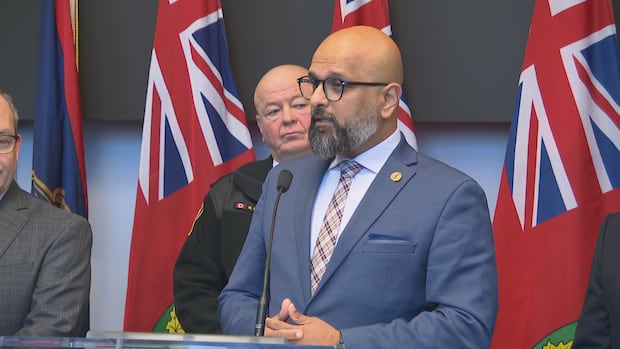
Ontario announces plans for tougher legislation addressing repeat offenders on bail
The Ontario government says it will introduce tougher legislation aimed at repeat offenders, following growing concerns about people with extensive criminal records being released on bail. The province’s new strategy is intended to strengthen compliance with bail conditions and increase deterrence.Jail violence is a ‘powder keg’: lawyer
Natasha Beitman, a senior associate at Templeman LLP who specializes in criminal law, said the issue of violence is a “multifaceted problem.”
She said conditions in jails are worsening across the board, noting that many of her clients lack access to resources like showers, phone calls and medication, which could increase stress.
“I would feel anxious and horrible and gross if I didn’t get to shower, [and] if I don’t get to speak to my kids or my wife or my mom … I’m going to be frustrated, I’m going to be scared, I’m going to be uncomfortable,” said Beitman.
“The violence has increased across the board because tensions and stress have increased across the board. It’s a powder keg, and I think people are delusional if they’re expecting people not to react with some degree of violence when they’re placed in those conditions.”
These conditions also impact correctional officers, who may go on leave or quit their job because of the working environment they are subject to, Beitman said.
 Natasha Beitman, a senior associate at Templeman LLP who specializes in criminal law, said the issue of violence in jails is a ‘multifaceted problem.’ (Submitted by Natasha Beitman)Hire more staff, union says
Cygler said immediately hiring more staff to deal with the influx of inmates would help alleviate the stressors he’s hearing from members and help increase access to services like health care, proper meals and support programs for inmates.
“Having consistent investment is really what we need to have a functioning correctional system in Ontario,” he said.
Violence in jails is “unacceptable,” said Saddam Khussain, a spokesperson for the Ministry of the Solicitor General.
“The ministry has zero tolerance when it comes to assaults or threats against staff. If staff are assaulted or threatened, the police are contacted immediately,” Khussain said in a statement, noting that inmates who engage in violent behaviour face misconduct penalties.
When asked about staffing shortages, he said the government has deployed over 3,300 correctional officers to its jails since 2020 and is “continually recruiting” new staff.
Beitman said changing Ontario’s correctional system would require a societal shift to recognize that inmates deserve “a basic level of human rights,” especially because Ontario jails are a “catch-all for everybody.”
“Right now, I’ve got everybody from clients who are charged with mischief … all the way to aggravated assault,” she said.
“No one is saying that it’s going to be summer camp and it shouldn’t be — it’s jail,” Beitman said.
“But at the same time, there is a basic level of human rights that we need to be affording to inmates. When we see the erosion of those rights, we see the consequences and the increase of violence.”