
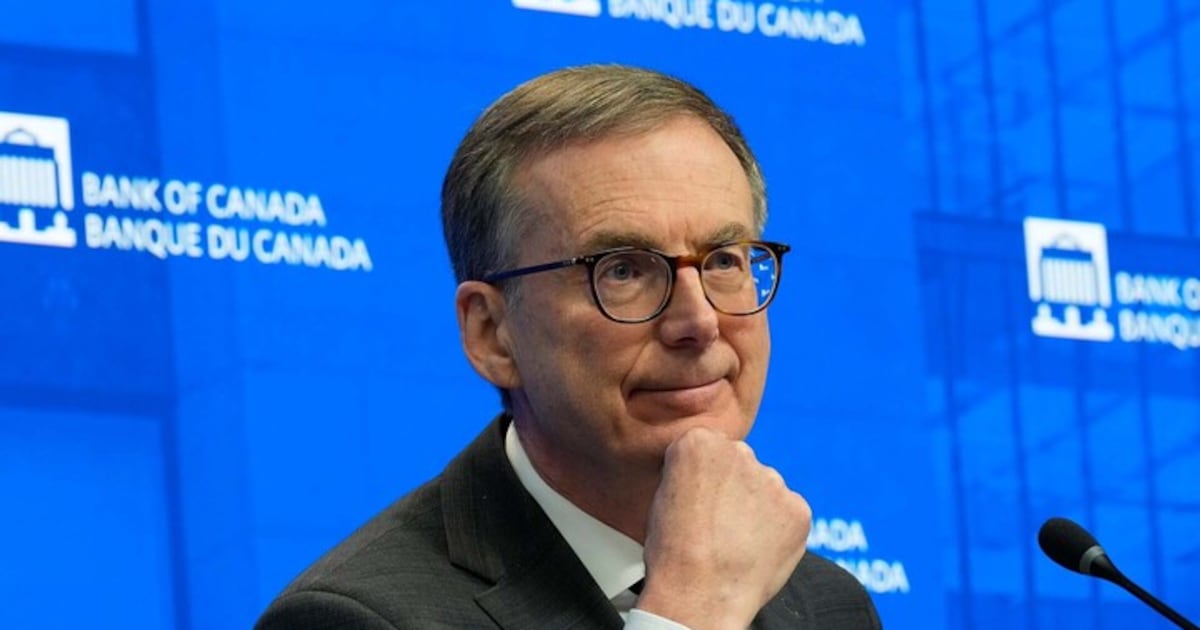
OTTAWA — The Bank of Canada held its principal interest rate at 2.25 per cent Wednesday, but warned rising oil and natural prices caused by the war in Iran will push up inflation in the short term.
In its latest monetary policy decision, Canada’s top bankers painted a picture of a weaker-than-expected economy that is facing new levels of uncertainty because of the war.
“Canada’s economy is dealing with a lot. And now, we face more volatility,” Bank of Canada Governor Tiff Macklem said in his opening remarks at Wednesday’s rate announcement.
Data released by Statistics Canada this week shows inflation dropped to 1.8 per cent in February from 2.3 per cent in January. Both reports represent data largely collected before the U.S.-Israeli strikes. The March CPI data, Macklem said, will be higher.
But how big the war’s impact will be, the bank says, depends on how high oil prices go and how long the conflict lasts.
“Inflation in Canada has been close to the two per cent target for more than a year,” Macklem said. “But, as we’ve seen, the war in Iran is causing oil prices to move sharply higher and this will push up inflation in the short term.”
Despite that warning, central bankers are holding the policy interest rate for the third consecutive time. It was lowered in October from 2.5 per cent. Macklem says the bank does not believe it will see goods and services rapidly increase because of higher oil prices. That, he says, gives bankers time to monitor the economy as a whole.
“As those risks evolve, as the economy plays out, we are prepared to respond as needed,” Macklem said, adding the bank can change the policy rate depending on how much support the economy needs.
The Bank of Canada will make its next interest rate decision on April 29. It will release the latest Monetary Policy Report, which provides a more detailed economic outlook for Canada, at the same time.
“We can’t fix the war,” said Macklem. “What we can do, though, and what we will do, is we will ensure that if energy prices stay high that it does not become ongoing, generalized, persistent inflation.”
How does the economy look?
After growing 2.4 per cent in the third quarter of last year, GDP shrank by 0.6 per cent in the fourth quarter. Early data from 2026 suggests the economy is expanding again, but at a slower pace than the bank forecast in its January Monetary Policy report.
The bank’s January monetary policy report assumed oil would be US$60 a barrel for the projected horizon; it is now hovering around $100 a barrel.
Recent data from Statistics Canada also shows the labour market is soft, with job gains late last year largely reversed in the first two months of 2026. Unemployment in February rose to 6.7 per cent and the bank says there is a lot of volatility in the export data, with exports looking soft.
The combination of a slowing economy and rising inflation creates a “dilemma” for the Bank of Canada, Macklem said.
If the economy were not facing those higher inflationary pressures, Macklem told reporters, central bankers would likely be talking about lowering rates.
“But, you know, we’re operating in a world where there’s more than one thing going on,” he said.
What this means for consumers
The bank says inflation due to higher oil prices will squeeze consumers, leaving them with less income for other spending. A lot of Canada’s fresh food is imported, and higher transportation due to higher energy costs could further boost food inflation.
”It’s a bit early to tell what the impacts of food inflation will be, but certainly energy is big input cost to food,” said Senior Deputy Bank of Canada Governor Carolyn Rogers.
Beyond that, the central bank warns transportation bottlenecks due to the closure of the Strait of Hormuz could also impact supplies of other commodities, including fertilizer, which could also pinch consumers.
“We know some of the supply can come back quickly, but not all of it,” Rogers said.
Looking more broadly, the bank says stock markets are lower, credit spreads are wider and global bond yields are higher.
The housing market is also looking weaker than the bank had projected in its January outlook, a factor that also plays into the bank’s monetary policy decisions.
“We need to take another look at the housing market,” Rogers said. “We need house prices to come down so housing is more affordable.”
But it’s not all bad, the bank says. Higher energy prices will boost income from energy exports, which would support the economy.
Canada is a net energy exporter, so it has more income coming to the country, which Macklem said has helped make the Canadian currency more stable than many other countries’.
“Relative to some other countries, we are in a pretty good position,” Macklem told reports.