
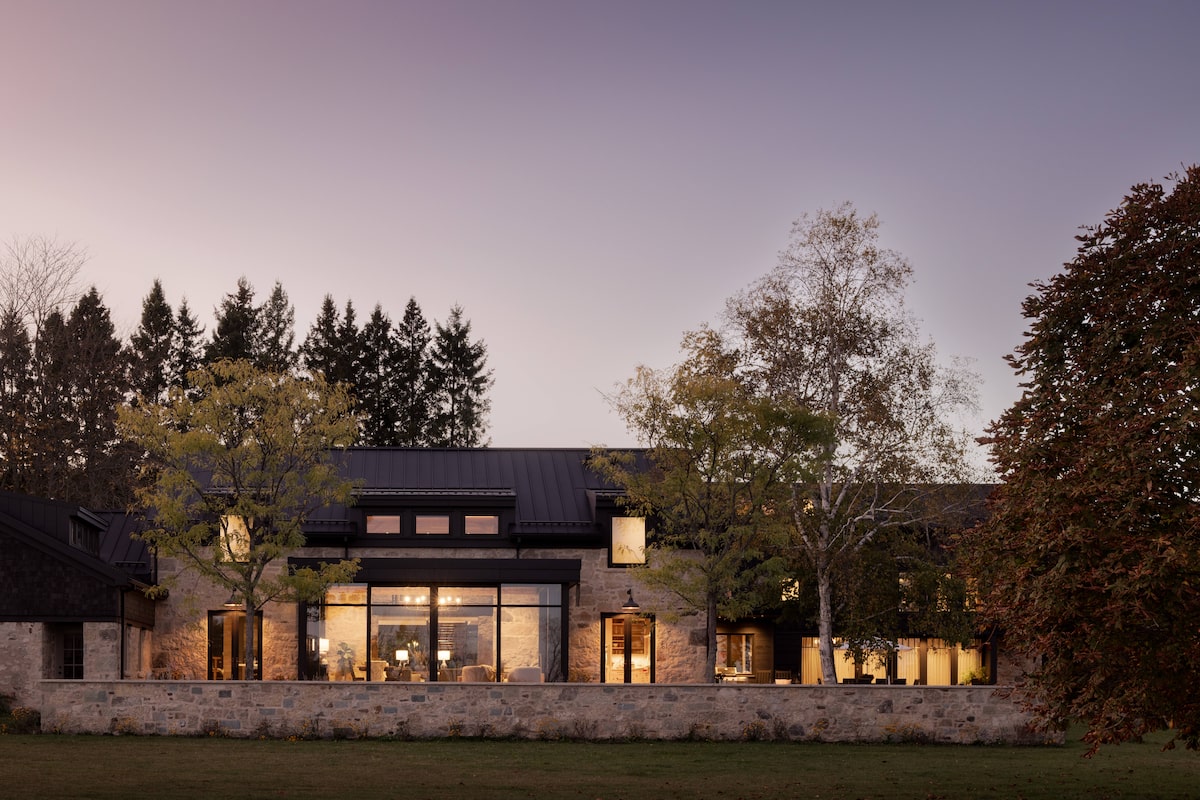
The Milton, Ont., home of Angela and Jim Murphy.Adrian Ozimek/Adrian Ozimek
It is said that architecture is about collaboration between people: clients, architects, engineers, designers and tradespeople. But, when it comes to heritage buildings and adapting them to our 21st-century lives, architecture is a collaboration between eras: despite different materials and styles, they have to work together to create a harmonious environment.
So, in April, 2021 when Angela and Jim Murphy purchased a collection of agricultural buildings near Milton, Ont., ranging in age from 170 years old to about 15 years old – an old stone barn, original farmhouse and tacked-on additions – it wasn’t long before they started to consider how everything connected. Which, by all accounts, was clunky and unharmonious.
“As you arrived, there were a lot of front doors [and] you didn’t know where to actually enter the house,” says architect Ajdin Mehanovic of mcCallumSather. “There were a lot of staircases, so navigating from first floor to second floor was extremely difficult.”
“Yeah,” agrees homeowner Jim Murphy. “Buying this place was like finding a lost puppy and bringing it home; ‘Holy [cow] what do we do?’”
Small improvements to the space included the removal of unnecessary drywall and popcorn ceilings.Adrian Ozimek/Adrian Ozimek
It’s not that the 21st-century additions were poorly built. Rather, there was little logic in how they had been grafted onto the heritage buildings, which, says Mr. Murphy, the previous owners had christened “stone house” and “wood house.”
“They really treated them as separate spaces,” he continues. “They entertained, they had retreats out here in this space, and then they kind of lived over here,” he explains as he points in various directions. The Murphys, however, wanted to live in all the spaces. So, “getting itchy” about a year in and without a grand plan, they started with a redesign of their primary bedroom. But even before construction was finished, Mr. Mehanovic found himself doing a first walk-through.
“We realized we ripped the Band-Aid, didn’t we, and we’re doing the rest of the damn house,” Mr. Murphy says with a laugh.
Although Mr. Murphy had a connection to mcCallumSather – in his previous life as a tech-entrepreneur he’d sat on a board with mcCallumSather director Drew Hauser – in his early, “half committed” days, he’d asked a contractor and a couple of architects to take a crack at conceptualization. But it was such a tough architectural nut, it wasn’t until Mr. Hauser and Mr. Mehanovic proposed a simple, elegant solution that the Murphys realized there had been “a breakthrough.”
Upstairs, a new metal catwalk connects two formerly disconnected spaces.Adrian Ozimek/Adrian Ozimek
A new foyer. That was it. But one large enough to connect and unify three separate buildings. With a grand staircase that would make the elimination of a half-dozen other staircases possible. Oh, and one that doesn’t mimic heritage. Make it Miesian, with black steel I-beams and glass (okay, make the stair treads out of reclaimed wood; Mies van der Rohe wouldn’t like it, but the Murphys do). And, up those stairs, a new metal catwalk to connect two formerly disconnected spaces, each with bedrooms (the Murphys have three almost-grown children).
The other big move? A relocated, larger kitchen, and, with the removal of a large bay window nearby, a dining area housed in a Modernist pop-out that’s almost as Miesian as the foyer. The hole where the large bay window was, says Ms. Murphy, an interior designer, was originally “one of the barn door openings.” Now, adds Mr. Murphy, it is “coffee morning” central, complete with a view of roaming chickens.
Small moves included the removal of unnecessary drywall – some of it hiding original axe-hewn posts – and popcorn ceilings. And sustainable moves of geothermal heating and solar panels.
Approaching the 12,000-square-foot complex today – very much a working farm, so Mr. Murphy has traded in his white collar for muddy coveralls – and not only is it clear where to enter, once inside, there is a logic as to how one moves about. While still a collection of odd room configurations, enlarged hallways, the manipulation of natural lighting, and a considered circulation plan mean first-time visitors won’t get lost, at least not right away. Existing (and very thick) stone openings are mirrored by new, thin openings that allow for long view-throughs and, in some areas, visual connections to the second floor also assist with way-finding. As does the pre-existing turret-with-staircase and the historic landmarks … or should that be housemarks?
Architect Ajdin Mehanovic of mcCallumSather led the renovation of the home, including relocating the kitchen and dining area.Adrian Ozimek/Adrian Ozimek
In the old stone barn – now the main living room – are two enormous wooden wheels about 15 feet up. Between the wheels, a massive piece of timber sports ropes with hooks: “Imagine it’s 1850 and you’ve got to fill [your barn] with hay for the winter,” says Mr. Murphy, a twinkle in his eye. “You would’ve brought a team of horses in this way with a haywagon on … and then brought your biggest horse on that rope out – it would’ve lifted the haywagon up, and then you’d spend the rest of the day [pitching] it into the hayloft.”
This may sound hippy-dippy, but it’s my belief that the respect for heritage by homeowners and designers alike means that the conversation between architectural eras reads, today, as smooth, interesting, and musical, rather than harsh, awkward, and jarring. “This one seemed to work out quite quickly because you guys were really good at decision-making,” agrees Mr. Mehanovic, looking over at the Murphys. “Trying to connect these dots and make sure everything was cohesive … that went pretty well.”
And speaking of decision-making, since the Murphys already sell products via murphypastures.com and co-own Elora Brewing Co., they are considering opening their (now) architectural showpiece to the public: “We’re good friends with Anita Stewart’s family and she did Food Day Canada,” says Mr. Murphy, “and we talked about doing a Food Day Canada event here and having multiple chef stations.”