
MOORESVILLE, N.C. — The sound of roaring engines threatened to overpower a song from The Offspring playing through a nearby speaker, as well as the grunts from the sportswriter trying to make it through his third set of dumbbell bench press reps.
Yet, these engines could not drown out Clear 28 Director of Strength and Conditioning Ryan Von Rueden as he provided motivation.
“Don’t quit,” he said while standing over the flat bench and stabilizing the writer’s shaking arms. “Two more, one more. Bingo! Now, you have nine more sit-ups.”
Coaching a media member through a sample NASCAR driver’s workout is a little out of the ordinary for Von Rueden — his primary focus is on the actual competitors as he provides motivation, feedback on form, and extensive education.
Yet, he made an exception on this day while providing a behind-the-scenes tour of Clear 28’s gym and rehab facilities, which the agency began putting together over a year ago to assist its drivers.
He put the writer through a workout that NASCAR drivers in his program might face as they train to face the challenges of the grueling season. It consisted of core work, cardio, strength training with dumbbells, and weighted squats using a belt machine instead of a barbell.

Von Rueden’s sample workout adapted for a media member
This workout blended some bodybuilding moves with something you might find in a nearby CrossFit gym. Yet, he adapted specific elements of the workout to fit that writer’s athletic abilities, something he does with all of his clients.
“We’re just trying to be the best version of ourselves for as long as possible,” he told FanBuzz during a one-on-one session. “So there’s a lot of crossover between sports performance and longevity. If we’re going to do it for a 45-year-old business person, why would we not be doing it with our drivers?
“And again, I feel like in this sport, everybody focuses on the race car so much, but the guy driving the thing is the most important piece. And I think that sometimes gets overlooked. So we’re just trying to…we’re trying to pour into the person that’s actually piloting the car, because that’s our controllable.”
Von Rueden has spent decades working in the sport while training multiple drivers. His time includes several years working with Kasey Kahne and then Ricky Stenhouse Jr.
Von Rueden still coaches Stenhouse and numerous up-and-coming NASCAR drivers. He just splits his time between two facilities now that he officially works for Clear 28. Stenhouse also sold his ranch and the purpose-built shop gym where numerous people toiled toward a common goal.
The veteran trainer works with some drivers at Kahne’s shop — this includes JR Motorsports driver Sammy Smith. But those who belong to the Clear 28 roster meet him on the Roush Yates Manufacturing Solutions campus in Mooresville. They work out in the gym overlooking the Roush bar and entertainment space.
This group of drivers includes Noah Gragson, Brenden Queen, Luke Baldwin, and Jack Wood. Von Rueden previously coached Clear 28 drivers Cole Custer and Sam Mayer, but they now train with the Chevrolet camp after Haas Factory Team switched manufacturers.
For background, Clear 28 is the driver agency co-founded by Brandon McReynolds, who also spots for Ross Chastain in the Cup Series.
Clear 28 also features John Lewensten (Chief Growth Officer), Briar LaPradd (Creative Content Manager), Von Rueden (Director of Strength & Conditioning), and Kaylie Green (Social Media Manager).
This agency first launched in 2022 and has since established itself in the sport while aiding in contract negotiations, brand management, content creation, and other crucial behind-the-scenes work for drivers.
The training program is an extremely important part of the process as the drivers try to become race-winners across multiple series.
“(McReynolds) knew that from an early age that if he ever became a spotter, he would have time, and so he built out a great whole other career,” Chastain told FanBuzz. “And running Clear 28 and what the good group behind the scenes there allows him to go do — he’s trying to take people to the Cup Series.
“And technically he’s a competitor to the group I work with at MMI, but we are aligned in a lot of things. We’ve had a lot of conversations over the years. I like the way he handles himself.”
Building the facility

Photo credit: FanBuzz Racing
While the Toyota Performance Center and the Josh Wise Program at Chevrolet directly support athletes affiliated with Toyota and Chevrolet, respectively, those driving for Ford and Ram don’t have one dedicated resource.
Some teams have an in-house program. This includes RFK Racing with its Human Performance Center focusing on strength training, nutrition, and other aspects.
“It’s taken a big step in the right direction,” Chris Buescher told FanBuzz. “We have Les (Ebert), our trainer, came over from the NFL world about right after I got to Roush, so it’s probably 15-16 years ago now.
“So we work out with him several times a week through strength and conditioning. We have a nutritionist. We have all the tools to dive into. So I can’t speak for the other Ford teams, but I know that it is a big deal to us here at RFK that we do try to plan out for these races.”
As Buescher indicated, not every Ford-affiliated driver works out of the same facility, nor do they follow the same program. The same holds true for the Ram drivers, who all currently race for Kaulig Racing.
Roush Yates VP of Strategic Partnerships and Marketing Todd English and Roush Yates President & CEO Doug Yates have been very aware of this reality and so they saw an opportunity to put something together. They believed they could benefit some of these drivers who needed guidance and a place to go.
“Todd sent me an email, and was like, ‘Hey, man, would you be willing to put together a gym for Doug,'” Von Rueden explained. “I was like, ‘Sure’ and then I sent — we had one of everything (pieces of equipment). And he’s like, ‘Well, would you be able to train like, four people in here?’
“And I was like, ‘Well, am I building this for you? Am I building it for Clear 28? Who am I actually building this for? What’s the end goal?’
“…When I built it for Doug, well, this is all we need. And then he was — he basically took the handcuffs off — and was like, ‘Whatever you would build if you were building it for you, build it.'”
So Von Rueden changed the approach and expanded his order from Ohio-based company Rogue Fitness.
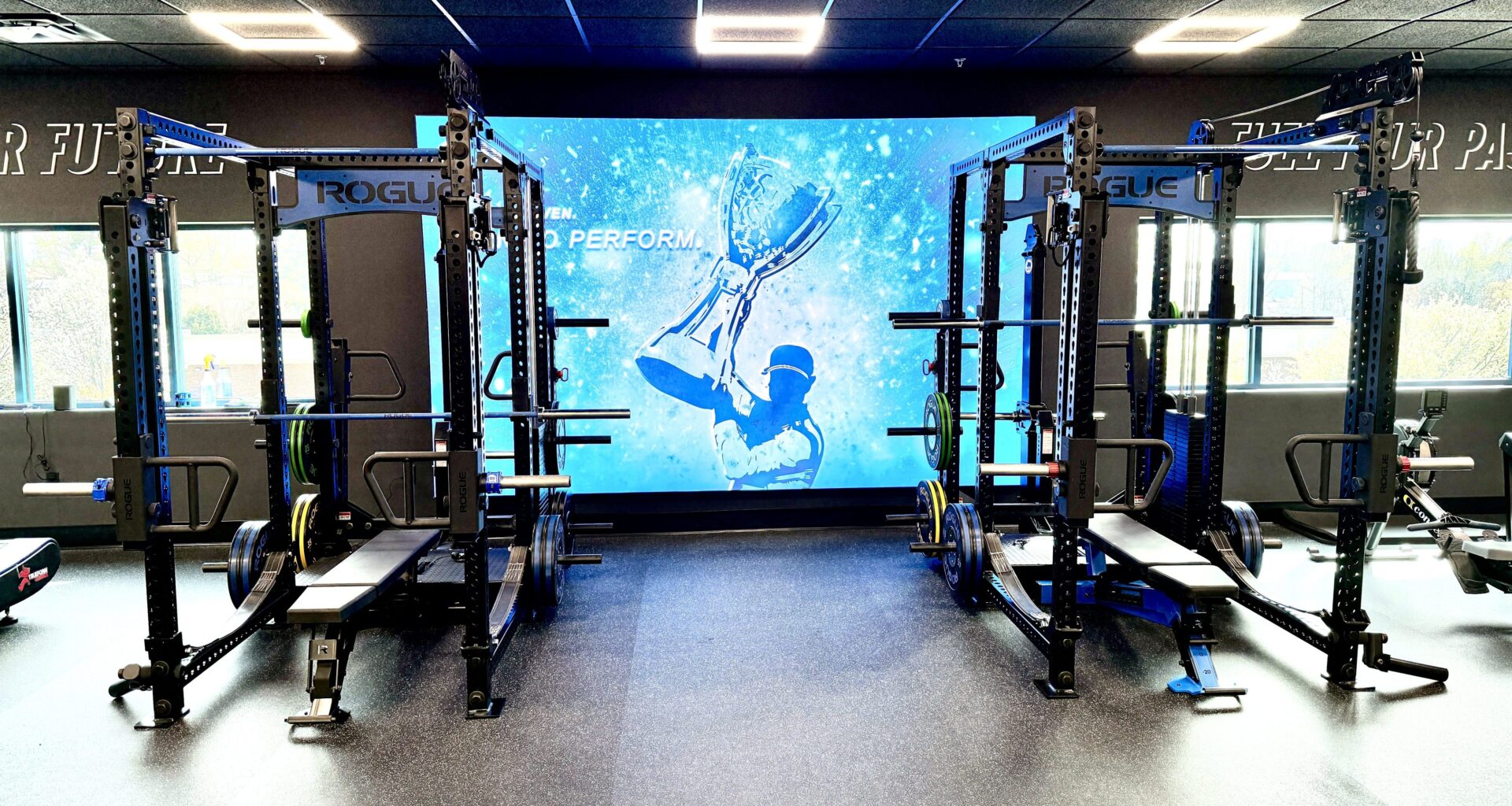
Instead of having only one weightlifting rig, he ordered multiple with blue accents to match the Ford Racing theme. He still kept one treadmill and one SkiErg, but he added in multiple rowers. He ordered two different styles of stationary bikes.
He took advantage of the advancements in the fitness industry over several decades.
“Basically, we kind of modeled it a little bit after what we had out at Ricky’s,” Von Rueden said. He added that they still kept the gym smaller in scale to provide a more focused approach to these younger drivers.

Photo credit: FanBuzz Racing
While he enjoyed his time coaching more than a dozen people per class at Stenhouse’s ranch, the veteran trainer knew that he would be better suited to having smaller groups at Clear 28.
He recognized that not all drivers in NASCAR come from a training background like Kahne, Stenhouse, or Smith. Some never really worked out in this manner until they began his program.
“You’ve got to teach them everything, right? And so you’ve got to be really careful, just because it’s really good for you to work out, but you can really get hurt if you’re not doing it right,” Von Rueden said.
“And things like…you don’t think about your meniscus and your knee, or you can get tendinitis somehow because you’re moving improperly. So really got to focus on teaching the mechanics of everything first before we kind of let the reins go.
“And I would say it takes about a year for me to get comfortable with somebody and be like, ‘Okay, you’ve earned the right to go do Murph, or you’ve earned the right to do 10 minutes of walking lunges, or 200 push ups in a row before I know you’re not gonna get hurt. I know you’re gonna maintain form.'”
Murph is a workout done in honor of U.S. Navy SEAL Lt. Michael Murphy, who died in the line of duty on June 28, 2005. This workout features a 1-mile run, 100 pull-ups, 200 push-ups, 300 bodyweight squats, and a 1-mile run. The workout calls for some athletes to wear a weight vest of 20 or 14 pounds.
So how does this work in practice? When Von Rueden works with Stenhouse, he knows he can write the workout down and then just occasionally correct the Hyak Motorsports driver’s form. He may also get a little sass in return. Their relationship is just like that after nearly a decade.
But when he works with Queen, a new addition to the program, he may have to scale some of the movements back.
A fitting example is a recent workout. Stenhouse, Von Rueden, and Sammy Smith completed a circuit featuring 200 push-ups, 100 inverted pull-ups, 200 sit-ups, 200 toe touches, and 10 minutes of walking lunges. They completed this in approximately 29 minutes.
Queen’s version of the workout would be smaller in scale for multiple reasons, including avoiding injury. He would do maybe 100 push-ups, 50 to 75 inverted pull-ups, 100 sit-ups, and eight minutes of walking lunges.
Getting back to full strength

Photo credit: FanBuzz Racing
While this gym sits behind locked doors, racing fans have seen a small glimpse. Gragson showed off parts of the facility while filming his daily life for the Full Speed: The Daytona 500 documentary on Prime Video.
He showed a little portion of the gym, some of his lifts, and the infrared sauna. He just didn’t show off all of the tools that the Clear 28 drivers can use to recover after each week of the season.
The recovery room, which will continue to expand with time, currently has the infrared sauna and a cold plunge. It also has a PEMF Mat that helps with relaxation as drivers lie on it.
The plan is to ultimately get a hyperbaric chamber where athletes can breathe 100% oxygen, but Clear 28 hasn’t reached that point just yet. After all, this facility has only been put together for just over one year.
For now, the athletes take advantage of the equipment they have, and they focus on getting back into racing shape as quickly as possible each week of the season.

Photo credit: FanBuzz Racing
“Their typical post race day workout would be come in, they roll out five to 10 minutes, (then) nice, easy cardio, just to kind of get the blood flowing and loosen up,” Von Rueden said. “And then, depending on the individual, if they wrecked, or just whatever is tight — so, like, I have a general idea of ‘Hey, we’ll just hit all of this that typically drivers need’ — hips, shoulders, low, back, hamstrings.
“But if they’re like, ‘Hey, my glutes are really tight, my shoulder’s really tight,’ whatever, then we’ll just kind of pivot and spend more time on those movements. And then they’ll finish, they’ll come down (to the recovery room). Hit (the mat) for probably 20 minutes, 10 on each side.
“They’ll hit (the sauna) for 30, depending on their schedule, maybe 45 minutes, but we’ll contrast them. So there will be 15 in (the sauna) and then one in (the cold plunge).”
The recovery doesn’t solely take place at the Clear 28 facility. These drivers will also go see a physical therapist to address specific concerns. They might receive some manual adjustments. Or, they will have some dry needling or cupping done.
Von Rueden sets up the appointments with the physical therapist and sends over each driver’s information. The therapist then takes it from there and builds a plan that would work hand-in-hand with the multi-day Clear 28 program.
The week has the same structure for each driver, albeit with some slight changes based on the race schedule.
Monday: The drivers just focus on recovering from the prior race. They hop in the sauna and cold tub, and they also use tools in the gym such as foam rollers to address specific pain points. They have a later start despite Gragson’s insistence on showing up at 7:30 a.m.
Tuesday: Interval training where drivers get their heart rate as high as possible and as low as possible in a short span of time. Think high-intensity movements for a short period of time, like fan bike sprints. Breathing is a major focus to help with that in-workout recovery. Von Rueden will test their reaction time between the intervals, if the body is recovered enough from the race.
Wednesday: The true traditional strength training day. This includes bench press, weighted squats, shoulder raises, shoulder presses, and some light Olympic lifting if the athlete has properly learned the form. The focus is on more reps at a lighter weight to build the muscular endurance, something that is a priority for drivers who spend hours at a time in the race car. They are not going to set personal records on lifts; that is something they can do during the offseason.
Thursday: This is a traditional cardio day. Those who can run without limitation will go for five to 10 miles. Those who can’t will do the equivalent work on one of the stationary bikes. This is to mimic some of that extended time in the race car.
Friday: This day is more of a wild card. Some drivers go to the track to race. Those who don’t leave just yet may do some more recovery work. They may also do a circuit of exercises that could include some lighter barbell work followed by a pull-up and then some bench press.
The next steps for Clear 28
While Von Rueden has built out a solid facility with Clear 28 and Roush Yates’ blessing, he still sees areas where they can make improvements. Sure, he would like to add in some extra equipment, but the big focus moving forward is on the education side.
Many of these drivers are young and single. They don’t necessarily have that nutrition background to rely on as they go through the week. Some don’t even eat their first meal of the day until they finish the workout.
Then they order two massive burritos from Chipotle. They are still eating healthy in terms of food quality, but they are also shoveling in more than 3,000 calories per day.
Von Rueden and Clear 28 have considered turning to a meal preparation service such as Factor, and they could still pull the trigger on that initiative later this season. For now, they are trying to just educate the drivers about calories in vs calories out and how food timing affects their whole system.
Food is more than just fuel. It also plays a role in sleep habits, hormones, and recovery.
“Showing them their habits, and how it’s affecting them,” he explained. “Like, look at…your hormones are jacked. You can’t sleep at night. Well, that’s because your cortisol levels are spiking at night, and your testosterone is crashing.
“So you feel like s—- during the day, you feel great at night. You’re wide awake. Why can’t I go to sleep? It’s because everything — the melatonin-cortisol inverse relationship’s all jacked up. So it’s like, we’re trying to to address things from a root level.”