
Formula 1 in 2026 has split fans and drivers like never before with new power unit regulations transforming the on-track action and leaving no one sitting on the fence.
Early races in Australia and China have been unpredictable, full of overtakes, and thrilling, delivering exactly what F1 fans have long demanded. And yet many still aren’t happy.
F1 2026 power unit rules debate: More overtakes, more strategy, more controversy
Want more PlanetF1.com coverage? Add us as a preferred source on Google for news you can trust.
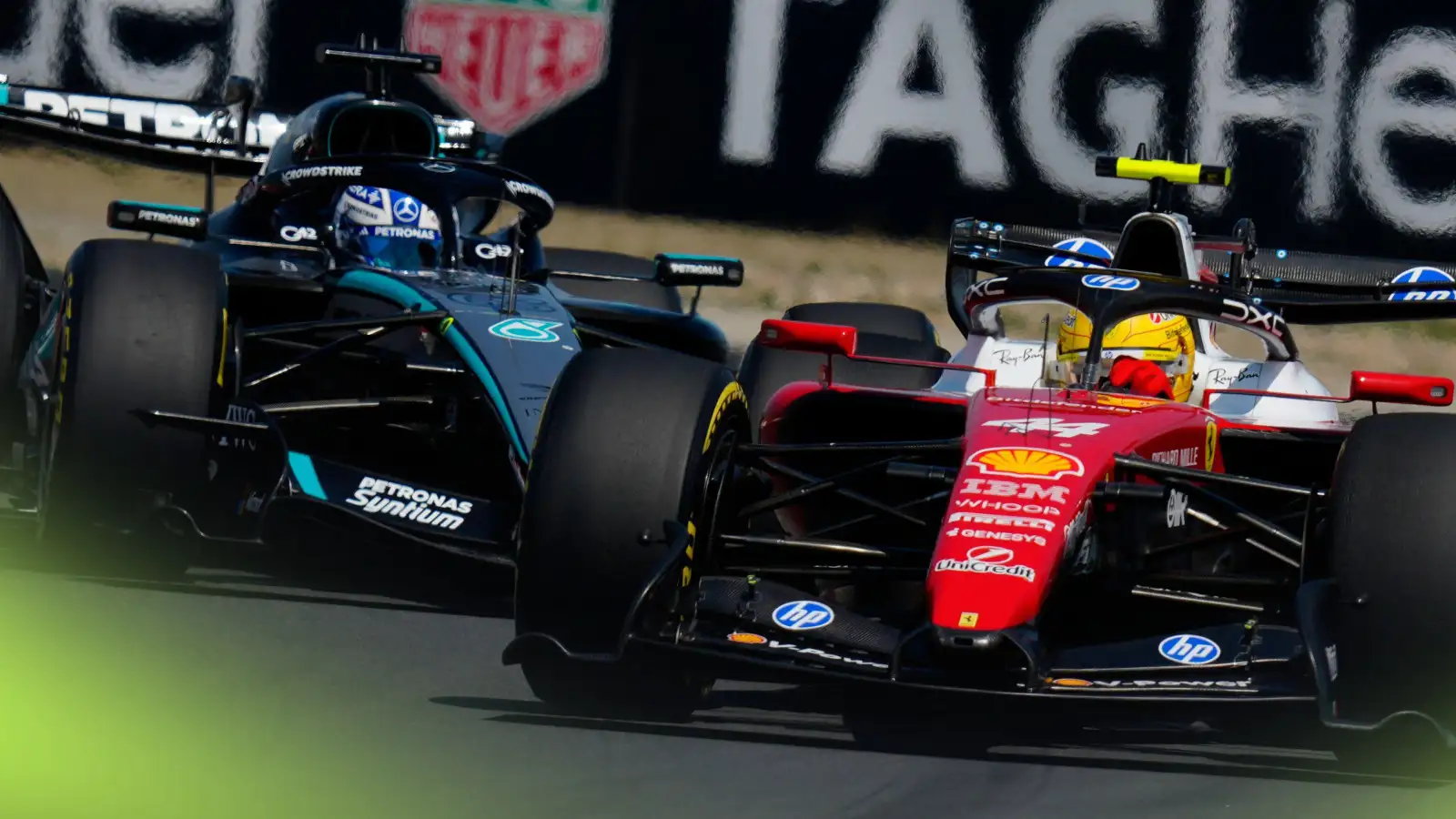
In the opening laps of the Australian Grand Prix, Charles Leclerc and George Russell exchanged positions multiple times. A week later, on Saturday in China, Russell was at it again, this time with Lewis Hamilton. In the race, Hamilton and Leclerc went wheel-to-wheel, while Russell had to battle his way back through the field.
By any objective measure, the three competitive outings so far in 2026 have been entertaining. Drivers have had opportunities to pass more readily than ever before.
The F1 2026 power unit regulations are not broken, they’re not wrong, they’re just different.
And for all the noise bemoaning the new rules, that too is nothing new; we saw it in 2014 when the hybrid engines were branded ‘artificial’.
Early reliability issues were resolved, and while Mercedes dominated, we ended that era with one of the greatest championship showdowns in F1 history.
The introduction of ground effects saw complaints too, with drivers concerned about the impacts of porpoising such that measures were introduced to protect them in the car.
And still, Lando Norris reflects on them as being the greatest cars ever – no doubt a view shaded by his F1 2025 world championship. But he wasn’t always of that view.
“The weight makes a massive difference for just the driving and how the car reacts,” he said during pre-season testing in F1 2022. It’s a lot heavier than it was last season so it just feels a bit slower, a bit more sluggish.”
In the four years that followed, technical convergence and a surge in new fans saw F1 race into the stratosphere.
Fundamentally, the power unit regulations that existed then remain. From 2014-2025 the combustion:hybrid ratio was 80:20, where now it is far closer to 50:50.
The battery is charged by energy recovered from the rear axle under braking, or by siphoning power from the internal combustion engine once the car has reached its terminal velocity.
Neither of these elements are new. Harvesting on the rear axle has occurred since 2014, while the term D-Rate referred to the process of stealing energy from the engine to charge the battery. In F1 2026, more energy can be stored and deployed strategically.
Now, when the electrical system harvests energy from the internal combustion engine, a process dubbed ‘super clipping’, it has a more obvious impact – revs drop and the car’s top speed reduces as the power is diverted to charging the battery.
That is jarring to see from a formula that has a reputation for extreme performance and drivers pushing to the ultimate limit.
For drivers, the new complexity can force an unnatural style, compromising speed in unusual sections to achieve a better overall lap time.
There are reliability elements and debatable safety concerns have been raised too. What if a car begins to super clip while another is on boost? The closing speed could be extraordinary.
It is those elements that have seen drivers draw comparisons to Mario Kart, and complaints of ‘fake racing’.
And one can understand their point. The new regulations have afforded them tools that can give them a significant temporary speed advantage, something alien in Formula 1.
Only it’s not. In the 1980s drivers had the ability to dial up or down the boost their turbocharged engines produced, affording them a pace advantage. For a time.
The limiting factor then was fuel. Run with too much boost for too long and you’d simply run out of fuel (and many drivers did). The challenge was knowing how much to use and when.
Sound familiar?
More on F1 2026 power unit regulations
Max Verstappen ‘throwing toys out of the pram’ with F1 2026 outburst
F1’s new era already looks like a major misstep
More recently, there have been different power modes available to drivers that achieve similar results. These were carefully managed for a multitude of reasons, engine reliability included.
Under the F1 2026 power unit regulations, drivers have access to battery energy for a short period. It’s finite, and while it can be recharged that process is not instantaneous. The difference now is it’s exaggerated in its power, and compressed in its deployment time.
Without a doubt it contributed significantly to the 120 overtakes seen at the Australian Grand Prix. For comparison, the 2025 event saw 45 passes, in 2024 it was 35. There were 29 the year prior and, in 2022, 34. In 2019, the final year the race was held before Albert Park was re-profiled in an effort to increase overtaking, there were just 14 passes – though some sources suggest even fewer.
The opening laps in Albert Park were thrilling as the lead changed hands multiple times. The same was true in China in both the Sprint and Grand Prix. There was an ebb and flow, a game of cat and mouse as drivers used the tools at their disposal to get the upper hand on the car in front.
Isn’t this exactly what drivers and fans have been asking for: more overtaking and more wheel-to-wheel action?
Just look back at the history of F1 – and you don’t need to look too far back – and you’ll find drivers vociferously complaining about an inability to pass.
“Overtaking was basically impossible unless somebody made a mistake,” complained Michael Schumacher following his first race back from retirement in 2010.
“That is the action we are going to have with this kind of environment of race strategy.”
Lewis Hamilton added: “It is a different challenge… It definitely didn’t make racing more exciting in terms of being able to overtake.”
The comments pointed to the dull racing that resulted in the banning of in-race refuelling, a concept reintroduced to F1 in 1994 with a view to add some spice to what had become processional races.
The period from 1994 until 2009 saw cars run light, race hard, and stop multiple times. It gave rise to the notion that F1 is a flat-out competition from start to finish with drivers on the very edge of adhesion.
In truth, that has never been the case. There has always been an element of management involved, be it tyres, fuel, clutch, brakes.
The increased electrical energy this year adds another element too that, or more accurately places greater emphasis on an element that has been there since 2014.
There are at least five instances where there have been races without ANY overtakes outside of the race start, including the 2021 Monaco Grand Prix.
Through the refuelling era, the average number of on-track passes rose above 20 only twice, in 1995 and 2000.
In the period since 2010 and the banning of refuelling, where drivers were having to manage their cars more, that figure only dipped below an average of 30 passes per race once, in 2017. Last year, the average was 30.9, the lowest figure since 2011.
This period also saw the drag reduction system, a device developed and introduced purely to increase the chances of an on-track overtake.
“To me it is obvious we have improved big time,” said Schumacher in 2011.
“We have had some exciting races. Look at Korea: if you think about the fight that Mark [Webber] and Lewis [Hamilton] had there, without DRS it would have been nowhere close. It would have been a normal and more traditional race.
“In that respect it doesn’t always work out perfect, but in general it has contributed a lot for some great racing.”
Jenson Button added: “It has brought a lot to the races.
“There are some instances when perhaps it made overtaking too easy, but there are always negatives with something like this.
“But the positives outweigh the negatives. It has brought a lot to racing, and you can get closer to the cars ahead. KERS has been important too.”
Perhaps foreshadowing most was Rubens Barrichello, then driving for Williams, who opined: “I heard for 20 years that overtaking is not enough and now people are saying it is too much. People are saying it looks too easy.
“The new people that come to F1 they will still have to get used to the fact that they must get a handle on the button. It is now easier as you get used to it, but the new guys will have to adapt to it.”
The difference today is that F1 has far greater visibility. Its fan base is having to grow accustomed to something that is more exaggerated than ever before, because having a means to temporarily boost one car’s performance over another is not new.
In F1 2026, drivers are having to lift and coast at points to manage their battery, just as once they did to manage fuel or brakes, or tyres.
And, we must remember, this is the worst it will ever be. The disparity between teams is a result of them venturing into the unknown, with little data. They will learn. Harvesting will become more efficient, the nuances of how the energy is used to attack and defend will become more clear as we, the fans, understand what the drivers are doing.
It’s almost certain that these rules won’t appeal to everyone, but there is little arguing the fact that they’ve thus far achieved one of F1’s core objectives: to create entertaining and competitive racing.
Is it perfect? No. Will it ever be perfect? I hope not, because it is that imperfection that creates the opportunities – a driver mistake, a miscalculation, a missed button press, a locked brake. Roll those elements together and the result is a Formula 1 with strategic nuance, with drivers who can once again miss the proverbial gear and afford their rivals an opportunity to pounce.
These rules are complex and need refinement, but they’re finally delivering what Formula 1 has always sought: unpredictable, strategic, and thrilling racing.
For decades the sport has cried out for more action, and the evidence suggests the 2026 regulations are finally delivering it, even if not everyone agrees.
Want to be the first to know exclusive information from the F1 paddock? Join our broadcast channel on WhatsApp to get the scoop on the latest developments from our team of accredited journalists.
You can also subscribe to the PlanetF1 YouTube channel for exclusive features, hear from our paddock journalists with stories from the heart of Formula 1 and much more!
Read Next: Aston Martin sets record straight over Adrian Newey Chinese GP absence