
EDMONTON — In a democracy, public officials should expect scrutiny. Robust debate is not a weakness of our system, it is a strength. But scrutiny must be applied consistently, and debate must be conducted with an awareness of its consequences. When it is not, public discourse can move quickly from accountability to harm. The campaign against the professional trip to Israel taken by Edmonton’s chief of police illustrates this danger clearly.
International engagement by police chiefs and senior public officials is routine. Leaders regularly travel to exchange best practices and learn from their democratic colleagues. These trips rarely attract public controversy. Yet when the destination is Israel, the response often changes dramatically — becoming more charged, more personal and more punitive.
That disparity matters. Holding officials to a different standard solely because they engage with Israel is troubling. It is not merely criticism of a policy choice or a foreign government. It is part of a broader effort to single out and delegitimize one country in a way that is not applied to others. When that country is the world’s only Jewish state, the implications for the broader Jewish community cannot be ignored.
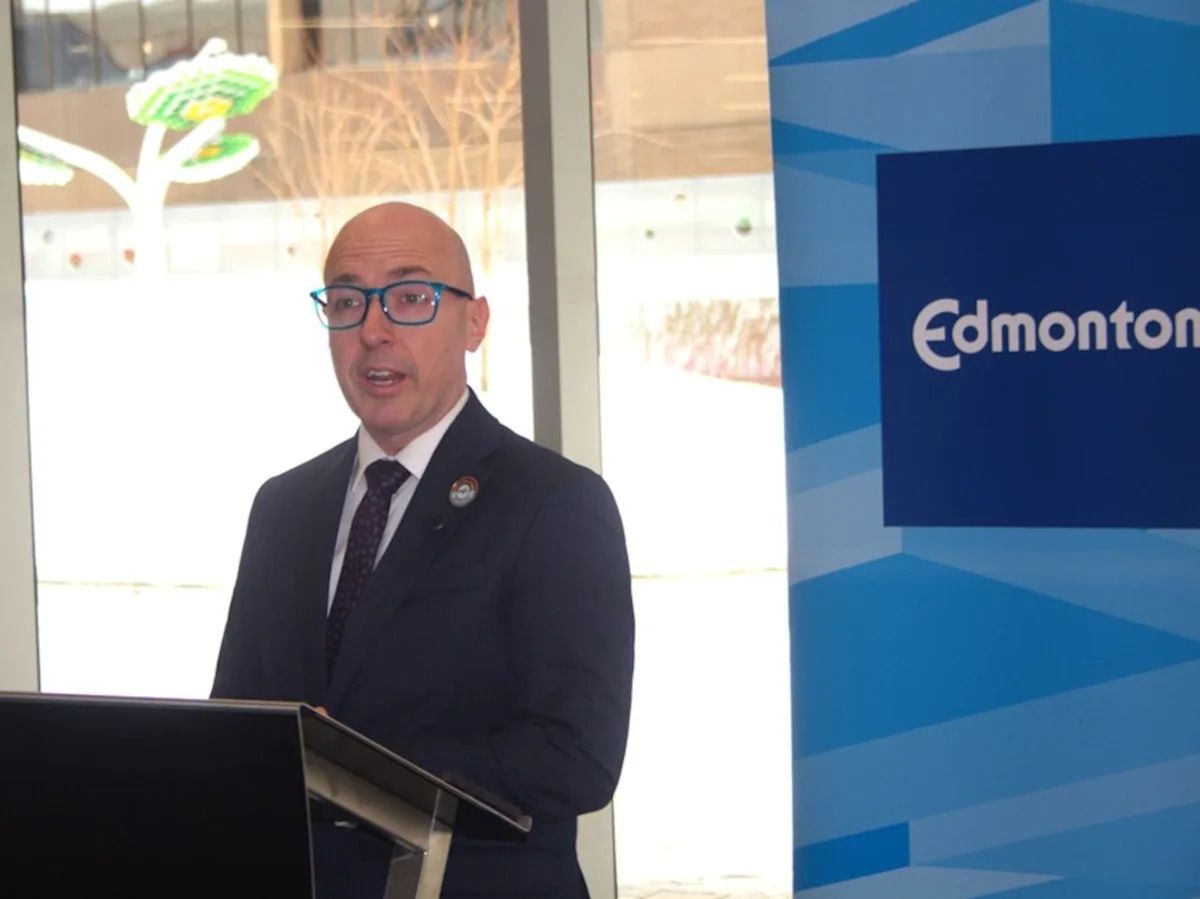
Edmonton Mayor Andrew Knack issued a statement on Friday saying he is “disappointed and frustrated” with Chief Warren Driechel’s decision to travel to Israel. The mayor’s statement was harmful and alienating, invoking “anti-Palestinian racism” and “Islamophobia” while stating concerns about “comments that characterize our community members as extremists” being divisive and designed to shut down the conversation.
This gaslighting of the Jewish community was presumably directed at our response to a divisive campaign for Chief Driechel’s resignation, which has invoked libels about war crimes and genocide.
The mayor went on to further demonize Israel, ending with a request for the Edmonton Police Commission to review its travel policy, given the “sanctions in place.” Sanctions are not neutral language. They carry significant political and moral weight, and their casual deployment in municipal discourse risks portraying Israel as uniquely deserving of punishment or isolation. In fact, Canada has a free trade agreement and a strategic partnership with Israel, which includes security. The only “sanctions” are on some settlers.
Mayor Knack’s statement only serves to legitimize selective outrage and reinforce the idea that engagement with Israel is inherently suspect in a way that engagement with no other country appears to be. That is a double standard playing out in real time.
Criticism of any government, including Israel’s, is legitimate and necessary in a democratic society. But there is a clear and important distinction between principled policy critiques and the application of exceptional standards that treat engagement with Israel as uniquely problematic. When professional interactions are re-framed as moral transgressions — especially by those in high civic office — the line between criticism and discrimination is crossed.
This concern is sharpened by what we are seeing on the ground. Community reporting and monitoring efforts across Alberta consistently show that antisemitic incidents remain among the most frequently reported forms of hate‑motivated activity. In this context, discussions surrounding a police chief’s trip to Israel will contribute to division if they are not handled thoughtfully and responsibly. Language that inflames rather than informs does not stay confined to debate — it shapes attitudes, behaviour and, ultimately, community safety.
The effects are not confined to opinion pages or political debate. Polarized discourse has real consequences at the community level. At a time when synagogues are being shot at, it heightens security concerns for Jewish institutions. And it sends a message to Jewish Edmontonians that their identities and global connections are subject to suspicion in ways that others’ are not.
This is not how inclusive societies are sustained. Canada’s strength lies in its ability to allow space for disagreement without demonization, and for passionate debate without vilifying entire communities. That balance is increasingly fragile. When civic leaders elevate rhetoric that isolates one country — and, by extension, one community — it undermines social cohesion at home.
If we allow double standards to stand unchallenged, we should not be surprised when division deepens and trust erodes. The cost of that failure will be borne not by institutions, but by communities. That is a price all Canadians should refuse to pay.
Mayor Knack has called upon Driechel and the police commission to “meaningfully connect with our community to repair where trust has been broken so that all Edmontonian feel safe.” Mr. Mayor, when you say “our community,” does that include the Jewish community, and will the same courtesy be given to us?
National Post
Stacey Leavitt‑Wright is the CEO of the Jewish Federation of Edmonton.