
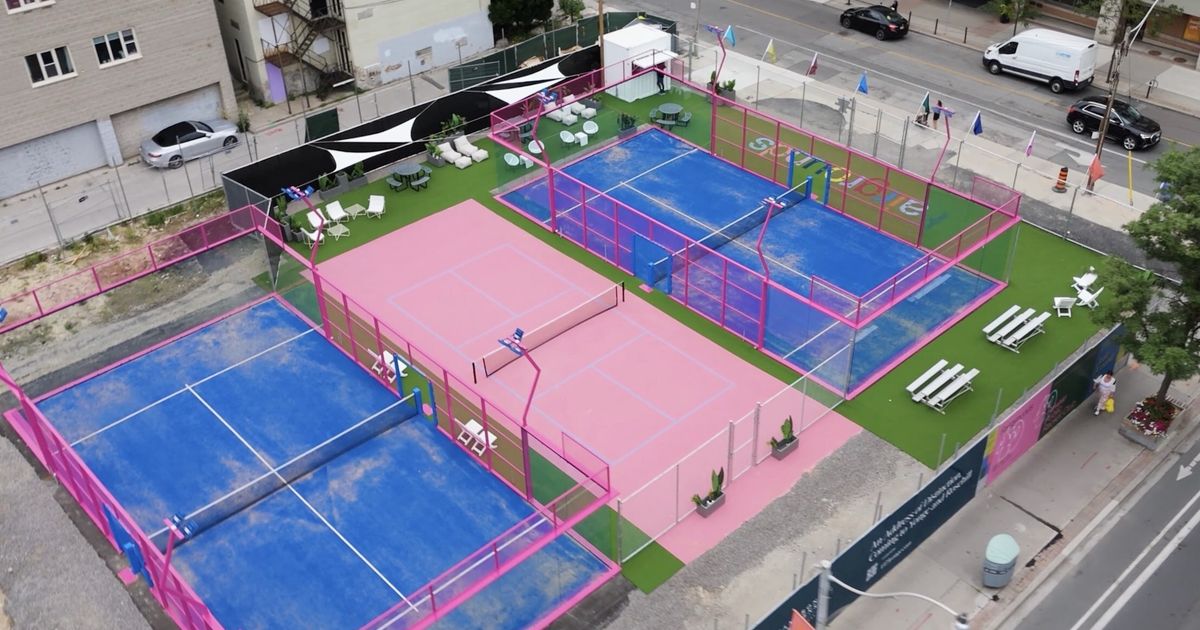
A local Toronto racket sports hub could soon disappear after a property tax reclassification significantly increased costs for the site.
The future of Fairgrounds Racket Club, located at 8 Rosehill Ave., now hangs in the balance, after the site was temporarily activated as a community recreation space. The site currently serves as a temporary outdoor racket court on land that is planned for a future mixed-use residential development by Originate Developments.
Rather than sitting vacant, Fairgrounds says the site has been transformed to offer pickleball and padel courts, in an effort to create a space for “physical activity, social connection, and neighbourhood programming.”
However, since the recreational courts charge booking fees, the Municipal Property Assessment Corporation (MPAC) has reclassified the site as “commercial,” rather than residential, meaning the racket club now faces taxes that are 2.3 times higher, resulting in an annual increase in property taxes of $500,000.
Fairgrounds says the survival of the courts depends on a solution or intervention, without which, the property would remain vacant until construction for the development begins.
“This site was intentionally activated so it wouldn’t sit empty while the development process moves forward,” said Adam Sheffer, co-founder of Originate Developments. “Instead of a boarded-up lot, the community gained a place to play, gather, and stay active. Unfortunately, the current property tax system unintentionally penalizes these kinds of temporary uses.”
The Yonge + St. Clair BIA also defended the courts, noting that the recreational spaces have had a positive impact on the community.
“Having activity on this site has been a real benefit for the neighbourhood,” said Jason Glionna of the Yonge + St. Clair BIA. “People come to play, and then they visit local cafes, restaurants, and shops. It’s exactly the kind of activation that strengthens and supports small businesses.”
In Toronto, vacant development land can remain classified as residential and taxed at a lower rate; however, the temporary community uses can trigger significantly higher commercial taxes.
“With the condominium market slowing and development timelines lengthening across the city, many properties may remain in transition for extended periods. Without policy adjustments, interim uses that bring life and activity to neighbourhoods may become increasingly difficult to sustain,” Fairgrounds writes.
The racket club goes on to suggest several solutions to address the issue, including he creation of an Interim Use Property Tax Sub-Class for lands in transition, a Community Improvement Plan (CIP) that would allow Toronto to provide grants to address property tax increases associated with interim activations, and a Municipal Capital Facility designation, which has already been used in the city to support recreation facilities.
Fairgrounds also boasts locations in Leaside, Etobicoke, and at Stackt Market.