
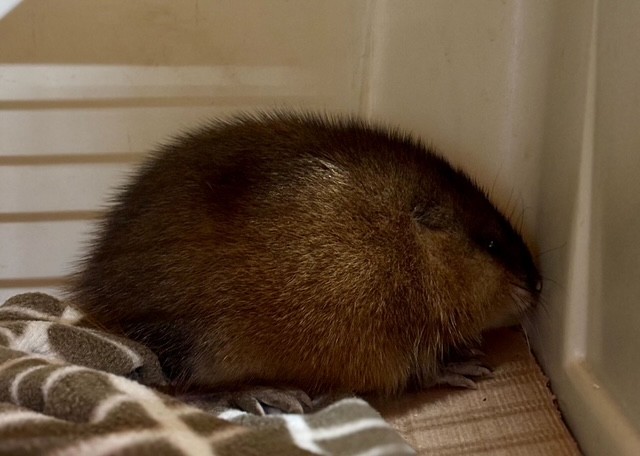
A frightened muskrat found hiding under a car on a busy Moose Jaw street is back in the wild after a successful rescue, thanks to local volunteers with the Wildlife Rescue Society of Saskatchewan (WRSOS).
Far from home: an unusual rescue in the city
The muskrat was discovered Friday under a vehicle on Athabasca Street, far from any nearby water, prompting concern from residents who tried to gently guide it to safety.
Instead, the animal retreated further under the car.
“We didn’t know what was going on with him, and he was literally terrified. It took him a little bit of time to relax, eat and calm down before he was released,” said executive director Bonnie Dell. “We think he might have been chased by a dog or something, because there was no open water around.”
After the call came in, a local rescue volunteer responded and safely contained the animal. It was then placed in a quiet environment to recover from the stress of being in a busy urban setting.
At first, its behaviour raised concerns.
“He was very, very quiet at first, which concerned us,” Dell said. “We thought that maybe he was sick.”
By the next morning, the muskrat had rebounded.
“Overnight he ate and made a nice little bed for himself… and by morning he was quite defensive against rescuers, so we knew he could be released.”
A return to safety
Rescuers then worked with wildlife rehabilitation partners to identify a suitable release location nearby. Warmer weather helped open up local water, creating the right conditions for release.
The muskrat was returned to a wetland area within about a kilometre of where it was found.
“We had to be careful where we released him because he would have had a cache of food somewhere to get through the winter,” Dell explained. “We don’t ever want to take them out of their territories because they know where it’s safe. They have shelter, they know where to find food.”
Moose Jaw among busiest areas for wildlife calls
The call is one of many coming from the Moose Jaw area, which has become a hotspot for wildlife incidents.
“It has become our third busiest place for calls after Saskatoon and Regina,” Dell said.
Dell noted that Moose Jaw hosts a rather large urban wildlife population, attributed in no small part to the Wakamow River area and the connection to the Qu’Appelle Valley on the city’s east side.
“You guys have a lot of wildlife there, a lot of urban wildlife as well,” said Dell, adding that Moose Jaw is the provincial hotspot for skunk calls. “We have a really good team of volunteers in Moose Jaw, so we’re very lucky, and that you’re so close to Regina, so we can quickly get animals into the (Salthaven West Wildlife Rehabilitation Centre), which is great.
WRSOS also works closely with local partners, including the Moose Jaw Animal Clinic, to ensure rescued wildlife are able to return to their natural habitats in a quick and safe manner.
Read More:
Spring recruitment window now open
With spring approaching — the busiest time of year for wildlife calls — the organization is now in its annual recruitment period.
“We only onboard rescue volunteers in the month of March,” Dell said. “It’s a one-month window to apply to be a volunteer, and then we would do the rescue training in April.”
With demand for their services constantly increasing, the group is eager to welcome new members to its Moose Jaw team.
She said many volunteers stay involved long-term, with some remaining with the organization for years.
Dell added that while rescue training is done in a limited window in the spring, transport volunteers, who help move animals between locations, are accepted year-round.
Rescuers brace for spring surge
The Wildlife Rescue Society responds to calls across Saskatchewan every day of the year, relying on trained volunteers and partners to help injured or displaced animals.
“We are here every day, 365 days a year,” Dell said, adding that with warmer temperatures arriving, that demand is expected to increase.
“We are bracing ourselves for impact right now as the weather warms up.”
How residents can get involved
If you’re interested in becoming a part of the WRSOS rescue team, the window to do so is closing at the end of the month. Visit their website for more information about the organization, to apply to volunteer, and donate to help save wildlife throughout the province.
For regular updates on the animals rescued by the WRSOS, check out their social media pages.