
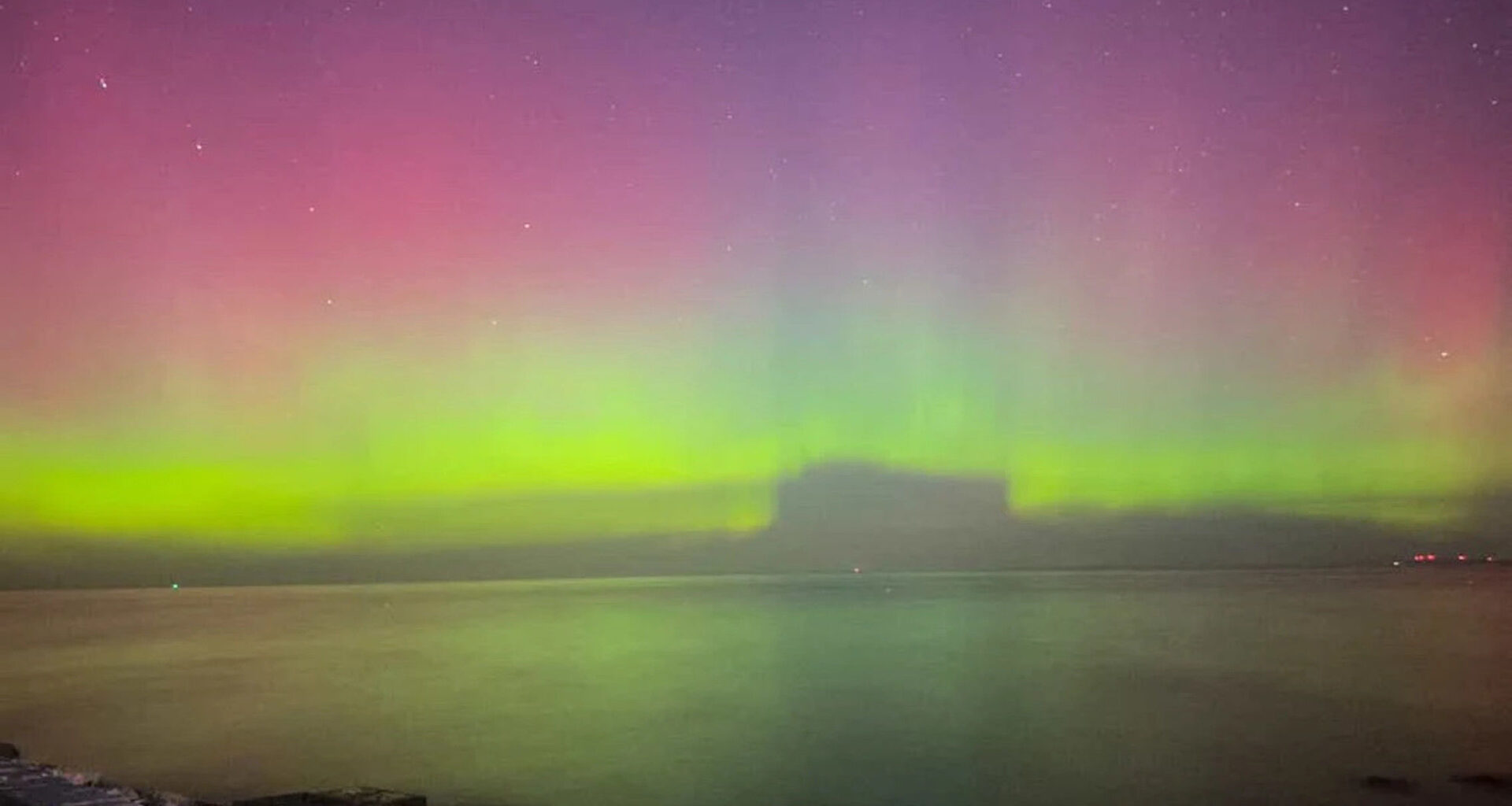
Based on their latest update, they are expecting active to stormy levels throughout the aurora and polar regions. Stormy levels are forecast across the sub-auroral region, which includes much of southern Canada and the northern United States.
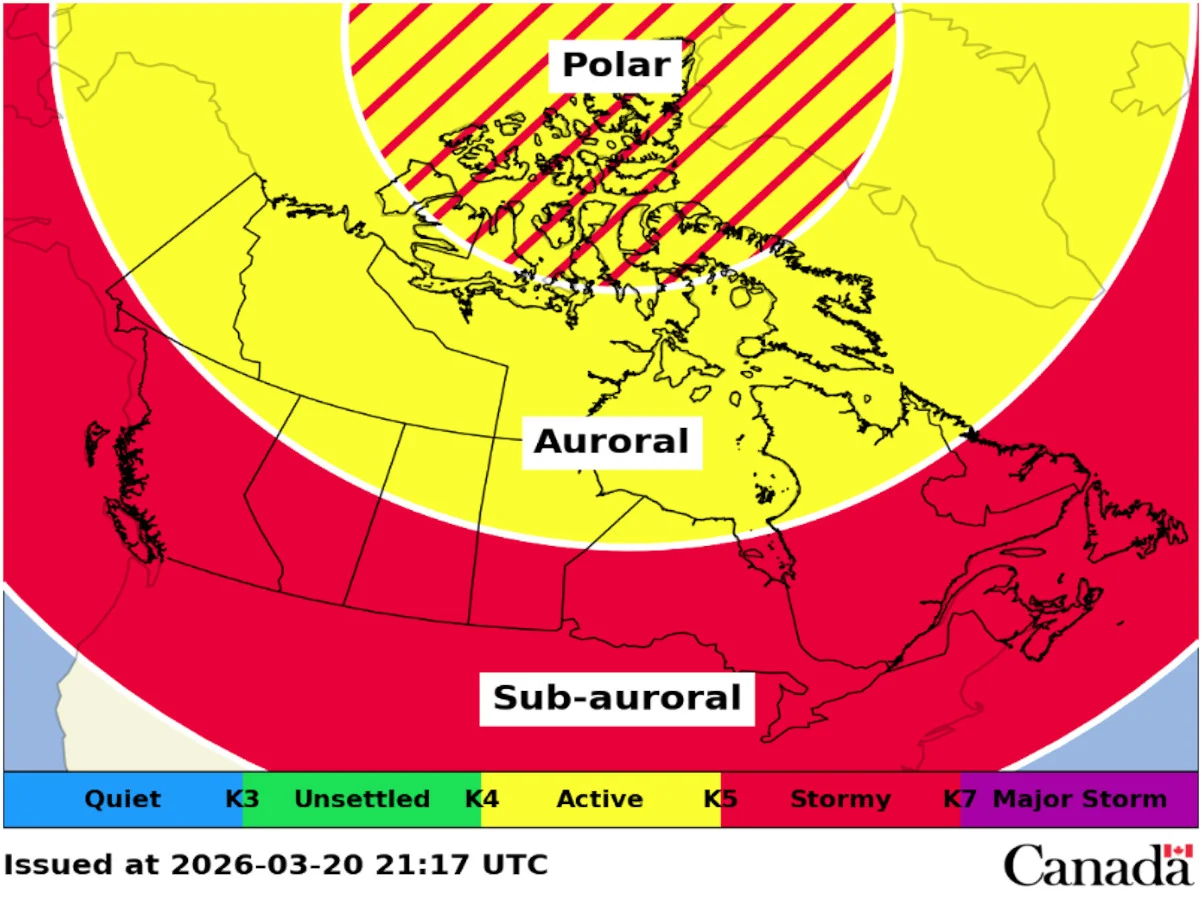
The 6-hour forecast for magnetic activity, issued by NRCan’s Canadian Space Weather Forecast Centre, at 5:17 p.m. EDT, on March 20, 2026. (NRCan CSWFC)
CWSFC forecasts update as conditions develop. Thus, the above forecast may change throughout the night tonight. However, active through stormy conditions are likely until Saturday morning.
READ MORE: Geomagnetic storms – what are they, what do the levels mean, and when should we worry?
Equinox Cracks?
The Sun and Earth are each surrounded by their own magnetic field. The Sun’s magnetic field contributes to solar activity, such as solar flares and coronal mass ejections (aka solar storms). Meanwhile, the Earth’s magnetic field reacts to these solar storms, and to the flow of the solar wind, which results in coloured displays across Canadian skies known as the Aurora Borealis, or the Northern Lights.
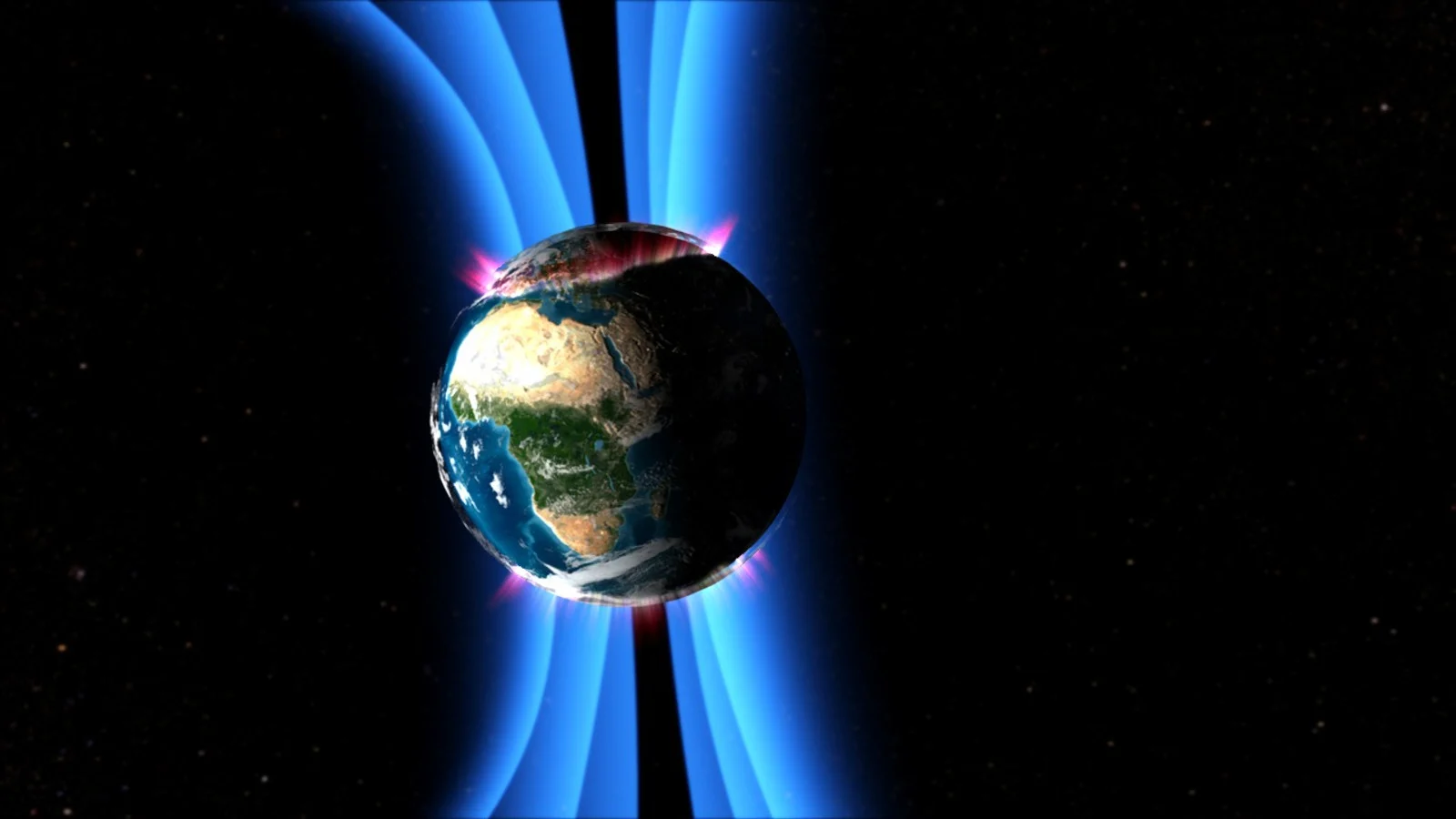
Auroras appear around the north and south poles of Earth as Earth’s geomagnetic field traps particles from the solar wind and funnels them down into the atmosphere. (NASA)
Due to Earth’s tilt, our planet’s magnetic field is nearly always out of alignment with the Sun’s magnetic field. So, even under the absolute ideal conditions for a solar storm or the solar wind to result in auroras, that misalignment effectively reduces the overall intensity of any that do appear.
However, around the spring and fall equinoxes, the magnetic fields of the Sun and Earth line up better than they do during the rest of the year. This can cause strong connections to form between the two, effectively opening up ‘cracks’ in Earth’s magnetic field.
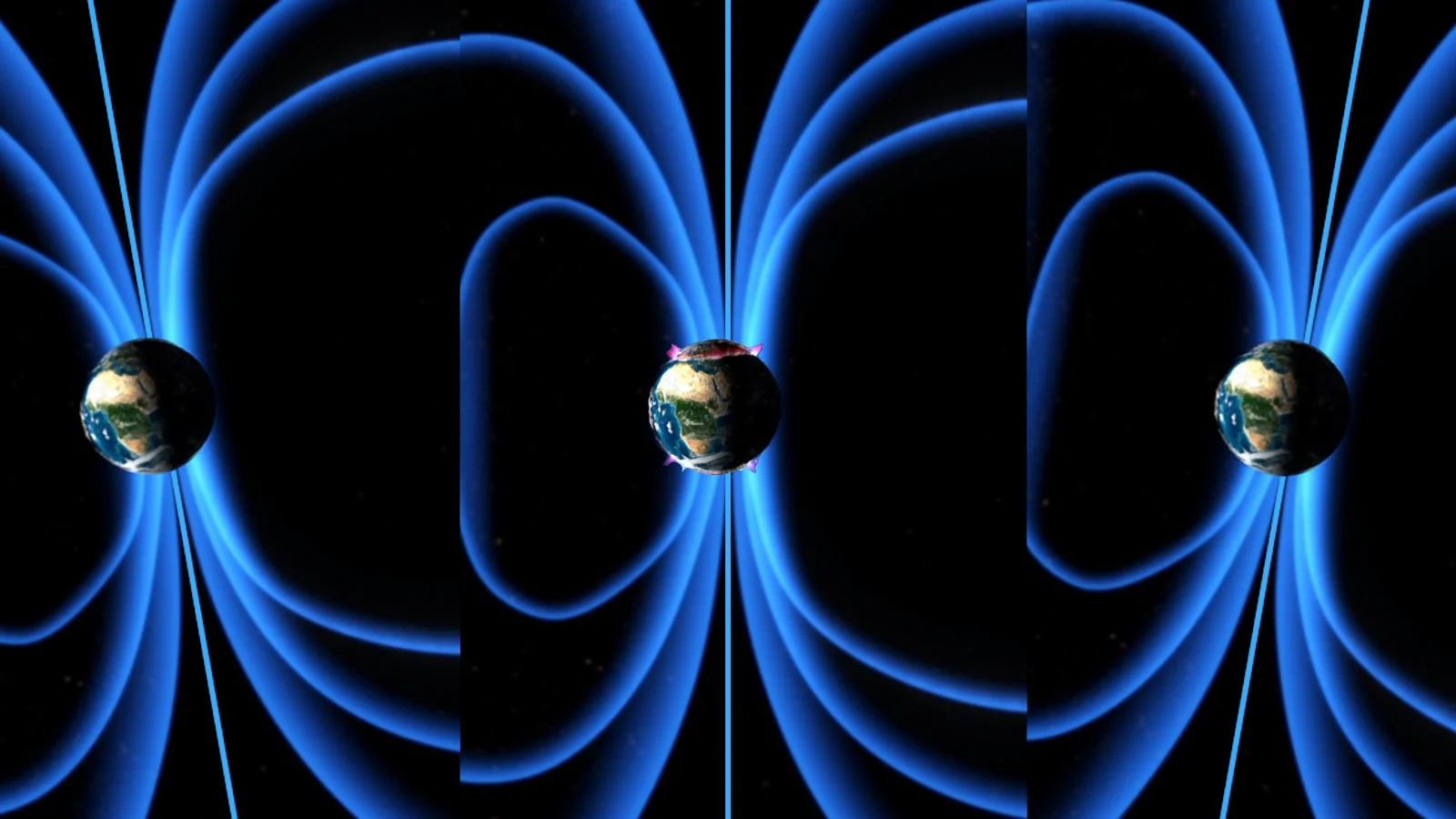
The orientation of Earth’s magnetic field at northern summer solstice (left), equinox (centre), and northern winter solstice (right). The Sun is located far off the left side of the field of view, and its magnetic field is oriented most in alignment with the centre panel. (NASA/Scott Sutherland)
READ MORE: Why are the Northern Lights so supercharged lately and how long will this last?
This is known as the “Russell-McPherron effect” and it produces fast-tracks for particles from the solar wind or from solar storms to stream down through that protective barrier and into the upper atmosphere.