
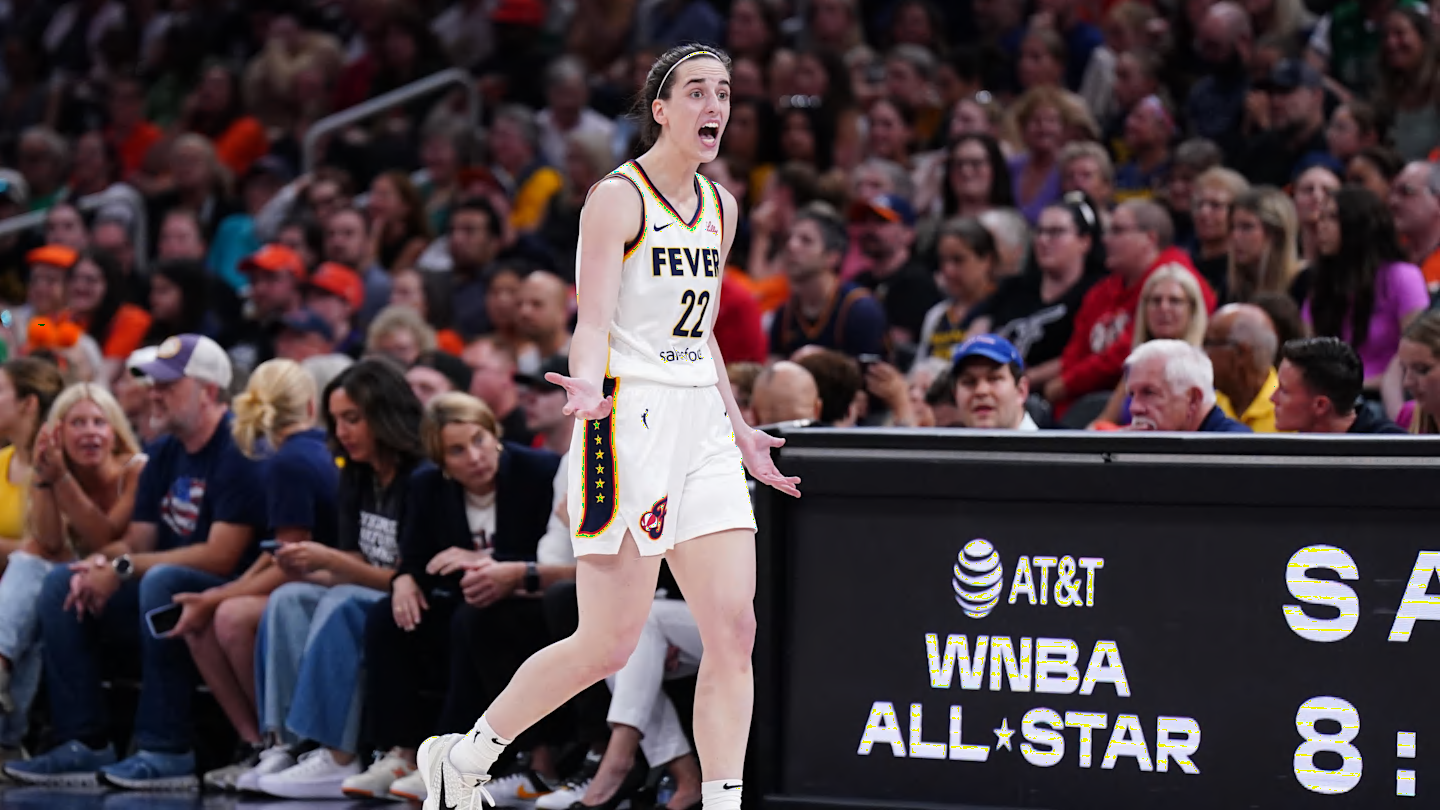
The WNBA and the WNBAPA have finally agreed to a new CBA, preventing a work stoppage and putting us on track to start the 2026 WNBA season on time. There’s a lot in the new CBA, but one of the more intriguing provisions is something called EPIC, or Exceptional Performance on Initial Contract. What is this new rule, and who benefits from it?
Bullet point summary by AI
The WNBA’s new CBA introduces the EPIC rule, allowing standout rookies to renegotiate contracts before their fourth season.Four young stars, including Caitlin Clark, are positioned to capitalize on this opportunity.This provision could reshape team strategies and player valuations as the league enters its 2026 season.What is the EPIC rule in the new WNBA CBA?
EPIC is pretty simple: players who are very good in their first three WNBA seasons now have the ability to renegotiate their deals before their fourth season.
A player named to the All-WNBA first or second team in one of her first three seasons is now eligible for a max extension before their fourth season. A player who wins MVP in one of her first three seasons is eligible for a supermax extension.
It’s a rule that won’t necessarily come into play often, but it does provide star players with a chance to get paid sooner. From a team perspective, it also gives teams a chance to guarantee three more seasons of a young star player via the extension.
So, who is — or could be — eligible for the EPIC extension?
Caitlin Clark
Indiana Fever guard Caitlin Clark | Stephen R. Sylvanie-Imagn Images
We start with a player who has already qualified for the max extension part of EPIC, but who still has one chance to win MVP and earn a supermax.
Clark earned an All-WNBA First Team nod in 2024 as a rookie, the only rookie to make either team that year. She’ll have to play 2026 under her rookie deal — albeit a rookie deal that will pay significantly more than her old one under the new CBA.
Salary
Under Old CBA
$85,873
Under New CBA
$530,000
Can Clark win MVP this season to earn the supermax extension? We’ll see, but her numbers were down significantly during the 13 games she played in 2025, though injury played a key role in that. Clark can’t shoot 36.7 percent from the floor and expect to win the award, though. We need to see a rise in efficiency, and we need to see the Fever competing for a top…let’s say, No. 3 seed in the playoffs?
Even then, Clark runs into an issue where she might be splitting the backcourt with Kelsey Mitchell, who still has high enough usage to take away from Clark’s stats a bit. Still, Clark is at least eligible for the normal max extension for 2027.
Paige Bueckers
Dallas Wings guard Paige Bueckers | Jerome Miron-Imagn Images
It won’t be until 2028 that Paige Bueckers is eligible to sign a max extension, but thanks to her All-WNBA Second Team nod as a rookie, she’s already earned her eligibility for it.
That gives Bueckers two more seasons to go after the MVP award if she wants to earn the supermax, which…won’t be easy. In addition to Clark potentially being competition, A’ja Wilson and Napheesa Collier are still at the height of their power, plus there’s team context to consider.
Only one player has ever won MVP while playing for a team that missed the postseason: Lauren Jackson, who won in 2003 on an 18-16 Storm team that finished just outside the postseason picture. Compare that to Bueckers’ Dallas Wings, who went 10-34 in her rookie season and have finished over .500 just once over the past 10 seasons. It’s possible that the Wings figure something out over the next couple of years and are able to add an impact player at the top of the 2026 WNBA Draft while also making smart free agency moves, but I wouldn’t necessarily bet on that.
Aliyah Boston
Indiana Fever forward Aliyah Boston | Trevor Ruszkowski-Imagn Images
Aliyah Boston is actually the first player who this provision can benefit, as she is entering her fourth WNBA season and was named All-WNBA Second Team last season.
There was a lot of pontificating early in the Boston-Clark era that the two weren’t a great fit together. I never bought into that concern. Clark played with traditional post bigs at Iowa, and it worked out — the 2022-23 Hawkeyes with Clark and Monika Czinano stand out as a strong example of how that kind of pairing can work.
And with Boston coming off her best WNBA season, why wouldn’t the Fever look to keep her around? You don’t luck into a roster featuring multiple young, ascending stars often, and as the league continues to grow and expand, it will become more and more difficult to acquire young talent. The Fever need to make a long-term commitment here.
Angel Reese
Chicago Sky forward Angel Reese | Kamil Krzaczynski-Imagn Images
Angel Reese is not yet eligible for a max extension, but of all the players who aren’t eligible, Reese has the best shot to get there.
Sure, she’s heading into her third WNBA season so she would need to make an All-WNBA team this year, but Reese is a two-time All-Star who averaged 14.7 points and 12.6 rebounds last year. She’s on the cusp of playing at that All-WNBA level.
And she also took pretty big strides last year to fix her biggest issue: efficiency.
Season
Field Goal Percentage
2024
39.1
2025
45.8
Reese still struggles to finish at the rim in a way that a big really, really shouldn’t struggle at, but improvement is happening. As a rookie, she shot 49.8 percent in the 0-3 foot range. Last year, that was up to 52.2 percent. I’m not saying she needs to shoot 65 percent at the rim, but if she could up that close to 60 percent, I think the increased efficiency would change the way a lot of people view Reese, giving her a viable shot to earn one of those All-WNBA spots and qualifying her for a max extension next season.
More WNBA news and analysis: