
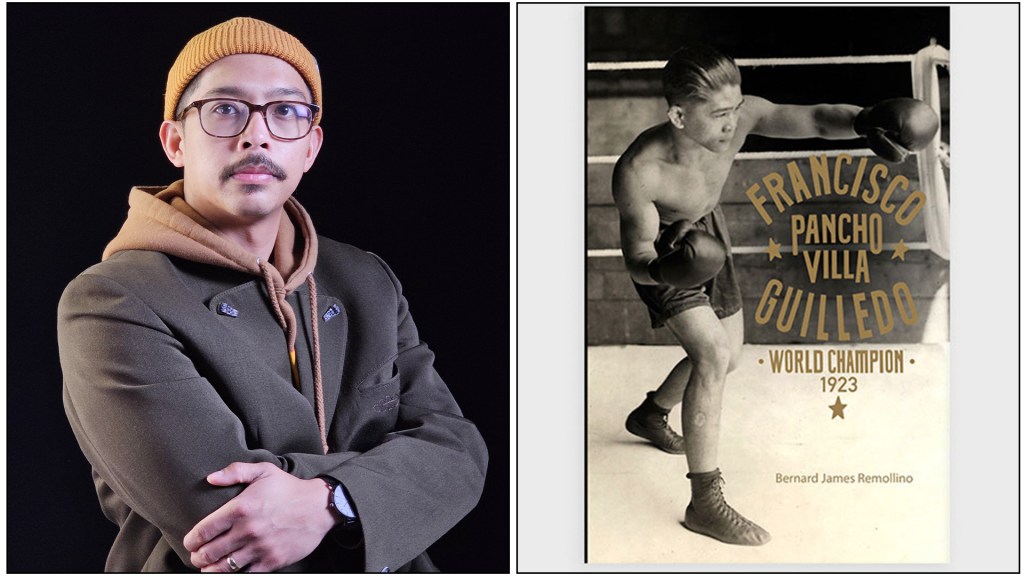
At first glance, you’d think it’s a book about boxing.
“The book opens up and the first sentence is, ‘This is not a boxing book,’” says Bernard James Remollino. “The second sentence is, ‘This is a history of resistance to U.S. imperialism mediated through the cultural industry of boxing in the Philippines.’ That is the sort of crux of things.”
Remollino is an associate professor of Asian American and Pacific American history at San Joaquin Delta College in Stockton, and the author of “Pancho Villa: World Champion, 1923,” about Filipino boxer Francisco “Pancho Villa” Guilledo, the first Asian flyweight world champion. The book is a collaboration between Remollino and Joe Aquilizan, founder of Bayani Art and Bayani Books, which published the story; and Remollino will be among the guests for a book talk and community gathering from 11 a.m. to 3 p.m. Saturday at the Skyline Hills Library. The event includes a performance by the artist Power Struggle, a screening of a documentary based on Pancho Villa by Kapwa Kollective, a discussion led by Kirin Macapugay, historical artifacts from the Bayani Art private collection, and light Filipino refreshments, according to the library.
Guilledo started as a smaller mention in Remollino’s dissertation work on working-class Filipino American boxers during the 1920s and ‘30s. He had long been interested in the ways Filipino boxers and fans of boxing were positioned in relation to the kind of organizing that was emerging during that time. He had found that many of the boxers weren’t really making much money, so they were working in fields and canneries while bringing their cultural sensibilities and relationships to a long history and tradition of resistance and fighting. Remollino was looking at the movement building and the political consciousness that emerged through engaging with popular culture, and he found that so many Filipino boxers, newspapers, fans, and sources outside of the Filipino American community all referenced Guilledo as a model of excellence and inspiration. (This interview has been edited for length and clarity. )
Q: Can you give us a little background on Francisco Guilledo? Where he was born and raised, how he grew up, and how he got started in boxing?
A: Francisco Guilledo is born on Aug. 1, 1901 in (Illiolo, in the Philippines). The Philippines had been colonized by the Spanish, and at the beginning of the 20th century, around 1898, we see control of the Philippine government shift hands into control by the United States under the presidency of William McKinley, and that relationship kind of persists to the present day. Francisco was born in the midst of the Philippine-American war. It’s this moment where the United States is kind of utilizing the Philippines as this laboratory for a lot of its military, policing, incarceration policies. An extension of the kind of settler-colonial conquest of the American West, and the dispossessions of indigenous people that have been practiced for a century or so. That comes to the Philippines in the form of war, as well as through the invocation, or establishment, of American-style modes of government and education that place Filipinos along this racial hierarchy, identifying them as these inferiors that need to be taught how to govern themselves. This policy was called “benevolent assimilation” and it was anything but. There was so much violence and death and dispossession, and Francisco was sort of born in the midst of that.
He is one of several children of rural Filipinos, who, over the course of him growing up, is very much in the shadow of an emergent U.S. empire, an emergent sort of U.S. hegemony building in the Pacific. He’s born to a single mother on an old, Spanish hacienda. He works as a goat herder for a little bit, and when he’s a teenager, like many other young Filipino boys and men, and women, moves to the cities to try to get wage work. The Philippines is under U.S. control, is rapidly industrializing, and that industrialization, just like it did in the U.S., caused a lot of upheaval in the rural areas. It forced a lot of people off of their lands, and Francisco and the folks around him were no different. So, he makes his way to Manila and, at some point, he links up with a friend and kind of learns boxing on the road. At some point, he arrives in Manila when he’s 17, from this place called Pondo. Historically, it was this space for revolutionary organizing against the Spanish empire, against Spanish colonizers, who had been in control and possession of most of the Philippines for over 300 years. So, Pondo is this place of resistance and it was sort of one of the birthplaces of the revolution; and the United States recognized that. It used to be its own municipality, but it’s strategically, deliberately starved of resources and incorporated into the city of Manila as a means of control. It becomes infamous for kind of being this slum sort of area. Because of the combination of cheaper lodging and rent, the lack of resources and things like that, it attracted many of the rural population who were coming to the cities. Part of what emerges there as a kind of money-making venture, are boxing gyms, among other things.
Boxing was framed by the United States as this “means of taking the Filipino out from the savagery of the cock fighting ring and teaching them these values of thrift, of abstinence,” according to one of the sources. These kind of Victorian values that would set them up for self-government, but it was a means of control. Boxing was introduced, in the Philippine context, first through Black soldiers who were serving with the U.S. armed forces, who were fighting in the Philippine-American war. Upon recognizing that the American policies toward Filipinos were very similar to the racially violent policies targeting African Americans, a lot of these Black soldiers deserted the American ranks and joined up with the Filipino fighters during the Philippine-American War. There’s archeological evidence of boxing gloves being at these sites where it was known that Black soldiers and Filipinos were sort of co-conspiring, that lends some feeling of truth to that. It was this reflection of the shared stakes and the shared struggles, even in that early context.
At some point, with the United States starting to establish more dominance in the Philippine government, economics, and society, we also see representatives of the YMCA establishing, among other things, a vibrant boxing industry in the Philippines. So, that’s the context by which people like Guilledo are sort of engaging with boxing. Francisco works odd jobs around Manila, and also works as a sparring partner for up-and-coming Filipino boxers. It’s at this point, as a sparring partner, that there’s this account at the gym of this guy, Pacquito Villa. The account is that Francisco is fighting Elino Flores, who’s a friend and sparring partner, but who is a couple weight classes above Francisco in this sparring match. Francisco lands a clean right and knocks him down, which is impressive because Francisco is all of 5-feet, 5-foot-1. This sparks an idea in Pacquito Villa and Franck Churchill, who is the White manager of several YMCAs in the Philippines and a promoter, to market Francisco and other Filipino fighters to American audiences, especially that Filipino fighters can fight and be used for profit. As a way to secure those winnings, Pacquito Villa actually adopts Francisco and, by virtue of that adoption, he and Frank Churchill give him the name, “Pancho Villa.” It’s timely because around 1917, 1918, Pancho Villa, the Mexican revolutionary, is very much looming large in the public consciousness.
Q: Why did he take on the name “Pancho Villa” and what was the significance in relation to Filipino history and culture?
A: At the end of the day, it’s kind of a strategic marketing decision. It was a means for promoters to create a clear association of this Filipino fighter and the characteristics that they could expect of him in the ring. Pancho Villa, the Mexican revolutionary, was labeled as a terrorist and this freedom fighter who’s characterized as this elusive fighter, this person that could outmaneuver American forces. Narrative-wise, it made sense to promoters to create this mythos around Francisco Guilledo, so that was the main significance. What it ended up doing is it started to link all of these struggles and experiences of resistance of non-White entities, nations, and communities to the consciousness of boxing. You have this link to Black political and racial consciousness and resistance, you have this link to a long history of indigenous dispossession that is kind of coming up in the Philippines, and now you have this link to the experiences of people of Mexican descent and Mexican-Americans in relation to the United States and its imperial ambitions. Guilledo’s image, in many ways, was kind of meant to show him as fast and elusive, like Pancho Villa, the dude that’s giving the U.S. trouble in Mexico. Really, what this demonstrated was this deeper possibility for creating these associations by the fans, the folks who were watching him. It was definitely, I would argue, an unintended effect of this naming that we, as historians with some hindsight, can now think about what it might have meant. I really think that for folks like these boxing promoters, the folks who have the most power in the structure were White men and they were trying to figure out how to stoke the most emotion from people, knowing that these were primarily White audiences. It created a means of making legible through the White gaze in the United States, who Filipinos might have been in boxing, first. Then, it also created this easy association to a villain you wanted to root against, this guy who was fighting these White fighters because he represented the folks who were causing mayhem and chaos to U.S. forces. The idea that it could be turned on its head by the fans and become this kind of rallying point, an empowering point? Folks in power, folks that play to hegemony, rarely have that kind of consciousness.
Q: In the description of your book, it says of Guilledo’s win that, “This historic triumph not only ignited the Great Filipino Boxing Era but also emboldened a nation facing the violence of U.S. imperialism.” That brought to mind a lot of the research and discourse on the connection between sports and nationalism; first, can you talk a little bit about some of the history between the Philippines and the U.S., specifically the circumstances of the 1920s in which the Philippines was only about 20 years removed from the Philippine-American War?
A: The Philippine-American War comes off of the Spanish-American conflict, and becomes a means of the United States to establish a presence in the Pacific. What ends up happening is in order to justify keeping the Philippines as a strategic outpost in the Pacific, it has to kind of formulate this justification for saying, ‘We have to kind of keep in the Philippines in order to teach Filipinos the values of democracy. We need to teach them there is this emphasis on manliness and civilization,’ that was the language that was kind of utilized in the period. There’s this notion that the Philippines, at some point, will be granted its independence when it has proven to the United States that it can self-govern in utilizing the values of Christianity, which was kind of a wild sort of thing to frame because, through colonization with the Spanish, much of the Philippine population had been forcibly converted to Catholicism. Also, because of the economic and social and political upheaval in the Philippines, Filipinos are kind of enticed, coerced, to work for U.S. companies and U.S. industries in Hawaii and in the mainland United States. Up through the 1930s, Filipinos become this new labor force from Asia that, because of their colonial status as U.S. nationals, they are able to circumvent a lot of the anti-Asian immigration laws of the time, so we see a large and visible population of mostly young, unattached Filipino men, coming to the continental United States and Hawaii and working in agricultural industries, working canneries in Alaska, service work in American cities. This starts to kind of engage the racial animus of the 1920s and the 1930s. It’s a continuation of these U.S. racial logics of exclusion that are, in the case of Asian American experiences, tinged with Orientalism. There is very real imminent and direct violence toward Filipinos, Filipino bodies. As a way to create modes of protection to safeguard Filipino workers, you also see the emergence of Little Manila and Manilatowns mostly throughout the West Coast.
In the 1930s, Congress passes the Tydings-McDuffie Act, which creates this timeline to Philippine independence; not because the United States thought it was ready for independence, but because creating this timeline would no longer make Filipinos U.S. nationals under U.S. immigration law. So, they could be legally excluded from the United States through those anti-Asian restrictions. That brought Filipino migration down to a trickle. There was also the Filipino Repatriation Act that incentivized Filipinos to self deport. This is sort of the general relationship that the United States was having with Filipinos in the Philippines and Hawaii and the continent. So, the 1920s and 1930s establishes the critical infrastructures and policies that would dictate much of Filipino and Filipino American migration, Filipino American lives, the Filipino diaspora and how it navigates space in Hawaii and the continent, its relationship to the Philippines-this is the kind of moment that Francisco and other boxers find themselves in.
Q: A 2017 article in the International Journal of Sociology (“Sports and Nationalism in a Globalized World”) talks about how “sports become central symbols in modern societies’ nationalism, by producing and, perhaps most important, activating the stories about who we are as members of countries” and how “being proud of national athletes’ successes…represents an experience contributing to, and activating feelings of, sameness among the people of specific countries…” How do you see this win by Guilledo during that time affecting the response of people in the Philippines to U.S. imperialistic violence? What does him winning a boxing championship have to do with this national struggle for independence?
A: Francisco wins the championship in June of 1923 and kind of shocks the world. The footage is replayed for weeks after. These replays are being broadcast and the radio technology made it so that people in the Philippines could listen to this fight live. It was sort of this momentous occasion and upon Francisco winning, there’s this two-day parade in Manila and the Filipino American and Filipino world is turning. The boxing world, in general, is also kind of identifying this as a watershed moment, in many ways. What this does is, I think it creates a visible kind of demonstration of the possibilities for victory against the violence of U.S. imperialism, against the kind of perceived hegemony and dominance of U.S. control and power, both in the Philippines and the U.S. government’s perceived control over Filipino American bodies in the continent and in Hawaii. It represents, more than anything, a means of Filipinos in the Philippines and in the diaspora being able to anchor these anxieties, these hopes for freedom, for independence, for liberation, into this example. The way that I think about it, as well, is that boxing offered this very straightforward way of seeing a contest of racialized bodies, in a similar way that Jack Johnson did just two decades earlier and what that meant for the general popular imaginations for African Americans. I think that Francisco’s example was kind of being mobilized in very similar ways.
After Francisco wins his championship fight, there is a proliferation of people, Filipinos in the United States and in the Philippines, who are boxing, who are engaging with boxing tournaments, who want to do amateur fights; not necessarily to become champions, but because there’s something in them, in their spirit, that is sort of ignited and bolstered in that respect. It allowed Filipinos to push back against a framing of themselves that the United States had sort of forced down their throats, to put it gently, on top of the economic and political domination that the United States attempted to establish through benevolent assimilation.
There’s also the work of Dean Worcester, the American anthropologist and zoologist who went to the Philippines and photographed peoples of the indigenous tribes of the Luzon region, the big northern most island of the archipelago. He put them in loin cloths, he made the women bare their chests so that he could see their tattoos, he took photos of them unclothed and then clothed them. It was like, ‘Hey, this is kind of our goal here in the Philippines, to turn these savages into these models of civility,’ or what have you. These images were sponsored by National Geographic and they toured the United States and Europe to show people that these were what Filipinos were, these savages, these dark-skinned, kind of small, diminutive creatures. It’s this really dehumanizing portrayal, and this is compounded at the St. Louis World’s Fair and the creation and sustaining of human zoos. These are people who are put on display and this is where the stereotype of Filipinos being dog eaters starts to kind of take hold because, as part of this display, Filipinos were forced to cook and eat dogs for the audiences. The cooking and eating of dogs was a ceremonial thing that only happened very, very rarely during special occasions, but the corruption of that made it so that the association was, ‘Oh, these folks are savages that would kill you just as soon as look at you.’ So, this was what Filipinos were told they were as part of the American education system in the Philippines, as well, and through the end of the Philippine-American War and onward. This was the language and framework that was taught to Filipinos by certified Filipino teachers. This is the feedback loop and Filipinos internalized what, in Filipino American psychological circles, is deemed a colonial mentality. This internalization made it so that it was easy to accept that they were what the Americans told them they were. Francisco’s victory allowed for an alternative possibility. It showed them that it was actually possible to fight back and to win against this kind of violence of Whiteness at the time. They might not have articulated it in that way, but definitely from the (historical) sources, you could tell that they were feeling some need to anchor their organizing and their resistance to a tangible model. I think that’s kind of why it was also important. And, the boxing industry was what it was. At the end of the day, this industry was rooted in making a profit and exploiting the labor of Filipino boxers.
Francisco was also this young man who earned money, who went out and engaged in the debauchery, the drinking, the womanizing, what is called the “conspicuous consumption” of one that has greater financial means. He also became this sort of celebrity at 20, 21, 22 years old and acted in those ways, as well, so I also don’t want to lionize the person. I want to make sure that we understand this as a historically contingent and contextual kind of moment that, for folks that were watching him, fellow boxers, were also able to see the potential in those victories and Francisco himself.
He gives credit to the fans for motivating him to keep fighting, and that’s kind of what led him to take on his last fight in July of 1925. He had an ulcerated tooth that he’d injured in training and, despite the insistence of his trainers and doctors to call off the fight, which was this 10-round, non-title fight in Emeryville, Calif., he says he didn’t want to disappoint the fans that came to see him. Indeed, people would come hundreds of miles for a chance to see this guy who meant so much to them. There was that relationship to the fandom and the stakes that were involved in showing up visibly for Filipinos and Filipino Americans in this moment of profound violence toward Filipinos in the United States and in the Philippines, and it was meaningful and impactful. He dies after this fight, of blood poisoning as a result of injuries sustained during this match, a few weeks shy of his 24th birthday. This sort of ignites this need to fill this gap. He’s considered to be, in many respects, the Great Brown Hope of the Filipinos. Several champions come up after him in the same weight class and different weight classes, but Francisco is kind of the model for that. This is one amongst a long lineage of fighters that, through the cultural politics of boxing, through the boxing industry, engaged in this dynamic of possibly troubling the expectations that the United States government placed on Filipino bodies and Filipino histories and Filipino American experiences. In those little ways, it allowed for a reorienting of how Filipinos talked about themselves; there was a little bit more hope, maybe a little bit more confidence, maybe a little bit more in the possibilities for how one might bring these inspiring experiences of watching a Filipino fighter win, into labor organizing and into community building efforts. None of these are isolated. As much as we might be tempted to put these things into silos, all of these are interconnected, all of these are weaving and informing each other. In that respect, it creates this community, this national identity, this feeling of oneness or sameness or connection. It also helps lay bare some of the limitations of nationalism.