
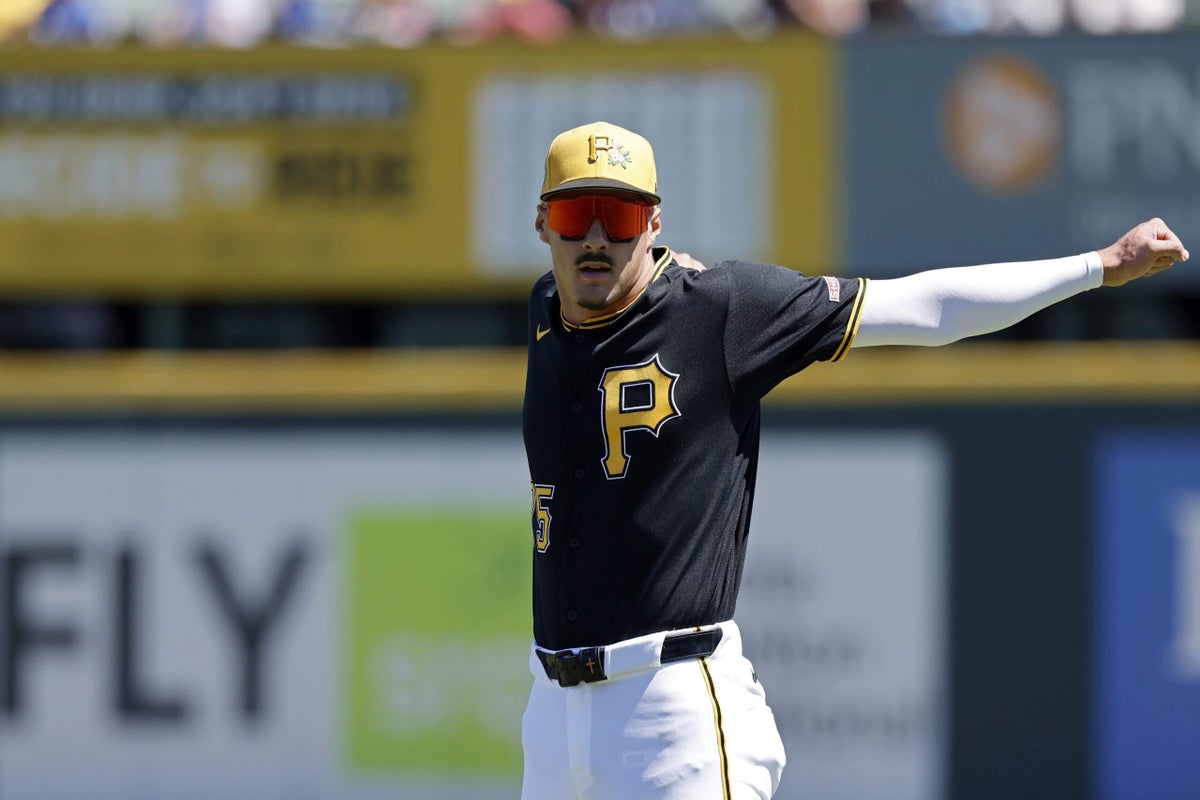
Every team will tell you that the projection models on Pittsburgh Pirates prospect Konnor Griffin are off the charts.
One rival club’s model, taking into account age, service time, positional value and other factors, ranks Griffin’s surplus value the highest of any position player and Pirates teammate Paul Skenes’ the highest of any pitcher. That same club already views Griffin as a top shortstop, even though he has yet to play an inning in the majors.
So why aren’t the Pirates including the 19-year-old prodigy on their Opening Day roster?
The cynical answer is, “He didn’t sign a contract extension.” And that likely is part of it. But Griffin also has only 98 at-bats above Class A. His offensive approach in spring training showed a need for further refinement. The Pirates could reasonably conclude that he is not yet ready to fulfill the models’ expectations, and will benefit from development time at Triple A.
Thus, while few would be surprised if the Pirates dangled a spot on their Opening Day roster as a carrot for Griffin to sign an extension, the question of whether Griffin should start the season in the majors is more nuanced. And the timing of a possible extension presents another complication.
If an extension was close, the Pirates would delay any announcement until after Griffin’s major-league debut, preserving their right to a Prospect Promotion Incentive (PPI) draft pick if he won Rookie of the Year. The talks, however, have not reached an advanced stage, according to people briefed on the discussions.
Griffin still can attain a full year of service and thus become PPI eligible if the Pirates promote him by April 9. The deadline, two and a half weeks away, should motivate the Pirates to increase their $100 million-plus offer to Griffin and complete the extension. And their heightened urgency to compete, demonstrated by their unusually active offseason, should compel them to get Griffin to the majors as quickly as possible.
The risk for the Pirates in delaying Griffin’s arrival is not just harming the team’s performance. Presumably, the team wants to avoid the same self-defeating path it took with ace right-hander Paul Skenes.
Remember that double whammy?
By delaying Skenes’ debut in 2024 until May 11, the Pirates lost their chance to gain a PPI pick if Skenes won Rookie of the Year. And when Skenes captured the award, he gained a full year of service anyway, costing the Pirates a year of club control.
Griffin, who turns 20 on April 24, is about two years younger than Skenes was then. The ninth overall pick out of Jackson (Ms.) Preparatory School in 2024, he also did not reach pro ball the way Skenes did, with three years of college experience. Griffin also is a position player, not a pitcher, and hitting arguably is the most difficult skill to master in sports.
The PPI pick, which to this point has ranged from No. 26 to No. 32 overall, is especially valuable to a low-revenue franchise such as Pittsburgh. But in their handling of Skenes, the Pirates separated what they perceived as the player’s best interests from that of the club’s. And while waiting six weeks to promote Skenes cost them the pick and a year of service time, his Rookie of the Year and Cy Young awards make it difficult to argue they mishandled his development.
With Griffin, the team is proceeding with the same caution, and not without justification.
Four of Griffin’s seven hits in Grapefruit League play were homers, but overall he batted .171 in 46 plate appearances, with 13 strikeouts and just two walks. Spring-training numbers can be taken only so seriously, and Griffin’s .125 batting average on balls in play indicate he was partly the victim of poor luck. But he also finished in a 2-for-18, eight-strikeout rut.
Detroit Tigers shortstop Kevin McGonigle, the game’s No. 2 prospect behind Griffin, according to The Athletic’s Keith Law, has looked like the more polished hitter, entering Sunday with more walks than strikeouts and a .923 OPS. It’s not necessarily surprising that McGonigle seems more advanced. The 37th overall pick in 2023, he was drafted a year earlier than Griffin, and is almost two years older.
The Pirates, then, might argue that the additional development time for Griffin is more valuable than the pick they would receive if he won Rookie of the Year – and, as much as promise as Griffin holds, the award would not be a fait accompli.
The Boston Red Sox signed second baseman Kristian Campbell to an extension shortly after Opening Day last season to preserve his PPI status and never benefited. Campbell spent more than three months in the minors, was not listed on a single AL Rookie of the Year ballot and failed to make Boston’s Opening Day roster this year. From Mike Trout to Jackson Holliday, countless other top prospects failed to achieve immediate success.
The Pirates, by starting Griffin at Triple A, believe he might follow the same pattern he did last season at Class-A Bradenton, at the outset of his first professional campaign. Initially, Griffin showed some of the same deficiencies in his swing decisions and plate discipline that he demonstrated this spring. But he adjusted quickly, and eventually forced promotions to High A and Double A.
If Griffin tears up Triple A, the Pirates would be foolish to hold him down in the minors long enough to deny him an extra year of arbitration and delay his free agency by one season. And if the team signs him to an extension, it would lose the motivation to engage in such shenanigans. All of the service-time considerations would disappear.
The problem is, finding the right number for an extension might be a challenge. Griffin is a darling of the models in part because of his speed, baserunning and defensive skill. Those qualities, along with his vast offensive potential, make his long-term dollar value difficult to project.
One target for Griffin might be the eight-year, $130 million extension that the Red Sox awarded Roman Anthony last August, with escalators that can bring the total value of the deal to $230 million. By then, Anthony had nearly 200 plate appearances in the majors, and clearly was destined for stardom.
Perhaps Griffin would take something lower, but he is a shortstop and Anthony is a corner outfielder. No matter what economic system the league and union adopt in the next collective bargaining agreement, Griffin’s value as a free agent entering his age 26 or 27 season would be extreme.
First, though, he needs to get to the majors. Even if Griffin does not agree to an extension, the Pirates can wait on him only so long.