
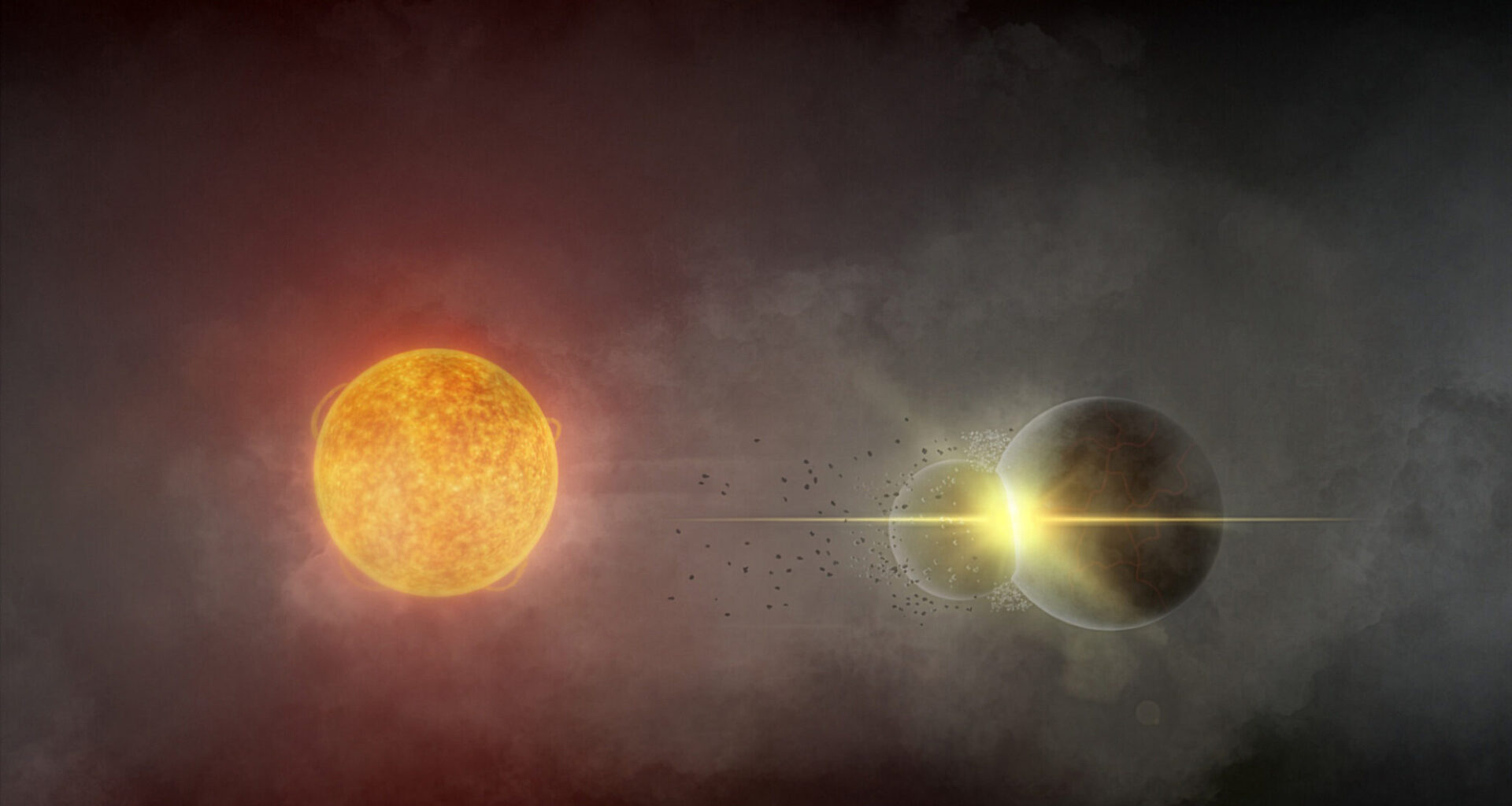
Planet formation is not a gentle process. In young star systems, growing worlds often collide, break apart, and come back together. Collisions in distant solar systems are common, but spotting one requires patience and luck. The planets need to pass directly in front of their star for the debris to dim its light, and that flicker occurs over several years.
In 2020, Anastasios (Andy) Tzanidakis, a doctoral candidate in astronomy at the University of Washington, was reviewing old telescope data when he noticed something unusual. A star called Gaia20ehk, about 11,000 light-years away near the constellation Puppis, was behaving strangely. Normally, as a stable ‘main sequence’ star like our sun, it should shine steadily. Instead, it began flickering wildly.
He said, “The star’s light output was nice and flat, but starting in 2016, it had these three dips in brightness. And then, right around 2021, it went completely bonkers. I can’t emphasize enough that stars like our sun don’t do that. So when we saw this one, we were like ‘Hello, what’s going on here?”
The flickering wasn’t caused by the star itself. Instead, massive amounts of rocks and dust were orbiting the system, blocking its light in patches. The likely source was extraordinary, a catastrophic collision between two planets.
“Incredibly, telescopes caught this impact in real time,” said Tzanidakis. “Only a handful of planetary collisions have ever been recorded, and none resemble so closely the one that formed Earth and the moon. Observing more events like this could reveal much about how our world came to be.”
Tzanidakis, who studies extreme changes in starlight, had previously identified a binary star system with a dust cloud that caused a seven-year eclipse. But Gaia20ehk posed a new puzzle. Its strange pattern, brief dips in brightness followed by chaos, had never been seen before. This debris, heated to nearly 900 degrees Kelvin, blocks the star’s light in patches while glowing brightly in infrared.
The breakthrough came when Davenport suggested checking infrared data. Unlike the visible light, which dimmed and flickered, the infrared light spiked.
“That means the material blocking the star is so hot it glows in infrared,” Tzanidakis explained.
Such heat points to a cataclysmic planetary collision, which could also explain the initial dips in light.
Tzanidakis explained that the flickering could be caused by two planets spiraling toward each other. At first, they grazed each other, producing little infrared energy. Then came the catastrophic collision, and the infrared light surged.
Clues suggest this impact is similar to the one that formed Earth and the moon 4.5 billion years ago. The dust cloud around Gaia20ehk orbits at about 1 astronomical unit, which is the same distance as Earth from the sun. Over time, that material could cool and solidify into a system like ours, though this process might take years or even millions. It weighs about 4 × 10²⁰ kilograms.
For now, the discovery highlights the need to find more collisions. The Vera C. Rubin Observatory’s upcoming survey could detect up to 100 new impacts in the next decade, helping scientists understand how planets, and potentially habitable worlds, form.
“How rare was the Earth–moon collision?” Davenport asked. “That’s a fundamental question for astrobiology. The moon may be one of the key ingredients that make Earth so good for life, from tides and weather to shielding us from asteroids. If we can catch more of these events, we’ll start to learn how common those dynamics really are.”
Journal Reference:
Anastasios Tzanidakis and James R. A. Davenport. Gaia-GIC-1: An Evolving Catastrophic Planetesimal Collision Candidate. The Astrophysical Journal Letters. DOI 10.3847/2041-8213/ae3ddc