
.jpeg)
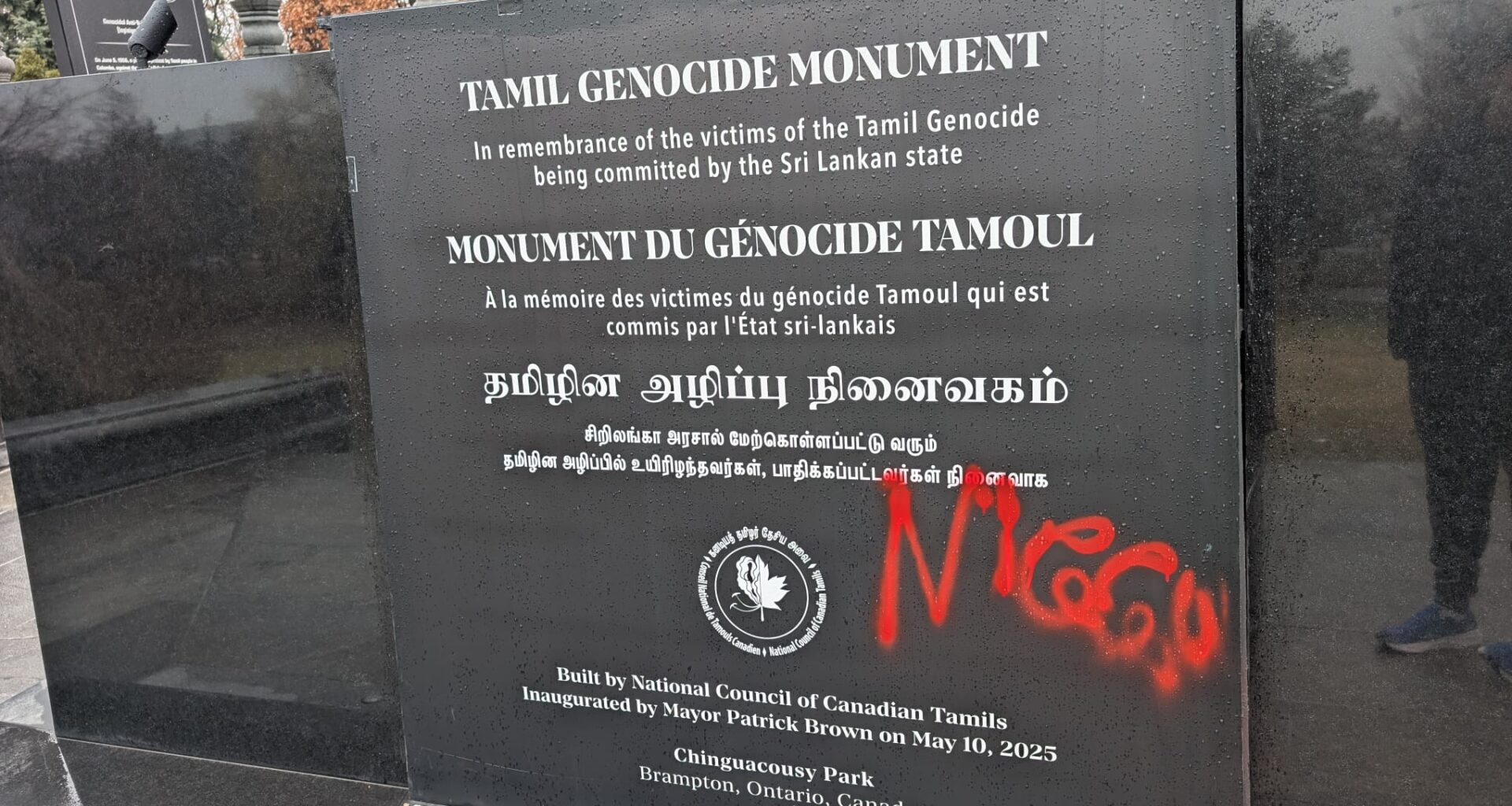
The Tamil Genocide Monument at Chinguacousy Park in Brampton was vandalised in the early hours of 20 March 2026, in the third such attack on the site since the monument was unveiled less than a year ago.
The main podium and three panels of the monument were tagged with graffiti, and two panels sustained minor damage. The vandalism was discovered by the City of Brampton’s Security Services staff early the following morning. Peel Regional Police has been notified.
The National Council of Canadian Tamils (NCCT), which holds ownership of the monument, condemned the attack in a statement dated 21 March 2026. “This act of vandalism is not an isolated incident but part of a broader pattern of Tamil Genocide denial and distortion,” the organisation said, adding that “such continuous and deliberate acts to target the Tamil Genocide Monument clearly suggest that the Tamil Genocide deniers are actively working to silence the victims of the Tamil Genocide.”
.jpeg)
The NCCT called on the Peel Regional Police and the City of Brampton to thoroughly investigate the incident using surveillance camera footage and other available evidence, and to ensure those responsible are held accountable.
This is the third attack on the monument since it was inaugurated in May 2025. Previous acts of vandalism took place on 27 May 2025 and 15 June 2025, when most of the lighting fixtures illuminating key elements of the memorial were destroyed on both occasions. Following an investigation involving surveillance footage after the second attack, Peel Regional Police arrested two suspects and charged them with mischief over $5,000.
The NCCT reassured the Tamil Canadian public that the primary structure of the monument remains intact and will continue to serve as a place of remembrance and education. “Despite these repeated acts, the Tamil Genocide Monument remains intact and will continue to stand as a powerful symbol of remembrance, resilience, and truth,” the organisation said. It also called on Canadians more broadly to “remain vigilant, informed, and united to combat Tamil Genocide denial and distortion” and urged Tamil Canadians specifically to report any acts of Sri Lankan foreign interference to local law enforcement.
.jpeg)
The attacks on the monument come as no surprise to those who tracked the fierce opposition the structure faced long before a single stone was laid. The Tamil Guardian revealed in 2024 that Sri Lanka’s government representative in Toronto had formally written to Brampton Mayor Patrick Brown in May of that year, demanding that the construction be halted. The letter claimed that the monument would “severely disrupt communal harmony” within Canada. Brown rejected the intervention outright. Brampton City Council had voted unanimously in favour of building the monument, and Brown said that Canadians would ensure it was constructed. When it was unveiled, he was characteristically direct: “The genocide deniers — you’re not welcome in Brampton, you’re not welcome in Canada, go back to Colombo.”
The Sri Lankan government, which strongly opposed the monument, summoned the Canadian High Commissioner in Colombo to convey its disapproval. When the monument was finally unveiled, the newly formed NPP government in Colombo issued a statement condemning it and denying that any genocide had taken place — demonstrating that the change of government in Sri Lanka had done nothing to alter its position on the Tamil genocide.
A group of Sinhalese Canadians also staged a protest at the construction site when the foundation stone was being laid, with protesters claiming the Brampton mayor was “destroying peaceful Sri Lanka.”
The monument itself was born directly out of Sri Lanka’s own destruction of Tamil memory. Its inspiration came after the Mullivaikkal memorial at Jaffna University, erected in 2019 to honour the Tamil lives lost in the genocide, was bulldozed by Sri Lankan authorities in January 2021. That act of destruction, which the Tamil Guardian documented in detail, provoked outrage across the Tamil homeland and among diaspora communities worldwide. Brown pledged to build a monument in Canada in response, stating: “Where they tear down a statue and they tear down history in Sri Lanka, we would do the opposite in Canada.”
The 4.8-metre stainless steel structure, which features an outline of the Tamil homeland and nine panels representing the nine districts of the North-East, details the acts of genocide perpetrated by the Sri Lankan state since 1948. Canada’s Parliament unanimously voted to recognise 18 May as Tamil Genocide Remembrance Day in 2022.
The NCCT was unequivocal in identifying the broader context behind the repeated attacks. “The Sri Lankan state has been perpetrating deliberate, aggressive, covert and overt foreign interference against the Tamil diaspora for years,” the organisation said in its statement. “Sri Lanka’s foreign interference in Canada attempts to undermine the advocacy efforts of Tamil Canadians.”
.jpeg)
.jpeg)