
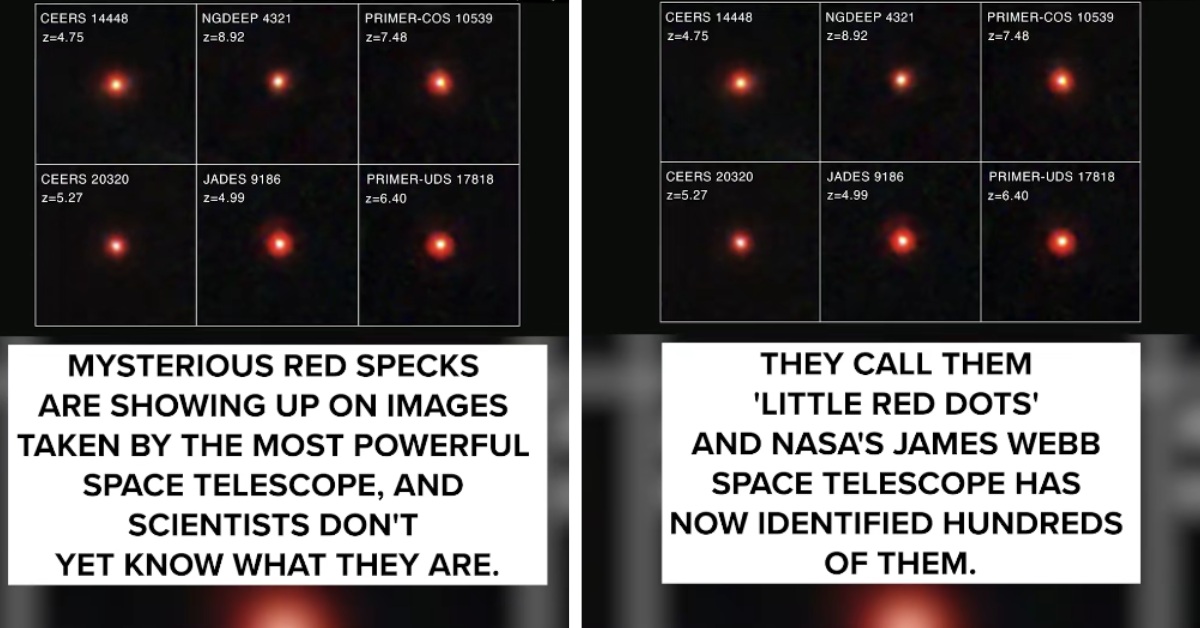
These little dots could be the start of something never seen before.

The vastness of space cannot be understated. According to experts, space is always expanding and creating new forms, some of which are so far away from we may never have known they existed. As such, there’s always something new to learn about space, and because the universe is still growing at a rapid rate, many times we don’t know what we’re seeing when we do find something new.
That’s the case with a discovery from the James Webb Space Telescope (JWST), which uncovered a series of red dots.
Article continues below advertisement
While the words “red dots” may not exactly blow your socks off when you learn that one of the world’s largest and strongest telescopes has photographed them, things do get slightly more exciting when you hear what people believe they might be.
That’s because these little dots could be the start of something never seen before — like the birth of a new galaxy, or even the start of a new black hole — and now the pros are in a race to figure out what they are, and what they could possibly mean.
 Source: Felix Wegerer/Unsplash
Article continues below advertisement
The James Webb Space Telescope has photographed little red dots.
The JWST has found a collection of little red dots, which Space.com says are a literal blast from our past. According to the publication, the dots appear red due to their distance from the JWST, which tends to view wavelengths created at great distances as a deeper red.
Essentially, what the telescope is viewing is something that happened very far and very long ago, likely in its earliest days of development. Initial speculation had people convinced that these were powered by black holes.
Experts believed that they were consuming all of the matter in their path, growing bigger by the minute.
However, after more researchers looked at the dots a new picture began to appear. Mainly because they didn’t seem to have the same properties that other black holes have had in the past. Instead, a new round of experts believe that they are “globular clusters” which are creating their glow due to a stellar population forming new structures, which includes a Supermassive Star.
Article continues below advertisement
JWST is always causing problems… Meet the little red dots: a new class of galaxies that shouldn’t exist. Too bright, too massive, too common for the early universe. Turns out, they’re hiding supermassive black holes that are growing at ridiculous speeds. Some are as massive as all the stars in their galaxy! 😳 Problem solved? Not quite. These galaxies disappear after 1.5 billion years, and their black holes aren’t glowing in X-rays like we’d expect. What’s going on?! 🕵️♀️ JWST is answering big questions… but leaving us with even bigger ones. I dive deeper into this and more of JWST’s latest discoveries in my new video on my Dr Kirsten Banks YT channel! 🚀📺 JWST Space BlackHoles Galaxies Universe Mystery
♬ original sound – Dr Kirsten Banks – Dr Kirsten Banks
Determining exactly what the dots are will require a lot more work, like detecting certain known chemical patterns from mature globular clusters that would include things like enhanced helium and nitrogen levels, confirming the theory.
Also, researchers will need to see at what temperatures these little red dots operate, since they already know what temperature ranges stars are known to operate at.
Article continues below advertisement
What does the discovery of these little red dots actually mean?
In the grand scheme of things, discovering a possible collection of black holes or a possible birth of new globular structures may not seem super important, but Space.com says that if the dots can be confirmed to be the ladder, it will give researchers a look into what the beginning of the formation of the universe entailed.
LiveScience says that may mean that the dots date back to the first 2 billion years of the universe’s life span, meaning it could tell them how the first stars were born.