
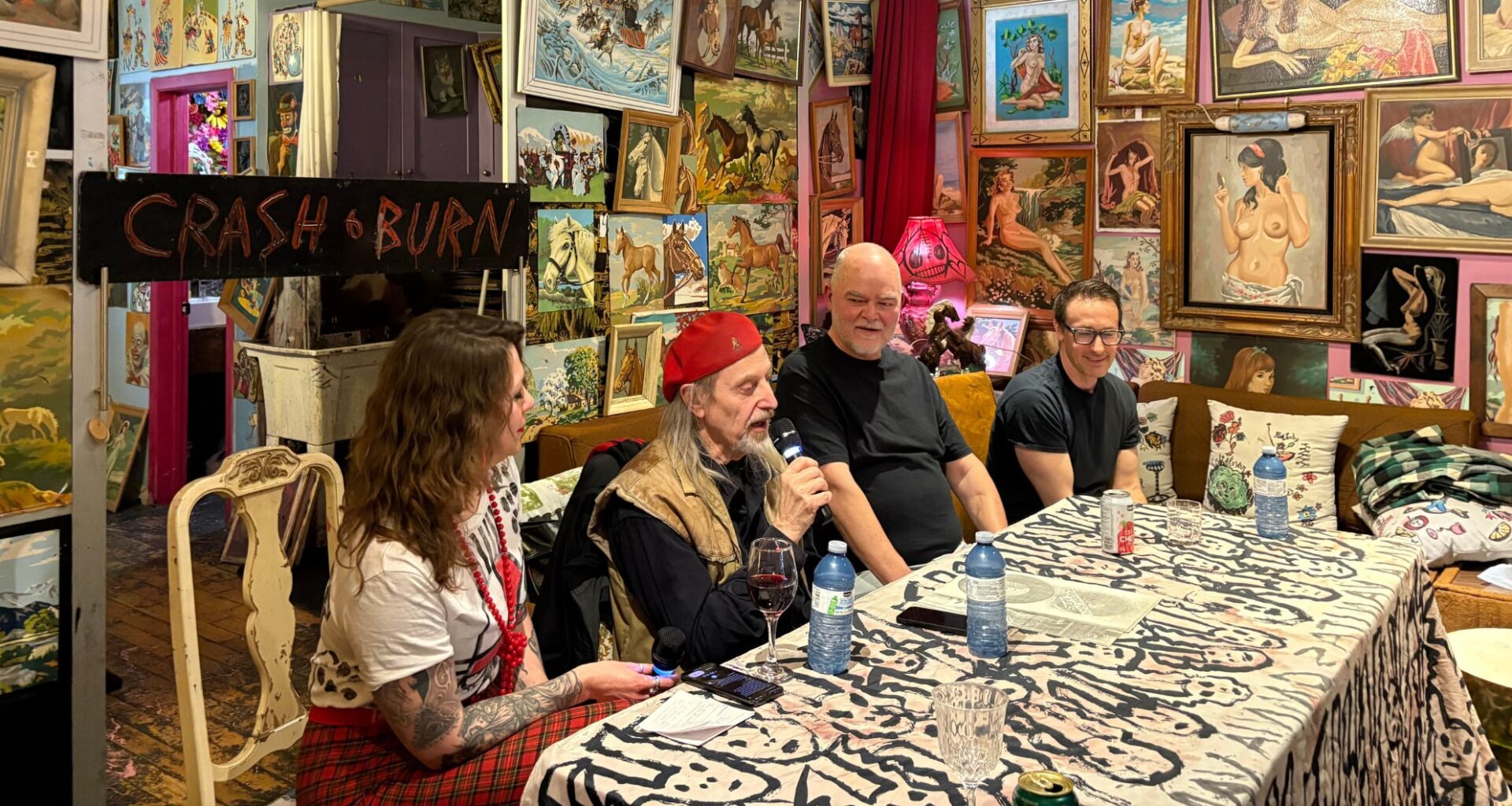
The latest Punk Talks panel was held at the whimsical DIY fashion and art space Peach Berserk Sunday afternoon in Parkdale, featuring three OGs reminiscing about Toronto’s late-70s punk scene and founding bands such as Viletones, The Ugly, The Curse, The Diodes, and The B-Girls.
Put together and moderated by Liz Worth, author of 2009’s Treat Me Like Dirt: An Oral History of Punk in Toronto and Beyond, 1977-1981, the sold-out event kicked off with a screening of the 15-minutes film An Afternoon With The Viletones At New Rose, by Suzanne Naughton, who passed away in February, and concluded with a punk-themed silkscreen workshop with Peach Berserk owner Kingi Carpenter.
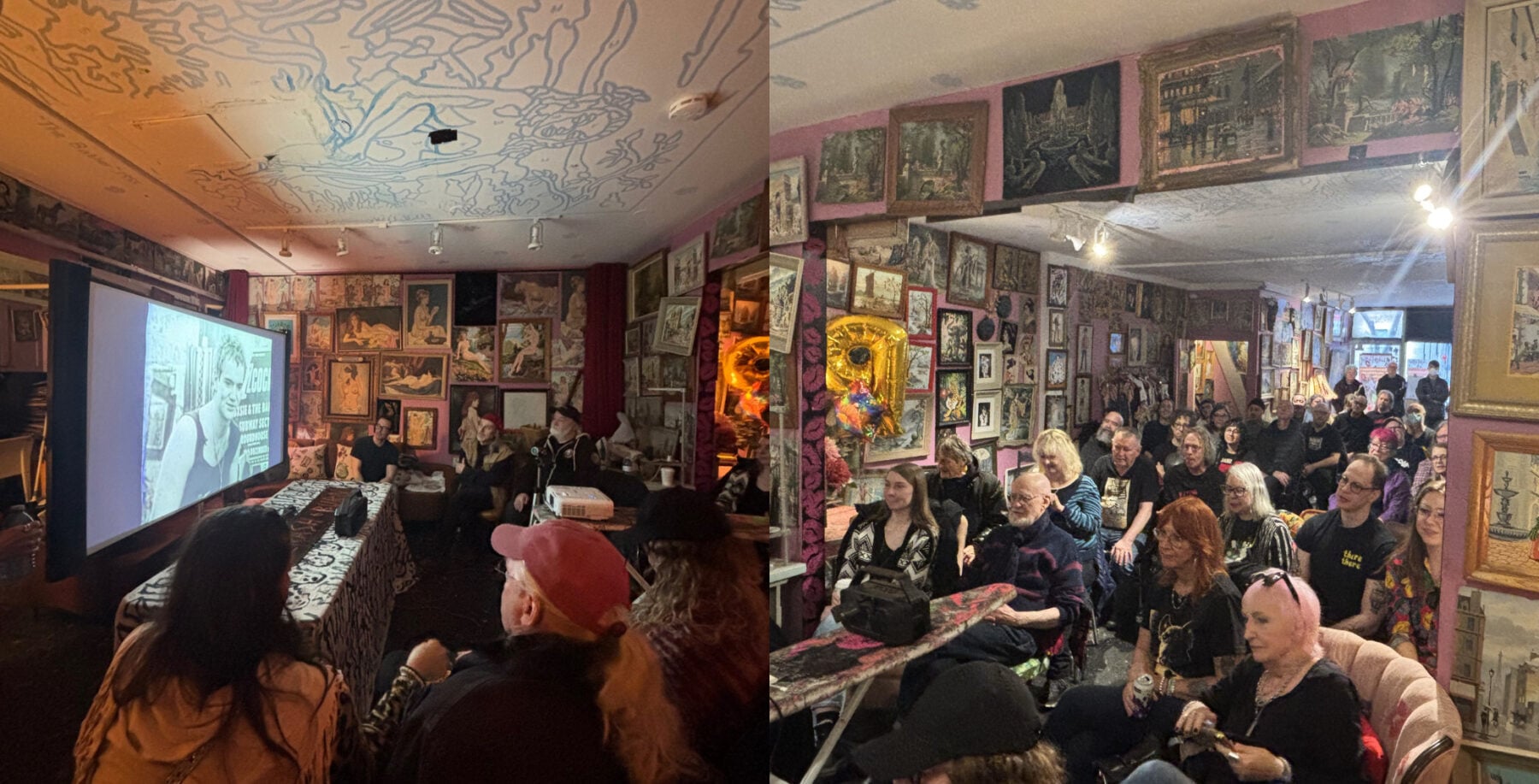 Punk Talks began with a screening of the 15-minutes film, An Afternoon With The Viletones At New Rose, by Suzanne Naughton. (Courtesy: Andrew Robertson)
Panelists were Montreal-based Ralph Alfonso, founder of Toronto’s first punk venue, Crash ‘N Burn, who also managed The Diodes; Don Pyle, photographer and author of Trouble in the Camera Club: A Photographic Narrative of Toronto’s Punk History, 1976–1980, and former member of bands Crash Kills Five and Shadowy Men on a Shadowy Planet; and director Kire Paputts (son of the Viletones’ bassist), who worked with Colin Brunton on 2013’s The Last Pogo Jumps Again about the Toronto punk scene in 1976-1978.
“The common theme today with everybody who’s here on the panel is that they have all played a role in documenting Toronto punk history. And so that’s going to be a big focus of what we’re talking about today,” said Worth.
Her first question was if they knew at the time that we would still be talking about Toronto punk 50 years later?
“No. I think everybody thought it was probably a phase or temporary lifestyle adjustment they were going through,” said Alfonso. “Although, at the time I was a rock writer as well, so I was documenting it for various publications like New York Rocker and there was a magazine here called Cheap Thrills. So, I kind of knew there would be documentation of it, but I didn’t think we’d be here to a packed place talking about people sadly no longer with us.”
Added Pyle: “I never even thought about it being something that people would talk about in the future. I never really thought about the future,” he admitted. “But, at the moment that it was happening, what is considered to be punk — beginning in Toronto is 1976 when the Ramones came here — I was 14 years old, and, to me, it felt like a revolution happening.
“So, this felt like it was a radical new thing and was a really exciting time to enter into going to shows. But, I didn’t think that people would be talking about it 50 years later because I felt like as an ideal that it burned out really quickly and by 1978, to me it was kind of over and whatever came after that was the ripple effect of that in so many splintered ways… and it’s still happening today.”
There are still a few tickets available for the last Punk Talks: Post-Punk and Toronto’s Queen Street West Scene, on April 26. Tickets are just $12.19 on Eventbrite and include a silk-screening workshop and refreshments.
“Learn about punk’s roots in art, counterculture, and more, and how the punk movement shaped Queen Street West and Toronto’s underground art scenes from the 1970s-1980s and onward,” reads the description.
The panelists are:
John Borra, solo artist and prominent figure in Toronto’s post-punk scene. In the 1980s and early 90s, he was a member of A Neon Rome, Groovy Religion, and Change Of Heart. He also played with the Viletones, Cheetah Chrome (Dead Boys), and more.
Kingi Carpenter has been a fixture of Queen Street West since the 1980s. She credits punk as a major influence on her work in fashion and silk screening. Even though Queen West has changed dramatically since Peach Berserk started, she is keeping its original spirit alive.
Bruce Eves was assistant-programming director at the Centre for Experimental Art and Communication (CEAC) in the 1970s; in the 1980s, he was the co-founder of the International Gay History Archive. Eves has since expanded his work to include spoken-word projects at the Black Eagle’s Dirty Queer Poetry Nights.
Nick Smash, author of Alone and Gone: The Story of Toronto’s Post-Punk Underground, has deep roots documenting punk history thanks to his fanzine Smash It Up, which captured Toronto’s emerging hardcore and new wave scenes. He was also drummer for the Toronto post-punk band the Rent Boys.