
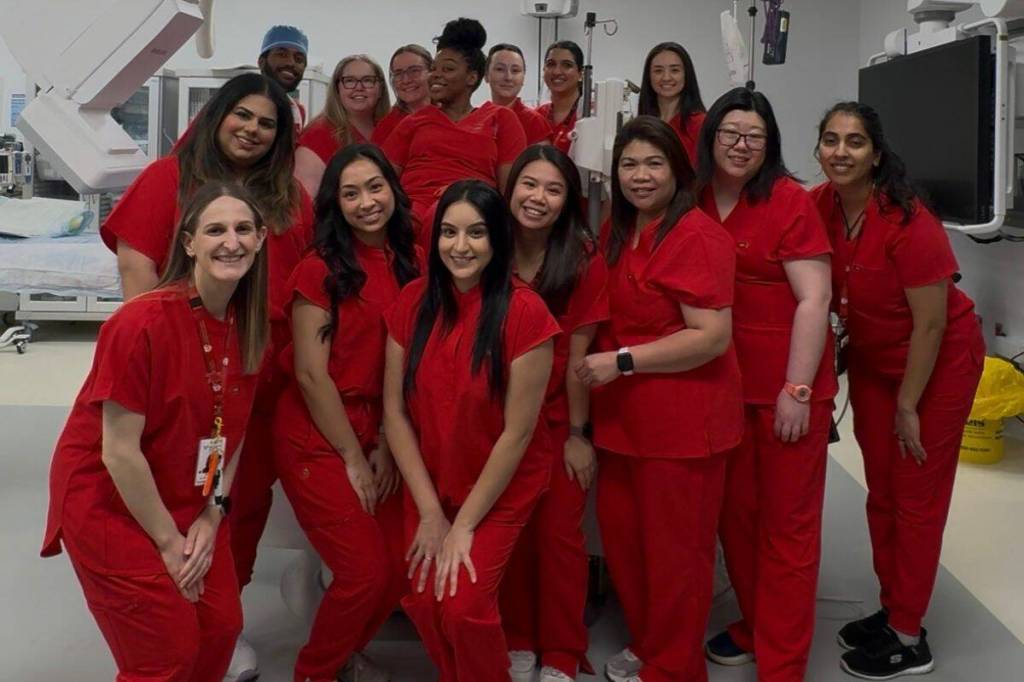
Surrey Memorial Hospital’s cardiac catheterization lab opened in December, and it is already making a world of difference for residents to have this procedure so close to home, said interventional cardiologist Dr. Alexandra Bastiany.
The new cardiac catheterization suites are the first of their kind south of the Fraser. Before they opened, if a patient needed a cardiac procedure such as angioplasty, diagnostic angiography, or invasive coronary imaging, they would have to travel to Royal Columbian Hospital in New Westminster or to hospitals in Vancouver. These patients can now be diagnosed and treated at Surrey Memorial Hospital. To date, the team has done around 400 cases.
The overall feedback Dr. Bastiany has received from patients has been really positive.
“I’m extremely proud and happy to be part of this program. It’s honestly a unique opportunity to showcase my expertise, but also to be part of such a thing. It’s so much bigger than me,” she said.
Although those with an acute heart attack will still have to travel to New Westminster for treatment, the plan is to eventually be able to treat them at Surrey Memorial.
A 2025 report from the Canadian Institute for Health Information found that chest pain is one of the most common reasons people visit the emergency room.
So it only makes sense for Surrey Memorial Hospital, which has one of the busiest emergency rooms in the country, to work towards having a “complete and well-rounded cardiac centre in Surrey,” Dr. Bastiany said.
She stressed the “golden hour” in treating heart attacks, noting that the sooner an artery is opened, the better.
So having the ability to do this at Surrey Memorial only makes sense.
“I do believe in my core that it will make a difference, and it makes a difference for patients who don’t have to travel to New West to get their procedure,” she said.
REPRESENTATION MATTERS IN HEALTH CARE
Dr. Bastiany had known since high school that she wanted to be a doctor, she says, as she loved science and the “working with people and the human interaction” that the job provides.
But her love for cardiology began in college, when she started studying anatomy.
“The goal of becoming an interventional cardiologist came later when I realized that I really wasn’t meant to be sitting in an office all day,” Dr. Bastiany said. “When I did my first rotation in interventional cardiology, it was love at first sight, and I was like, ‘This is what I need to do.’”
Dr. Bastiany is also the first Black interventional cardiologist at Surrey Memorial Hospital and is passionate about ensuring that all patients, especially Black, Indigenous, and people of colour (BIPOC), really feel seen, heard, and understood when receiving treatment at the hospital.
Often, when a person visits the hospital and does not see themselves represented among the health-care workers, it can cause some distress, Dr. Bastiany said.
“No one looks like you, no one understands your culture, no one understands where you’re coming from. So that’s definitely something that can be unnerving,” Dr. Bastiany said. “We have studies that have shown that whenever patients have a member of their of their medical team that can relate to them, already the level of stress is down, and they have a little bit more confidence in the care that they’re going to receive.”
This is especially important for Black and Indigenous people who “have been let down by the health system” across Canada and the United States.
“So having representation in the workforce is something that will benefit the patient, their faith in the system, and also it helps the other physicians and the other health-care workers learn about different cultures, learn about how to help patients from a different background,” she said.
Due to a lot of historical and internal biases, BIPOC people can often fall through the cracks of the health-care system.
For instance, data shows “that Black people and women are less likely to be referred to cardiac rehab,” Dr. Bastiany said. “For example, we know that women are less likely to have their symptoms identified when they show up for a coronary syndrome, either acute or chronic, and we know that Black people are less likely to be referred for a heart transplant.”
Dr. Bastiany and her team at Surrey Memorial are working to change this.
“My goal is to make sure that anytime I have an encounter with a patient from a visible minority, they feel comfortable, that they feel seen and heard, and that they get the best possible care. And honestly, I’ve been amazed by the team at Surrey. I’m just one player on that team.”
Dr. Bastiany – who is originally from Montreal and moved to the Lower Mainland via Thunder Bay in December – only started at Surrey Memorial in December, and she said this level of cultural care had already been in place for some time.
“The care that these patients are receiving is (nothing like) I have ever seen before,” she said.
“We’re already doing great, and I think that my role in all this is just to kind of push this agenda, to make sure that all our patients are getting the best care that they deserve, especially the patients from the BIPOC community, because, historically, they have been let down by the system,” she said.