
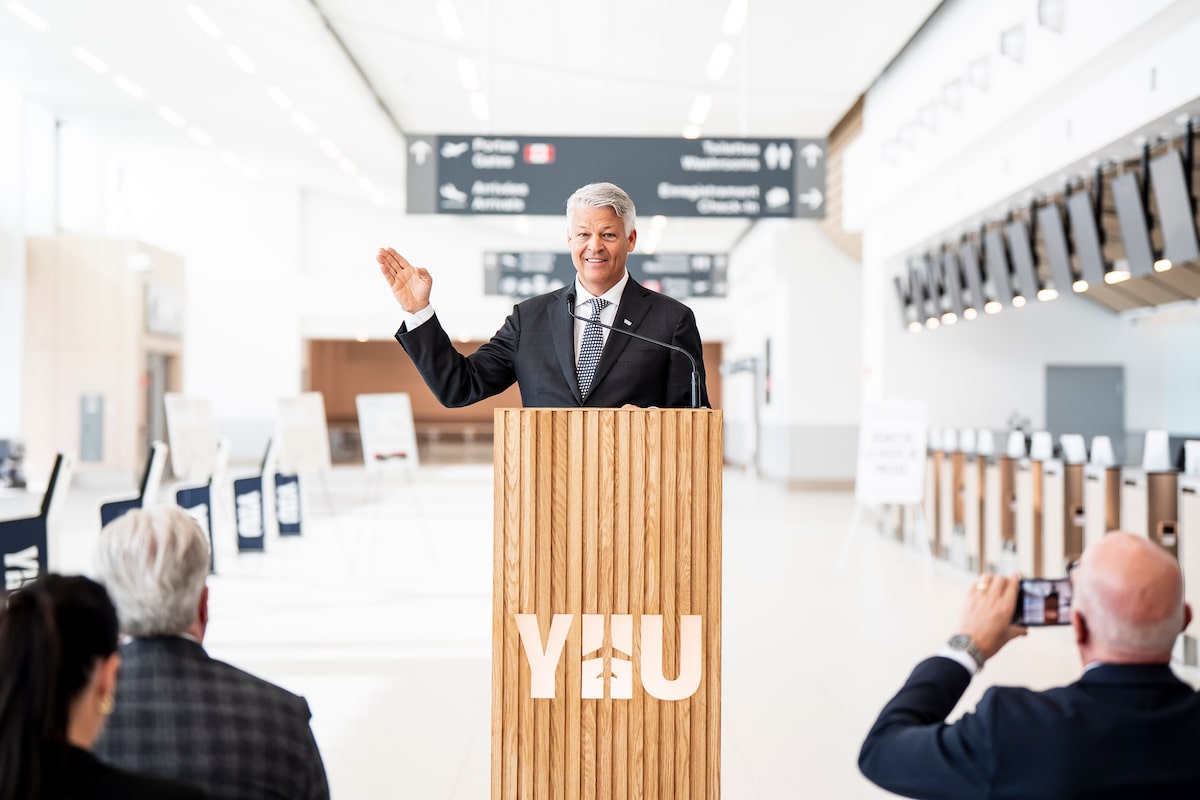
Charles Roberge, President and CEO, YHU Infrastructure Partners, gives remarks at the new commercial terminal at the Saint-Hubert airfield called the Montreal Metropolitan Airport, in Longueuil, Que., on Tuesday. YHU, a partnership between Porter and Macquarie Asset Management, is investing $450-million to build and operate the terminal.Christopher Katsarov/The Canadian Press
Porter Aviation Holdings Inc. is making a big wager on a new airport terminal for Montreal’s south shore, aiming to draw four million passengers a year to a modern facility that it vows will be the envy of Canada’s aviation industry.
The Toronto-based holding company, which runs Porter Airlines, has partnered with Macquarie Asset Management on a $450-million investment to build and operate a new terminal called the Montreal Metropolitan Airport, located at the existing Saint-Hubert airfield in Longueuil, which until now has been used for flight school training and private aviation.
Construction is nearly complete, with flights set to begin on June 15. Service will be limited to domestic routes because Trudeau International, the region’s other major passenger airport, has exclusivity rights over flights outside Canada.
“This facility is going to change travel for Montrealers, just like Billy Bishop did in Toronto,” Porter Chief Executive Michael Deluce said in an interview Tuesday, referring to the Toronto Island Airport. The passenger experience is “incredible,” he added, describing it “Billy Bishop on steroids” for its expansive lounges and ease of access.
The waiting lounge of the new terminal.Christopher Katsarov/The Canadian Press
The airport’s launch opens a new and potentially contentious chapter in the Montreal region’s air travel history. Following the closure of Mirabel Airport to passenger flights in 2004, Montreal-Trudeau is currently the only major airport in the region and its management hasn’t been particularly thrilled at the prospect of a new competitor siphoning off customers.
Aéroports de Montréal, the authority that operates Montreal-Trudeau, went to court last year to stop St-Hubert from rebranding to Montreal Metropolitan, arguing that it would sow confusion among travellers. Management of the St-Hubert airfield has countered that ADM is trying to protect “a monopoly,” and says it has a strong claim to the name because it is closer to Montreal’s downtown than the Trudeau airport.
The conflict remains unresolved. Meanwhile, Porter has pushed ahead with the project. Signs are up on nearby highways directing drivers to the Met, and the name spans the front of the 400-metre-long terminal, which has nine gates. Officials welcomed the media and guests for a tour on Tuesday.
Charles Roberge is the chief executive of YHU Infrastructure Partners – the Porter-Macquarie partnership – says the Met offers a quick and easy travel experience, starting with the ability to park your vehicle 20 metres from the check-in counter.
Ford to declare Billy Bishop Airport a ‘special economic zone’ to allow jets
The vast majority of workers at the airport, except for security and restaurant staff, are Met employees rather than those of contractors, which further streamlines operations and allows for a quick response to problems, Mr. Roberge said. He added that it’s a unique model in Canada.
“How many times have you taken the plane and said to yourself ‘Why does it have to be so complicated?’ The lines, the detours, the long walks, the delays,” Mr. Roberge said. “Our objective is simple: Speed, fluidity, simplicity, in complete safety.”
Porter will offer flights from the Met airport to 11 Canadian cities to start, including 27 weekly departures to Billy Bishop, 20 to Toronto Pearson, and 14 to Vancouver. Pascan Aviation, a Quebec regional carrier, will also fly out of the facility. There’s room for other airlines over time, officials said.
Many major cities in the world have a secondary airport. The Met can handle up to 4 million passengers a year and Mr. Deluce said he expects that within two years it will be one of Canada’s ten largest.
Jacques Roy, a professor of logistics and operations management at HEC Montréal, said the Met should benefit in the short term from congestion at Trudeau, which is undergoing extensive renovations to boost its capacity. During last summer’s peak travel season, social media platforms were filled with videos of travellers walking long distances to the terminal after traffic delays slowed access by car.
“The bigger question is whether domestic market will be enough” to fuel the Met’s growth in the longer term, Mr. Roy said.
In a report released last summer, Canada’s Competition Bureau recommended that Ottawa remove barriers that limit smaller airports from competing with major hubs, including eliminating international flight exclusivity clauses. Doing so, would require reopening long-term lease agreements that grant non-profit airport corporations operating and development rights.
Porter is widely credited for helping transform Billy Bishop into a modern facility with new infrastructure funded by both public and private sources. Porter launched in 2006 and passenger volumes grew to the point that airport operations became self-sufficient by 2010. That year, the carrier opened a new terminal that it later sold.
With a report from The Canadian Press