
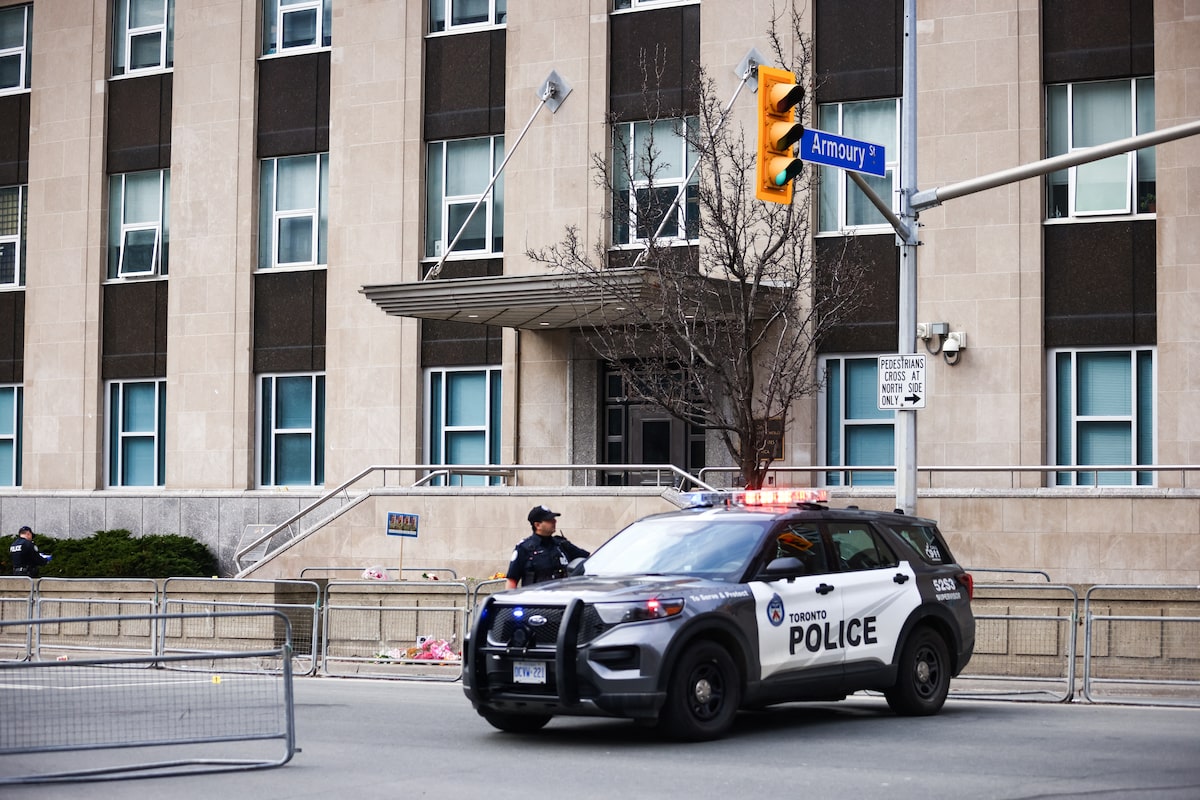
Police officers stand guard after shots were fired at the U.S. consulate in Toronto, March 10.COLE BURSTON/AFP/Getty Images
Heavily armed officers will patrol religious sites and tourist hot spots in Toronto under a plan announced Tuesday by the city’s police chief, who also said the force would create an anti-terrorism unit and prohibit a long-standing anti-Israel protest from spreading into the nearby Jewish neighbourhood.
Chief Myron Demkiw pointed to recent incidents where shots were fired at the exteriors of two Toronto synagogues and the city’s U.S. consulate earlier this month as he announced the measures.
“Global conflicts, extremist ideologies and online radicalization, hostile foreign states, heightened polarization: These are realities that impact our work and that impact the sense of safety in our communities,” Chief Demkiw said.
Toronto is among cities across Canada that have seen regular anti-Israel protests since the deadly Hamas attack on Israel on Oct. 7, 2023, which was followed by Israel’s invasion of Gaza. Meanwhile, police forces have reported an increase in antisemitic hate crimes, including multiple high-profile incidents since the U.S. and Israel attacked Iran nearly a month ago.
Attack against Canadian Jewish community a ‘realistic possibility,’ federal report warns
The Ontario government has pressed the Toronto police to take a harder line against the protests. Earlier this month, the province unsuccessfully sought a court order to stop an Al-Quds Day rally in the city.
Some members of the city’s Jewish community heralded the Toronto police announcement. Critics of the force said more public consultation was needed, while the leadership of a Toronto mosque raised concerns about the prospect of heavily armed officers nearby.
John Sewell, co-ordinator of the Toronto Police Accountability Coalition, accused the force of overreach and questioned why the chief didn’t do any consultation or bring the issue to the police board.
“The police have given the public no chance to actually talk about this,” he said.
Mr. Sewell said there is no question the targeting of synagogues or a consulate must be taken seriously, but he disputed the need for officers carrying rifles.
“This is the police overreacting,” he said. “It’s the wrong way to go. It will not make the city feel safer. It will not deal with the problem.”
Opinion: Antisemitism has reached alarming levels. Now what?
Jaime Kirzner-Roberts, senior director of policy and advocacy at the Friends of Simon Wiesenthal Center, which recently forwarded a criminal complaint about antisemitic signs at the weekly protests in North York to Toronto police, said her organization is happy with the new approach, which she said would better protect Jewish people and the wider public.
“We will continue to engage, as these new policies are implemented, to ensure they are effective, consistently enforced and responsive to the very real security concerns facing Jewish communities today,” she said after the press conference.
Shaffni Nalir, general manager of the Toronto Islamic Centre, said a more visible police presence is needed outside his group’s mosque, which has seen two congregants – including a 13-year-old boy strolling with his younger siblings – attacked in separate incidents after leaving late-night Ramadan prayers this month.
However, Mr. Nalir questioned whether posting heavily armed officers would reassure the centre’s congregation of roughly a thousand regular visitors.
“Things like that will put the whole community into panic mode,” he said.
The Beth Avraham Yoseph of Toronto synagogue in Thornhill. The synagogue was struck with gunfire earlier this month.Fred Lum/The Globe and Mail
Deputy Chief Frank Barredo said the police service is also increasing enforcement against the weekly anti-Israel protest at Bathurst Street and Sheppard Avenue, by restricting demonstrators to that intersection and stopping them from moving to side streets in the predominantly Jewish neighbourhood.
He acknowledged that police can’t stop people from peacefully demonstrating, but said they believe they can legally force them to remain in one area. He said the department could seek a court injunction later if needed.
“What we are taking issue with, and restricting, is movement into quiet residential streets where there’s nothing more than people living in their homes – that’s all it is – there’s no political embassy there, there’s no consulate,” Deputy Chief Barredo said.
Toronto police said there has been an uptick in hate crimes reported since the start of the Iran war. The force said it has received 56 reports of suspected hate crimes so far this year, 32 of which investigators have categorized as antisemitic.
On March 16, Toronto police said a complaint about several antisemitic signs displayed by protesters the day before was being referred to the provincial Attorney-General’s office, which is mulling whether to approve the laying of criminal charges of willful promotion of hatred.
Toronto police said the new counterterrorism unit will work with its counterparts in the RCMP and the Ontario Provincial Police to focus on local threats, which Superintendent Katherine Stephenson said often fall below the threshold of Canada’s terrorism offences. Supt. Stephenson said such threats “pose no less of a danger and still require serious and special attention and criminal investigations.”
Christian Leuprecht, a political science professor at Royal Military College and Queen’s University, said the announcement did not surprise him.
“My first reaction is, we’re growing up. We’re now a world-class city,” he said. “New York has long had a dedicated counterterrorism team. The London Met has long had a dedicated counterterrorism team.”