
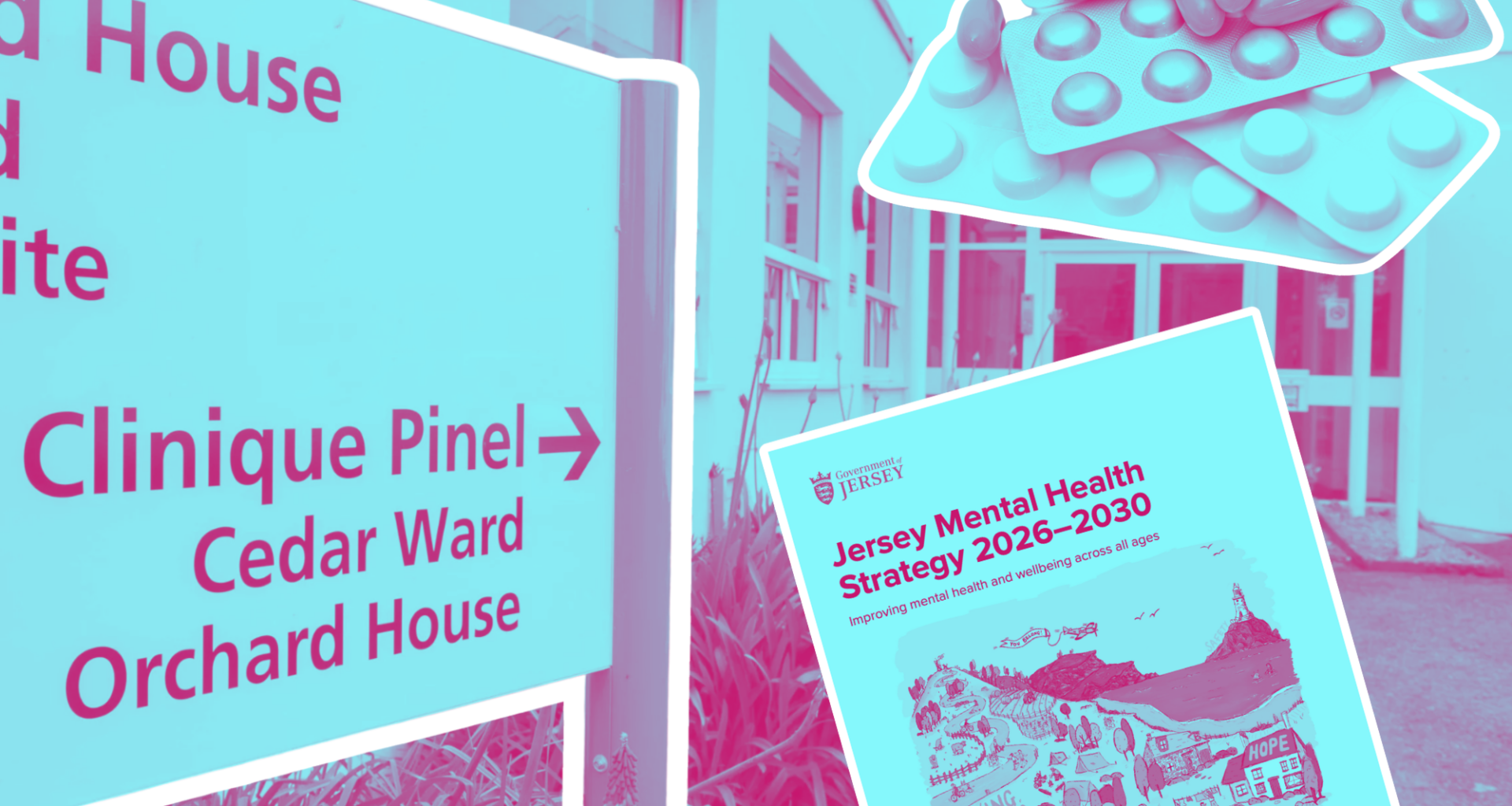
Jersey’s mental-health system is failing to meet the needs of thousands of islanders, according to a stark new government strategy which admits that half of those seeking help are not getting it.
Published last week, the long-awaited Jersey Mental Health Strategy 2026–2030 sets out an ambitious vision for reform.
But the government’s own document makes clear that the current system is struggling to cope, with thousands of islanders unable to access the help they need, long waits blocking treatment, and crisis care still falling short for some of the most vulnerable.
Express took a closer look at the strategy…
“Confusing and hard to navigate”
The report revealed that 50% of perceived mental-health needs are currently unmet, while half of those awaiting treatment receive no support at all while waiting.
Islanders said that getting help can feel “confusing and hard to navigate”, with support often arriving “too late” or not at all.
Long waiting times are the single biggest barrier to care, cited by 75% of respondents, while 57% said they could not afford private treatment as an alternative.
Nearly half also admitted they did not know what support was available, and 42% feared being judged or stigmatised.
“Distressing” crisis care
For those in crisis, the picture is even more alarming.
The report acknowledges that people experiencing acute mental-health emergencies are still being funnelled into the Emergency Department – something described as a “distressing and often a poor experience”.
It adds that crisis support is not always available when needed, and that access to help can be inconsistent.
The report states that crisis care “should not rely on Accident and Emergency Department attendance” and services must instead provide “alternative, age-appropriate environments for assessment and support”.
The document repeatedly highlights a system that is fragmented and difficult to navigate, with both patients and professionals raising concerns that services are not properly connected.
People with complex needs are too often “passed between services or fall between gaps”, while communication between agencies remains inconsistent.
Even where improvements have been made, the strategy acknowledges that these are not being felt consistently by patients.
Crisis care, triage and access have improved in places, but the experience remains uneven, leading to what is described as a “mixed experience of services”.
The strategy now promises a shift towards a 24-hour, joined-up crisis system, with community-based alternatives such as safe spaces and crisis cafés.
“Significantly increasing demand”
Meanwhile, mental-health demand is rising, with increasing complexity and severity, while social pressures – including poverty, housing insecurity and loneliness – are driving need.
Around 21,000 islanders live in low-income households, and those struggling financially are “more than twice as likely” to report loneliness and difficulty coping.
The strategy sets out ambitions for earlier intervention, better joined-up services and improved crisis care, with a focus on prevention and recovery.
But the document itself acknowledges the scale of the task ahead, stating that while progress has been made, “there is still more to do, and we must push forward ambitiously”.
It also recognises that demand is continuing to grow, warning of “significantly increasing demand for mental-health services” alongside an ageing population that will place further strain on the system.
Plans for change
The new strategy sets out four key priorities: prevention and early intervention, better integrated services, improved crisis care, and stronger recovery and rehabilitation support.
There is a clear shift in emphasis towards earlier help – recognising that many mental-health problems begin in childhood.
The report notes that 50% of conditions begin by age 14 and 75% present by the age of 24, underlining the importance of early support.
It also calls for more community-based care, improved access to services closer to home, and greater involvement of families and carers.
For crisis care, the focus is on creating alternatives to hospital, ensuring people know where to go, and providing faster, more consistent responses.
For recovery, the aim is to support people to live meaningful lives, with better rehabilitation pathways and fewer gaps between services – particularly for those transitioning between child and adult care.
Related