
Two dozen men in parkas huddled against the frigid wind in tight, almost meditative circles around metal tables strewn with playing cards, cash, and cigarettes. Every few minutes, one of the men slapped money on the table, and shouting would erupt, as players scooped up their winnings.
The scene is familiar to those who pour into Chinatown each day. From late morning to dusk, from cold to sweltering temperatures, groups of Asian men and women transform a patch of pavement adjacent to the Chinatown gateway into gametime.
The open-air play is often harmless fun: pai-gow poker, Chinese blackjack, and other games of chance. It’s communal time for people in a neighborhood lacking other recreational outlets.
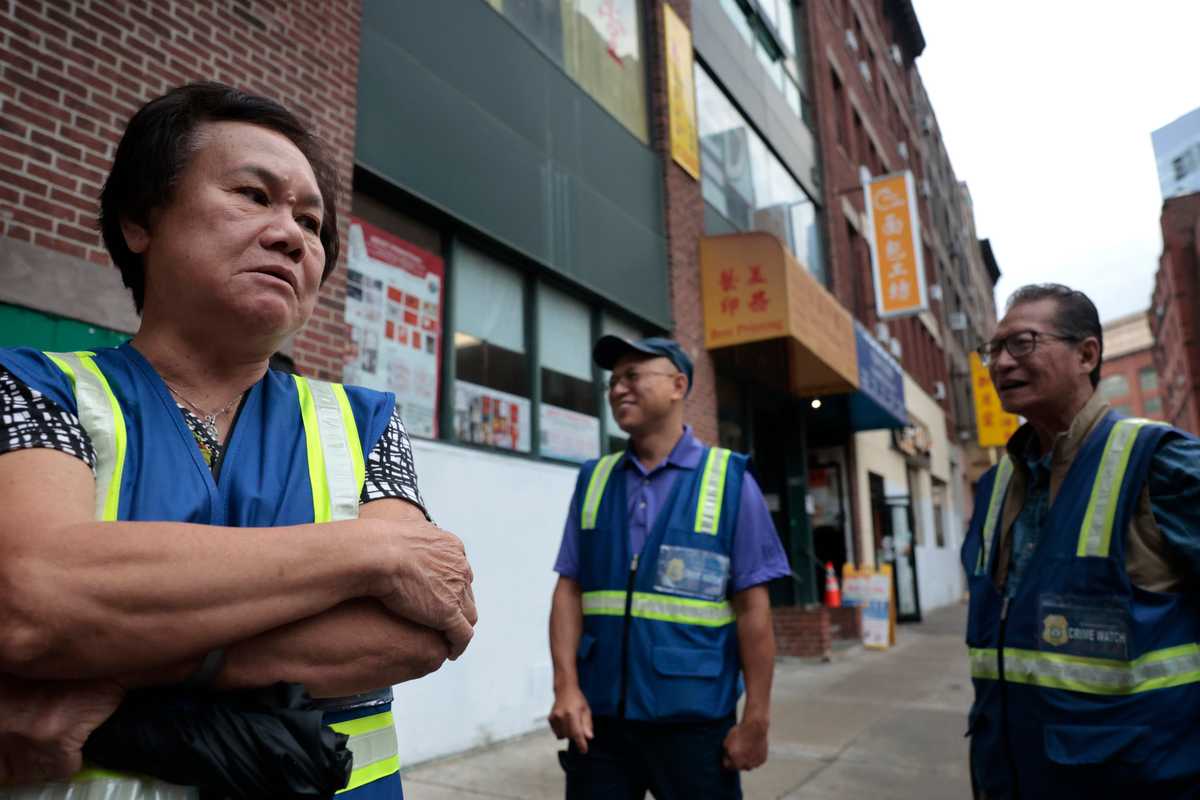
Rosemary Yee patrolled the neighborhood with other Crime Watch volunteers in August. The citizen patrol, organized by the Chinese Consolidated Benevolent Association, is in its 20th year. (Craig F. Walker/Globe Staff)
But for many longtime Chinatown residents, the outdoor games further prove that unfettered, compulsive gambling is encroaching into nearly every corner of the enclave. It is rupturing families, forcing people into bankruptcy, and is scarring the image of the neighborhood.
So they are pushing back — against the casinos, their elected officials, and their neighbors.
Yet the challenges they face here are daunting, made more difficult by years of government apathy and neglect.
Asian-led community groups leading the resistance to gambling said they feel overmatched by forces arrayed against them — including the massive casinos that barrage their neighborhoods with round-the-clock shuttles and billboards. Meanwhile, police and state and local prosecutors have seemingly looked the other way as dozens of gambling parlors in Chinatown hum late into the night, their rooms crowded with illegal slot machines and mahjong tables ringed with cash. Many residents and business owners say they are reluctant to report illicit betting and loan-sharking for fear of retribution from organized criminals.
Despite persistent complaints within the community of the damage wrought by gambling, access to treatment for Asian immigrants remains scarce. Out of 107 people in Massachusetts who are certified by the state to screen and treat gambling disorders, only six are proficient in Asian languages such as Cantonese, Mandarin, Vietnamese, and Korean, according to state data. In cities with some of the highest concentrations of people of Asian descent, including Malden and Quincy, there is not a single credentialed professional who specializes in treating gambling addiction, according to records from the Massachusetts Department of Public Health.
“We are like a tiny sesame seed compared to the casinos,” said May Wong, 75, who oversees daily games of mahjong, with no money changing hands, at the Boston Wong Family Benevolent Association on Beach Street in Chinatown. “You can encourage people to play for fun, but the other options have become too convenient.”
At the Boston Wong Family Benevolent Association in Chinatown, seniors seeking recreation gather to play mahjong and other games of chance — legally. It’s one of a number of places here where people can play socially with no money involved. (Craig F. Walker/Globe Staff)
Late last year, community members in Chinatown notched a rare victory: They persuaded the city’s zoning board to reject a proposal to open a late-night mahjong parlor in the basement of a brownstone near the enclave’s gateway.
In public hearings and in letters to Mayor Michelle Wu’s office, residents warned a legal parlor would attract outside criminals and imperil efforts to mitigate compulsive gambling. For some, the proposal harkened back to the 1991 Tyler Street massacre, when members of a Vietnamese gang gunned down five people inside an underground gambling parlor — one of the deadliest episodes in Boston’s history.
The rare victory signaled a rising power and solidarity against gambling, and the emergence of a new voice capable of pressing that hostility into lasting change.
“We already have enough gambling in Chinatown,” said Rosemary Yee, 80, a longtime Chinatown resident and board member of the Boston Chinatown Neighborhood Council, among the groups opposed to the mahjong parlor.
To Hung Goon, a longtime Chinatown resident and leader of the Chinatown Crime Watch , a volunteer-run community safety patrol, the pervasive gambling here reflects a deeper problem: a lack of recreational opportunities for scores of recent Chinese immigrants.
For two decades, his community patrol group has roamed the streets and alleyways of Chinatown in bright-blue vests and walkie-talkies strapped to their hips. They pick up discarded drug needles, untangle quarrels between residents, urge businesses to pick up their trash, and keep an eye out for people peddling drugs and stolen goods. Sometimes, they help police catch criminals.
In that time, Goon said, movie houses and other cultural institutions that once predominated Chinatown have closed. Years of gentrification have pushed out some of the traditional Chinese hometown associations — founded by immigrants from the same families or regions — that used to host recreational events and cultural festivals. And soaring commercial rents have squeezed out many of the mom-and-pop restaurants that stayed open late and catered to immigrant workers.
“Gambling has filled that void,” Goon said as he patrolled the neighborhood. “People have nothing to do. When you play for money, it brings some excitement.”
Simon Law patrolled an alley with other Crime Watch volunteers in Chinatown in August. (Craig F. Walker/Globe Staff)
Men bet on a card game as they played in a park next to the Chinatown Gate in October. (John Tlumacki/Globe Staff)
The spacious Pao Arts Center in Chinatown has become a focal point of this effort to broaden entertainment options. Monday nights, the second-floor of the center is transformed into a hub of activity — with karaoke performances, traditional Chinese dancing, and Ping-Pong. The center also holds monthly arts and crafts events, where mental health clinicians discuss the signs of compulsive gambling and encourage people to seek help.
One frigid November evening, the mood was buoyant as two dozen mostly older Chinatown residents poured into the center. One by one, they tossed their parkas on chairs and took turns at the karaoke machine. Soon, the room was alive with people dancing and singing under a haze of blue strobe lights. A projector flashed images of the Chinese countryside and women dancing in embroidered, silk costumes. Nearby, younger people darted back and forth at Ping-Pong tables.
“We’re trying to send a message that you don’t have to get on a bus and go to Encore [Boston Harbor] for fun,” said Daniel Ngan, an event organizer for the Pao Arts Center.
Daniel Ngan sang karaoke at the Pao Arts Center in Chinatown in February. (Danielle Parhizkaran/Globe Staff)
In Chinatown, especially, the area’s casinos are omnipresent. Just blocks from the site of the karaoke performances, shuttle buses arrive every 20 minutes along a busy street to whisk scores of residents to Encore Boston Harbor, the massive resort about 15 minutes north. And on a high brownstone near the shuttle stop, the Mohegan Sun casino regularly promotes concerts and other events on billboards. Last fall, the Connecticut casino unfurled giant banners touting a Chinese beauty pageant and a performance by David Tao, a popular Taiwanese singer.
This year, Encore marked the Lunar New Year with an extravagant celebration. Traditional lion dancers wound their way through the casino floor, while staff distributed red envelopes stuffed with $2 bills and tossed mandarin oranges — a symbol of good fortune in Chinese culture — into the air. Clusters of parents and their children reached eagerly for red envelopes dangling like ornaments from decorative plants, plucking them one by one until the branches were stripped bare.
“The reality is, this gleaming, fancy, welcoming casino with the free buses is a totally different experience from the overcrowded and often dirty existence in Chinatown,” said Ben Hires, executive director of the Boston Chinatown Neighborhood Center, as he walked amid scores of Asian-themed slot machines at Encore. “This really appeals to immigrants who are feeling a profound sense of isolation.”
The Encore Boston Harbor casino was luminous against a sky at dusk along Alfred Street in Everett. (John Tlumacki/Globe Staff)
Confetti fell as lion dancers marched through the lobby of Encore Boston Harbor casino during a celebration of the Lunar New Year on Feb. 21. (John Tlumacki/Globe Staff)
For those seeking to combat casinos’ marketing muscle, the struggle to secure reliable funding remains a persistent challenge.
Massachusetts spends more per capita on gambling treatment and prevention programs than any other state – a fact that state health officials often tout as proof of their commitment to tackling problem gambling.
But organizations focused on preventing compulsive gambling in Asian communities have, until recently, received just a tiny fraction of that money.
As far back as 2006, there was a wave of community concern in Boston’s Chinatown after Connecticut’s two tribal casinos, Foxwoods Casino Resort and Mohegan Sun, began sending regular buses to the neighborhood. Outreach teams sponsored by the nonprofit now called Massachusetts Council on Gaming and Health distributed fliers in multiple Asian languages warning of the harmful effects of gambling. They held focus groups, created a dedicated problem gambling helpline for Asian communities, and produced a 10-minute video on how to seek help – which a third-party bus operator agreed to play for passengers on rides to Foxwoods.
Yet by 2011, the $100,000 state grant that funded the project dried up, and the nonprofit that organized the outreach effort shifted to other priorities, according to community organizers involved in the effort.
On a January midafternoon, people lined up to board a small bus on Essex Street near South Station. The bus shuttles passengers to the Encore Boston Harbor casino in Everett for free. The buses arrive every 20 minutes at the designated stop. (John Tlumacki/Globe Staff)
Surveys have found that people of Asian descent represent up to 25 percent of patrons at the region’s large casinos, yet Asian groups in 2024 received only 8 percent of the state’s problem gambling mitigation funds, state records show. As recently as 2018, they didn’t receive a cent in state money, data show.
That means nonprofits such as the Boston Chinatown Neighborhood Center rely largely on a small corps of volunteers to organize community events, while the region’s casinos pour millions of dollars each year into shuttle buses, dedicated Asian marketing teams, and a steady stream of targeted promotional campaigns.
“It’s all about money,” said Chien-Chi Huang, who coordinated the now-defunct initiative when she was Asian outreach director for the Massachusetts gaming council. “You can’t outdo the marketing power of the casinos with temporary grants.”
Wayne Yeh moved from Northern California to Boston in 2012 for college, partly to escape the pressures of growing up in a household afflicted by gambling addiction. His parents ran a doughnut shop in Chico, and conflicts over gambling occasionally sparked disputes with extended family members.
Soon after arriving in Chinatown, Yeh felt surrounded by gambling – from the billboards promoting casino events to the ever-present shuttles and open-air card games near the Chinatown gateway.
“We are grappling with generations of indifference,” said Yeh, 34, the son of Laotian refugees who is now a law student at Boston College and policy director for Boston City Council President Liz Breadon. “The casino perks, the advertising … have seeped into everyday life, so they feel normal.”
These challenges are not confined to Chinatown.
In Lowell, home to the nation’s second-largest Cambodian community with at least 15,000 residents, community members have been alarmed by the recent opening of several smaller casinos just across the state line in New Hampshire. The newest, The Nash Casino in Nashua, features a bevy of card tables with Asian games. It announced its opening last March with a prominent ad in Lowell’s Khmer-language newspaper.
At last summer’s Lowell Folk Festival, scores of Cambodian Americans lined up for gambling vouchers, T-shirts, and other freebies handed out by casino workers at booths erected just feet from a stage where traditional Cambodian performers danced and sang.
Fearing a rise in gambling addiction, the nonprofit Cambodian Mutual Assistance Association has recently gone on the offensive, organizing gambling-prevention forums and distributing fliers at community events. Riverbend, a Lowell-based addiction treatment provider, employs the state’s only two gambling specialists who are fluent in Khmer; this year, the agency has been sending them into local schools and senior homes to educate people about the potential harms of gambling and the warning signs of addiction.
Winnings were displayed on a game at The Nash Casino in Nashua. (Brett Phelps for The Boston Globe)
On a Saturday morning in late October, two dozen people, mostly Cambodian immigrants, filed into a community center in Lowell for a public forum on problem gambling – the first organized by the Khmer community. An older man described nearly losing his home after gambling the money for his mortgage payment at a nearby casino. Another said he was struggling with loss of sleep after racking up $7,000 in gambling losses. Speaking in Khmer, a mental health counselor warned against “chasing losses” – escalating bets in the vain hope of winning back lost money.
“Many in our community see the casinos as a way to get rich fast, and they have no idea how to stop” gambling, said Sophanna Toh, a Cambodian American clinician specializing in drug and gambling addiction at Riverbend. “We’re here to show them how to stop.”
At many of these events, Asian community members are now being screened for signs of gambling disorders.
Clipboard-wielding volunteers with seven Asian community organizations statewide are routinely greeting people as they arrive at community events from the South Shore to Springfield with three basic questions such as, “During the past 12 months, have you tried to keep your family or friends from knowing how much you gambled?” Those who answer yes to any of the questions are encouraged to seek help.
Nearly 1,300 people have filled out the questionnaire since the project began two years ago – making it among the most extensive problem-gambling screening effort in state history, according to state officials who helped organize and fund the project. About 6 percent of those surveyed tested positive for a gambling disorder, and organizers say the surveys have broadened awareness of the problem.
Yet, historically, community efforts to combat gambling within Asian communities have ebbed and flowed based on the availability of grant funding and have been difficult to sustain, advocates acknowledged.
In other cases, efforts have come from inside the Asian American community, but advocates have been cautious about how forcefully to act. When contacted by The Boston Globe, several community groups in Chinatown and Quincy declined to discuss the underground gambling parlors and pervasive casino shuttles, citing their popularity with many residents. Others expressed fear that authorities would use gambling as a pretext to raid the neighborhood and detain immigrants.
“Gambling is everywhere [in Chinatown], but a lot of people here don’t want to talk about it,” said Lydia Lowe, executive director of the Chinatown Community Land Trust, a nonprofit working to preserve the neighborhood’s cultural heritage.
Michael Liu, a native of Chinatown and author of “Forever Struggle: Activism, Identity, and Survival in Boston’s Chinatown, 1880-2018,” stood at Oxford Place in Chinatown.
(Erin Clark/Globe Staff)
In Chinatown, that silence is partially rooted in the community’s past experiences with racial prejudice, said Michael Liu, author of a book on Chinatown’s history of community activism. From the 1880s until well into the 1950s, authorities repeatedly used gambling and other vices, such as opium use, as justification for rounding up scores of Chinese immigrants. Photos of past raids are displayed prominently on exterior walls of the Chinese Consolidated Benevolent Association, an influential business group in Chinatown.
“There is this enduring stereotype that Chinatown is a place of vice and corruption, and too often gambling has been used as an excuse to try to get rid of the community,” Liu said.
Such fears have complicated efforts by community groups to confront problem gambling.
Mei Hung looked visibly frustrated on a late-summer morning as she approached the crowds of men and women playing cards on metal tables near the Chinatown gateway. The executive director of the nonprofit Chinese Culture Connection in Malden has been trying to understand why gambling is so pervasive in Chinatown and to encourage players to pursue other recreational outlets. Yet most of the men were too immersed in the games to acknowledge Hung.
Finally, between hands of poker, an elderly man explained to Hung that he gambled at the park every day from 9 a.m. to 5 p.m., only breaking at midday to dash to his apartment for lunch. While the bets per hand were small, often no more than a few dollars, it was possible to lose hundreds in a single day at the park, according to the man, who asked to remain anonymous, citing the stigma in the community associated with compulsive gambling.
“What do people think when they see all this [gambling] at the Chinatown Gate?” Hung asked. “It presents the worst side of our culture.”
At times, even modest efforts to counteract gambling’s popularity have encountered pushback.
Every Saturday for eight years, dozens of Chinese residents of Sawyer Towers, a 10-story public housing tower in Quincy, gathered for lively games of no-stakes mahjong in the building’s community center.
May Wong (left) and May Feng danced as Anson Sun sang to the crowd on the grounds of the Braintree Historical Society on Aug. 11, during the lobsterfest held by the Chinese American Association of Braintree. Frank Poon and Lisa Tong, in the rear, performed a Cantonese opera “The Gambler’s Song” earlier. (Pat Greenhouse/Globe Staff)
Frank Poon and Lisa Tong performed their duet “A Gambler’s Tale,” a Cantonese opera that tells the story of damage wrought by gambling, inside the Waymark Seventh-day Adventist Church in Dorchester on Dec. 4. (Lane Turner/Globe Staff)
The gatherings were the idea of Frank Poon, a longtime community leader with deep ties in Boston’s South Shore Asian community. He became alarmed by the outsized presence of older Asian men waiting on corners for casino shuttles.
Poon saw the mahjong gatherings as a way to foster discussion about compulsive gambling and its harms within the community. To stimulate dialogue, Poon would stride to the front of the room with a microphone and perform a song about gambling set to the rhythms of a traditional Cantonese opera. The song, called “The Gambler’s Tale,” described one man’s descent into poverty, heartache, and self-loathing.
“I am broken! I am scared!” Poon bellows in Cantonese as he sings. “I’m scared that I won’t have money for a plot to bury myself.”
But his events came to an abrupt end last fall, when the building’s tenants association raised complaints about the crowds and noise.
Disappointed but undeterred, Poon took his message elsewhere, performing at various Asian cultural festivals and senior homes. Sometimes, he shows up in a silk shirt decorated with gambling dice and tears it off in the song’s dramatic final verse, to symbolize the gambler’s break with his destructive past.
“I’ll keep singing that song until I die,” Poon said, “or until the casinos stop targeting my people.”
Boston Globe correspondent Esmy Jimenez contributed reporting.
CreditsReporters: Chris Serres, Mable Chan, Danny McDonaldEditors: Anna Kuchment, Kris Hooks, Anica Butler, Mark MorrowPhotographers: John Tlumacki, Craig F. Walker, Danielle Parhizkaran, Pat Greenhouse, Lane TurnerPhoto editor: Leanne Burden SeidelVideo producer: Raphael ChincaVideo director: Julianne VaracchiDesign: Ryan HuddleDevelopment: Daigo Fujiwara-SmithInteractives editor: Christina PrignanoDirector of photography: Bill GreeneAudience: Lauren BookerSEO strategy: Ronke Idowu ReevesCopy editor: Michael J. BaileyTranslator: Xiaoya Shao 邵潇雅Proofreaders: Wenqi Cao 曹文淇, Ricole Chen 陈苏瑜, Chloe Nie 聂静萱Quality assurance: Nalini Dokula
© 2026 Boston Globe Media Partners, LLC