
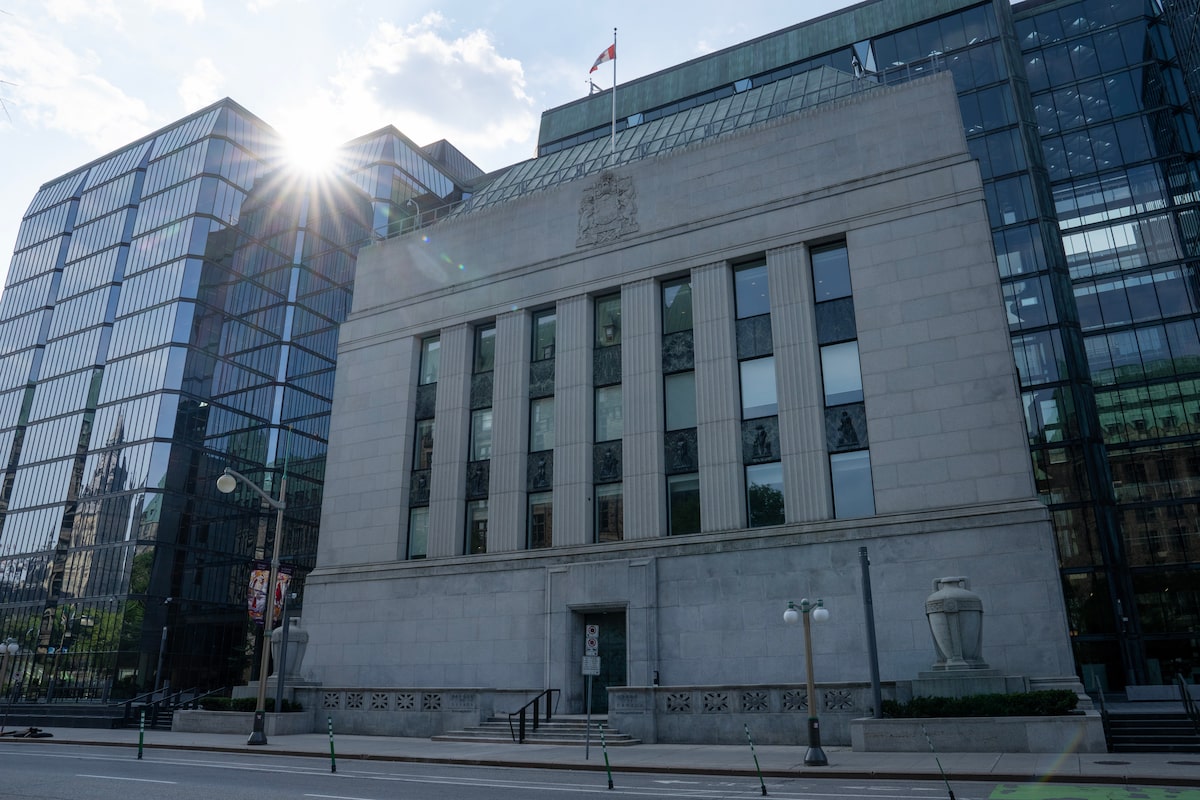
The Bank of Canada building in Ottawa in July, 2025. Views that short-term high oil prices could push up inflation may lead to expectations of central bank interest rate increases, writes Andrew Galbraith.Adrian Wyld/The Canadian Press
Sharp moves in Canadian bond yields since the outbreak of war in the Middle East reflect worries about the global impact of the continuing conflict and uncertainty over its economic fallout.
But experts say market signals in Canada display a focus on near-term inflation that may understate the risks to economic growth. That may create opportunities for investors with a different outlook.
Since the day before the conflict began, the yield on 10-year Government of Canada bonds has risen more than 50 basis points – half a percentage point – to a high of 3.643 per cent earlier this week.
The two-year yield, which can be seen as an indicator of market expectations of Bank of Canada policy, jumped even more sharply, rising nearly 82 basis points to a high of 3.212 per cent on Monday.
The story at the shorter end of the yield curve is not just its rapid rise, but its marked volatility. After touching its high on Monday, the Canadian two-year yield pulled back nearly 25 basis points amid rising investor hopes that negotiations between the United States and Iran could help to bring the three-and-a-half week conflict to a quicker end. As those hopes dissipated on Tuesday, the yield climbed again.
Canadian dollar hits two-month low as geopolitics dominates trading
“The true vol is in the short-term interest rate markets globally because every headline that comes out impacts expectations,” said Dhruv Mallick, head of credit at Leith Wheeler Investment Counsel in Vancouver, using a market shorthand for volatility. Views that short-term high oil prices could push up inflation may lead to expectations of central bank interest rate increases, while worries over a hit to economic growth may boost expectations of cuts.
For now, said Mr. Mallick, “economies are doing okay-ish, so any kind of swing on inflation is your driving factor.”
Volatility has been exacerbated by what Mr. Mallick said are thin trading volumes as geopolitical uncertainty prompts long-term investment managers to sit on the sidelines. “It’s just not worth the volatility because you could invest in something on Friday and it’ll be completely changed on Monday,” he said.
In Europe, sharply higher prices for liquefied natural gas and oil have led to more concern around the potential for the conflict to weigh on economic growth, said Dustin Reid, chief fixed income strategist at Mackenzie Investments in Toronto.
In contrast, he said he was “a little surprised” in meetings with U.S. counterparts that they remain more focused on inflation risks than worries about longer-term growth. Their consensus was that U.S. growth would be unlikely to take a significant hit unless oil stayed around US$120 per barrel for at least six to eight weeks.
The oil price has soared since the start of the war, but hopes for an end to the conflict have helped Brent crude, the international benchmark, pull back from highs near US$120 per barrel to around US$104 per barrel by Tuesday.
Abeed Ramji, head of Canadian debt capital markets at TD Securities, pointed to what he said was a growing narrative that economic growth in Canada and the U.S. will remain solid while the oil shock fades in the near term. That helps to explain why volatility in interest rates has not yet translated into broader concern affecting Canadian corporate debt markets.
S&P Canada bond index data shows that the spread, or premium, demanded by investors for holding Canadian nominally riskier high-yield over investment-grade corporate debt has barely changed since the outbreak of war.
“This is an inflation shock, not a credit shock,” Mr. Ramji said in an e-mailed response to questions, noting that credit spreads tend to lag sustained increases in rate volatility.
“Credit spreads care more about growth, defaults and liquidity. There is an argument to be made that those haven’t cracked yet as credit fundamentals are generally still strong. Growth and corporate earnings are holding up and cash flows are still solid (so far).”
But Mr. Ramji said the prevailing market narrative ignores historical precedents of oil shocks leading to a risk of recession, including the 1973 OPEC oil embargo, the 1979 Iranian revolution, the Gulf War and a spike in the price of oil before the Global Financial Crisis.
Mr. Reid at Mackenzie Investments said that the market’s focus on inflation had made it overestimate the Bank of Canada’s appetite for raising rates, noting that at one point on Monday, markets were pricing in expectations of four increases.
“That seems to be a bridge, or even a couple of bridges, too far.”
This could offer an opportunity for investors with a different outlook to bet on lower yields at the shorter end of the curve, he said, such as through a short-term fixed-income fund.
“People ask me all the time, ‘Where do you think the market is significantly mispriced?’,” said Mr. Reid. “Particularly sitting in Canada, that looks to be one of those places.”