
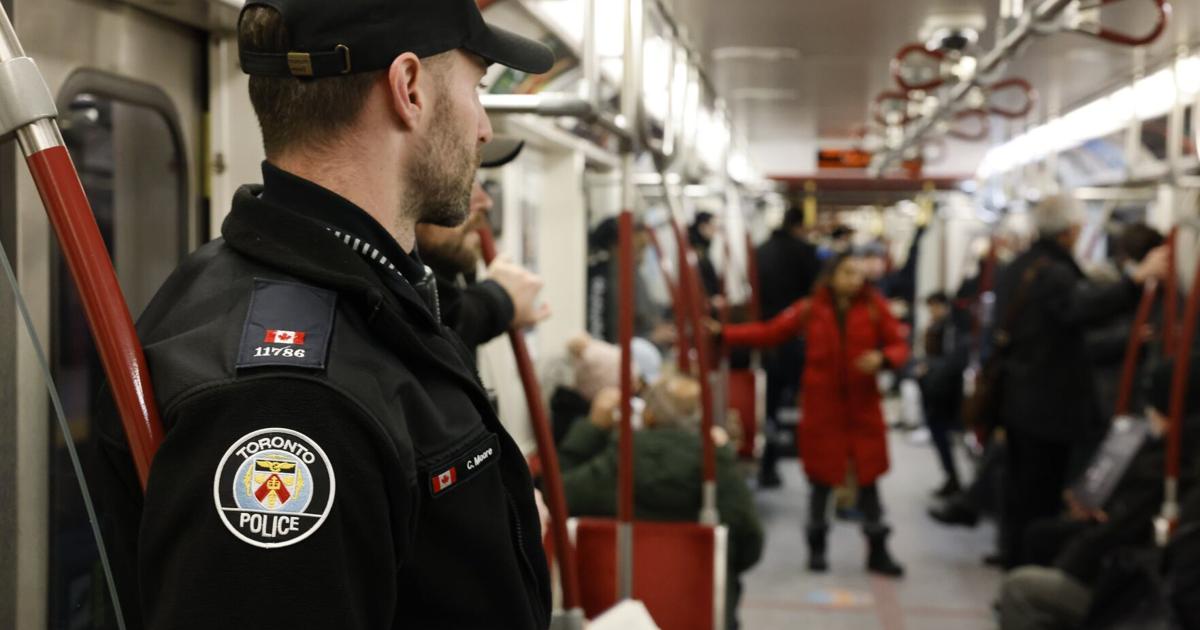
Major crime in Toronto is down, assaults on the TTC subway are declining and violence is on a downward trend at the subway’s busiest stations, according to the latest data.
Still, Coun. Brad Bradford (Beaches—East York) says Torontonians don’t feel safe taking the subway.
In a motion Thursday, Bradford will ask council to make several recommendations to the TTC board he says are aimed at improving safety on the transit system.
“It starts with an honest assessment of the problem,” Bradford said in a recent social media video about his motion. “Safety isn’t defined by statistics in a spreadsheet — it’s about how people feel.”
Bradford’s motion includes proposals designed to improve lighting and cleanliness standards at subway stations, as well as for an audit of them with an eye toward safety and crime prevention.
But the two ideas on the motion coming under the most scrutiny by council and TTC board members are plans to fund a pilot program to install platform edge doors, and the deployment of Toronto police officers at every subway station. Critics are questioning the cost and some are accusing the councillor of playing politics.
“Parents tell me that they will not let their kids ride the subway alone. Shift workers dread a late-night commute. Seniors have stopped going out,” Bradford said at a press conference this week to talk about his motion. “When that many people are telling you the same thing … the answer is to stand up and fix it.”
Bradford said his proposals will be part of his campaign when he runs for mayor this fall. When asked how he would fund the ideas, Bradford said: “I’m not going to (presuppose) that at this press conference.”
Crime, safety and a ‘shared responsibility’
TTC safety is a complex issue that isn’t rooted in a single failure and therefore can’t be improved by applying a single solution, experts say.
Reported assaults on the TTC’s subway trains, stations and tunnels dramatically spiked from 2015 to 2023, according to police data. In 2015, there were 263 incidents. In 2023, there were 855. Those numbers have decreased in the past two years. There were 831 incidents reported last year, on a system that sees millions of trips every year through the city.
In a presentation to the TTC board last April, TTC staff called safety a “shared responsibility.”
They noted that many incidents — criminal offenses, non-criminal and disorderly conduct — are symptoms of other issues complicating their work, such as the closure of supervised consumption sites, or homeless people or those in a mental health crisis using the TTC as a safe, climate-controlled place to rest.
“Across Canada, although safety issues are generally decreasing in frequency, many are becoming more complex to resolve,” due to the fallout of underfunded health, housing and social services, David Cooper, a transit consultant with two decades of expertise in transportation and safety policy, told the TTC board last April. Cooper authored in 2023 the national transit safety recommendations, which indicate police are one part of a multi-faceted solution.
What Toronto is doing about TTC safety
Both the municipality and Toronto police have shifted away from a “police-led” approach, with Mayor Olivia Chow and police Chief Myron Demkiw previously saying a “health-led” method is best for addressing underlying issues such as poverty, homelessness or mental health crises, with police as support where needed.
“A police officer in every single station, that’s just not realistic, particularly in light of the budget constraints the city is facing,” said Coun. Jamaal Myers (Scarborough North), chair of the TTC board. “I don’t even think it’s effective.”
Myers said two things can be true at once: crime is declining, yet people feel unsafe. He noted the TTC, community crisis teams and the police are addressing subway safety issues, including an increased presence of TTC special constables and other transit staff.
Bradford acknowledged those workers and their efforts. “I want to be clear for folks: I have a great deal of respect for the crisis workers, for the outreach teams, for the front-line TTC staff who show up every day,” Bradford said. “It’s not about replacing them, it’s about making sure that the system has the enforcement backbone it needs so that those workers can do their jobs.”
According to a 2025 TTC report, calls for a “person in crisis” are concentrated in Line 1’s “U-Zone,” between St. George and Bloor stations — the busiest on the subway. The city is spending $1.8 million on a pilot to expand its mental health crisis teams onto those platforms.
Stations such as TMU and Bloor-Yonge see the most amount of traffic, so they also see the most number of reported safety incidents. The TTC’s least-used subway stations, such as Bessarion or Rosedale, are among the quietest, because they are in low-density neighbourhoods with little commercial development.
“Some of the most uncomfortable scenarios are when there’s nobody there,” Bradford said at Monday’s press conference. “So I would suggest having police officers in all of our stations … if you want more people to use Bessarion.”
Toronto police announced last fall they were dedicating four officers between Union and Wellesley stations and another four officers between Bloor and Eglinton stations seven days a week. Spokesperson Nadine Ramadan said so far this year there’s been a downward trend in general crime on TTC property.
“However, we also understand that lower crime numbers don’t always translate into a greater sense of safety,” Ramadan said.
There are many reasons perceptions of safety might not match data. Researchers typically point to media giving prominent coverage to sensational stories and rare tragedies, and elected officials using the fear of crime as a political tool.
“I think (Bradford’s motion), unfortunately, ignores what’s really happening in the system,” said Coun. Alejandra Bravo (Davenport), a TTC board member. “It’s a way to try to capture attention, but it won’t deliver on the ground because (safety) requires a lot of different personnel” with different skills.
Nelson Wiseman, professor emeritus of politics at the University of Toronto, said Bradford’s proposal is “a political statement” rather than a practical approach.
“He’s not presenting any (crime) data,” said Wiseman, adding that using specific incidents of crime in order to make generalizations that it’s rampant is straight out of the conservative politicians’ playbook. “I was robbed in Puerto Vallarta,” said Wiseman. “That doesn’t mean everybody in Puerto Vallarta gets robbed.”
It’s unclear how much money would be needed to deploy police at every station, which Bradford proposes should be part of the city’s 2027 budget. This year’s bump in police spending brought the service’s funding to $1.43 billion, of which about $1 billion is salary.
While supportive of the idea, Toronto Police Association president Clayton Campbell said it’s “unrealistic” with current staffing levels. “It would be hundreds of (more) officers,” he said.
Toronto police’s current five-year hiring plan, approved in 2024, already includes $20 million to hire 143 new officers this year.
Platform doors for safety
Also as part of next year’s budget process, Bradford is asking to start construction on a pilot program to install platform edge doors at some TTC stations by end of next year, and a 10-year funding plan for the doors along “priority stations” on Line 1.
Platform edge doors are generally seen as an effective safety barrier to prevent suicides attempts and trespassers.
TTC data shared with the Star showed 10 suicide deaths last year, relatively the same as a decade ago, except for a brief spike during the first year of the pandemic, and 13 suicide attempts, which was a decrease from before the pandemic.
The challenge of the doors is the $55-million-per-station price tag and the complex planning required to construct them. Others on council say it’s a measure that would be competing with the multibillion-dollar repair needs of an aging transit system.

City council this week is being asked to commit to moving ahead with construction for a pilot
Last week, Chow said she “would love to see” the doors installed. “However, we can’t leave the tracks not fixed. So the state of good repair has to come first,” she said of the TTC’s growing repair backlog, which sits at nearly $12 billion over the next 15 years. Chow pointed to the Scarborough RT track’s deteriorating anchor bolts that derailed a train in 2023 and sent five people to the hospital as an example for the pressing need to stay on top of that backlog.
Coun. Josh Matlow, a current TTC board member who has long supported platform-edge doors, said wanting to install them requires talking about the trade-offs and repercussions in a cash-strapped city. “It’s not honest to simply say, ‘Look for efficiencies.’ You need to name them,” he said.
Matlow said funding these proposals would mean choosing a combination of fare increases, tax increases and/or cuts to other services — if the federal and provincial governments don’t help.
Bravo noted the TTC is still an outlier in North America for its extremely low levels of senior government support.
When asked by the Star, the province rebuffed the idea of giving more money specifically for platform edge doors, while the federal government was noncommittal but said it was open to discussions.
As far as the city paying for the doors itself, each one per cent property tax increase is the equivalent of raising about $50 million. It’s unclear whether TTC fares would need to go up or, if so, by how much.