
Adam Sýkora made his NHL debut for the New York Rangers on Wednesday night. The second-round pick from 2022 has spent the last three years in the AHL and had amassed 58 points in 131 games. He is not typically known for his offence, but with the team’s lacklustre forward depth, he has a chance to make an impression for next season.
*
The Utah Mammoth signed goaltender Michael Hrabal to his three-year entry-level deal. The 21-year-old second-round pick from 2023 just finished his third season of collegiate hockey and will report to the Utah’s AHL affiliate.
*
Some news on Victor Hedman:
The Tampa Bay Lightning announced today that defenseman Victor Hedman will be taking a temporary leave of absence from the team for personal reasons.
No further details will be shared, and the team asks that his privacy be respected at this time.
— Tampa Bay Lightning (@TBLightning) March 25, 2026
There is no need to speculate here, we just wish the best for Hedman and his family.
*
Boston and Buffalo had a key matchup on Wednesday night as this might be a preview of a first-round series. Boston came out on top in this one with a 4-3 overtime win. David Pastrnak managed a goal and two assists with three shots, and that gives him 90 points on the season for the fourth straight campaign. It also puts him over the 60-assist mark for the third straight season.
Charlie McAvoy had an assist, a shot, three blocks, two PIMs, and a hit in a great multi-cat night. He has 35 points in 31 games in calendar 2026.
Jason Zucker scored twice while Zach Benson tallied the other marker for the Sabres. Ukko-Pekka Luukkonen took the lost in net, giving up four goals on 31 shots.
*
Dakota Joshua managed a goal and an assist while both Nick Robertson and John Tavares scored in Toronto’s 4-3 home win over the Rangers. Mattias Maccelli managed a pair of assists at 5-on-5, and now he and William Nylander are the only Toronto forwards with at least 10 goals and 10 primary assists at 5-on-5 this season.
Joseph Woll was great in net for the Leafs, stopping 40 of 43 shots for the win. Since the start of last season, Woll’s .907 save percentage is higher than Igor Shesterkin, Jake Oettinger, Jeremy Swayman, and Dustin Wolf.
Mika Zibanejad scored twice in the loss while Alexis Lafreniere totaled a goal, two assists, and seven shots. Since Artemi Panarin‘s last game with the Rangers on January 26th, Lafrenière has 11 goals, 10 assists, 48 shots, and 6 power-play points in 19 games.
*
At the Trade Deadline, the Boston Bruins acquired forward Lukas Reichel from the Vancouver Canucks in exchange for a sixth-round draft pick. Reichel started in the AHL, where he had five points in three games, and was called up to the NHL last week. He has two points in three games since the recall, averaging 14:02 per game with some secondary PPTOI. Reichel, the 17th overall pick from 2020, never really established himself in Chicago during their rebuild and Vancouver clearly wasn’t a good spot for him, either.
In January of 2025, I wrote about Reichel’s time in the NHL over at another website. The long story short was this: Reichel had some tracking data – namely what he does on zone entries – that put him in company with high-end forwards across the league. It wasn’t a small sample, either, as we were talking about over 700 tracked minutes at 5-on-5 spanning four seasons and 169 NHL games, and what he does on zone entries is something that normally helps teams offensively.
Now that Reichel is back in the NHL, it’s worth going over what happened in Chicago, what makes him a unique player, and why it can work (or not) in Boston.
We have to start with the tracking data, as compiled by the website All Three Zones, and we are starting with:
All offensive zone entries/60 minutes
Percentage of those entries carried in (not dumped or passed in)
We are looking at this data relative to the player’s team, so if a player’s forward teammates average 20 zone entries/60 minutes, and the player we’re looking at averages 25 entries/60 minutes, the relative difference is 25%, or (25-20) divided by 20.
Across the four seasons from 2021-2025, we have a group of 138 forwards who spent all four years with the same team and had at least 700 tracked minutes at 5-on-5. Relative to their respective teammate forwards, here is who Reichel compared with by zone entries/60 minutes, and percentage of those entries carried in:
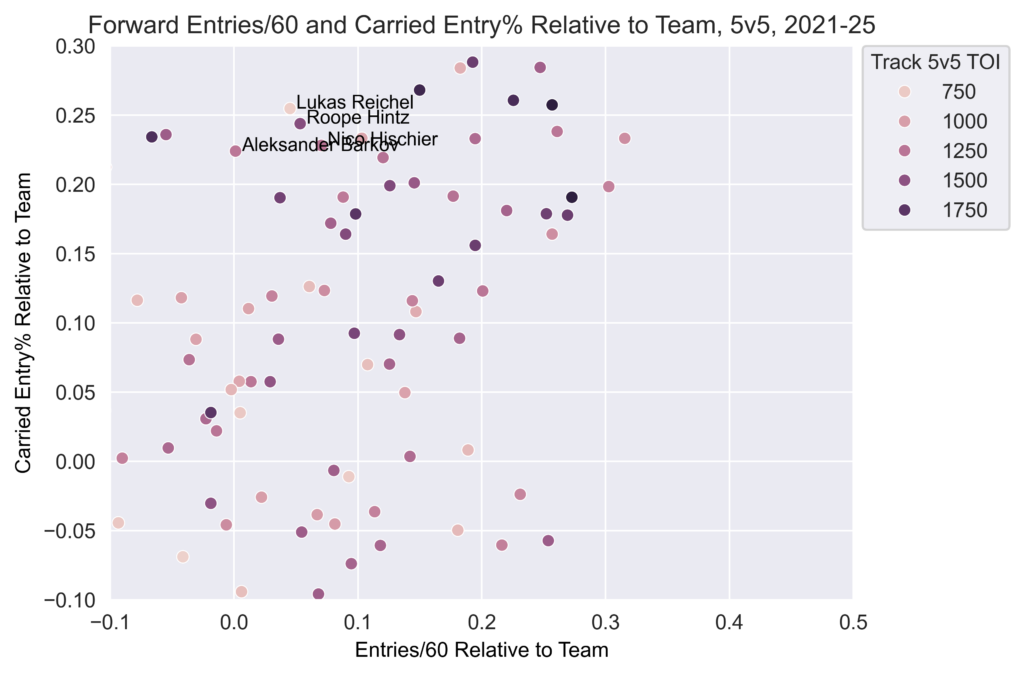
The names are Roope Hintz, Nico Hischier, and Aleksander Barkov. I don’t think he’ll ever be the defensive force Barkov is, or a centre that takes over 1500 faceoffs a season like Hischier, but Hintz is an interesting name to see, considering Hintz didn’t become an impact player until his age-24 season.
Reichel’s rate relative to his team is important to highlight because of just how bad the Blackhawks were for his tenure: from 2021-2025, Chicago was dead last by goals per 60 minutes at 5-on-5 and were nearly 6% worse than the next-worst team (per Evolving Hockey). Their 5-on-5 goal-scoring rate was 13% worse than the 29th-place team.
One key with Reichel is that even if we don’t look relative to his team, even if we just look at the actual entries and carried entry% of each player, the comparable names over those four seasons are very positive:
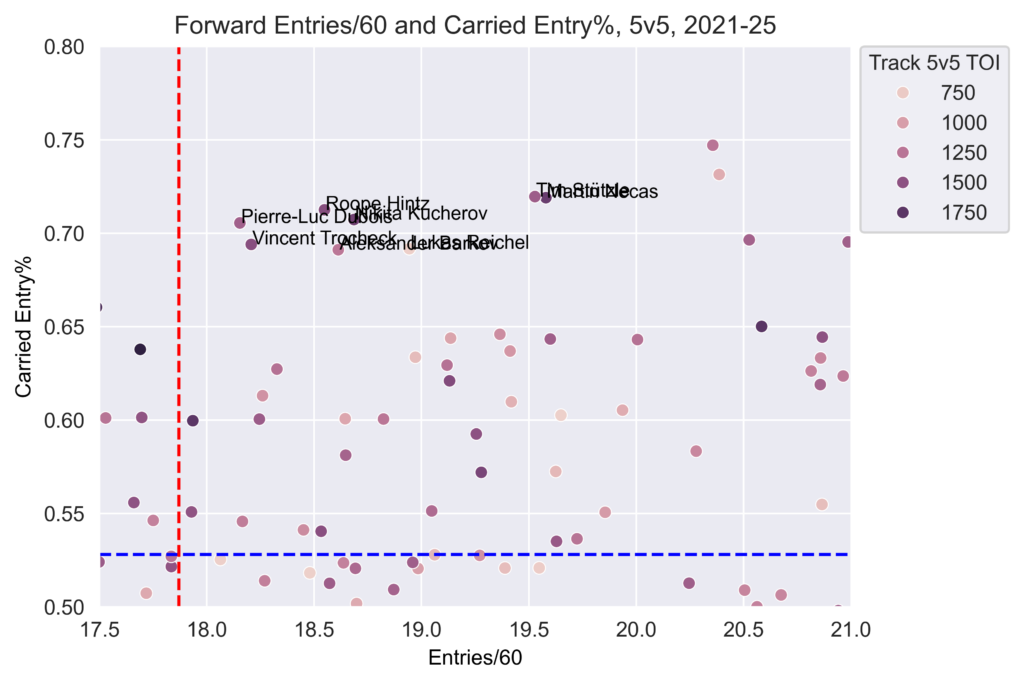
A lot of those names overlap, but they are: Barkov, Hintz, Pierre-Luc Dubois, Vincent Trocheck, Nikita Kucherov, Tim Stutzle, and Martin Necas. Look at those seven names and then add Reichel as the eighth. That is why what he’s done on zone entries is so important to look at. If Reichel ends up not sticking in the NHL, he’ll be a huge outlier in a group that contains (at worst) established top-6 forwards and (at best) true superstars.
What makes Reichel different is how he created offence. Using the same tracking data, there are two different ways that teams and players create offence at 5-on-5:
Rush – Shots (and assists on shots) immediately following a zone entry.
Cycle/Forecheck – Shots (and assists on shots) after sustained zone pressure.
The difference between the two is important to highlight: generally speaking, a shot off the rush is more dangerous than a shot off the cycle/forecheck, but offence off the rush can lead to poor defensive results because if the puck doesn’t go in, players are often out of position defensively, leaving their team open to a counter-attack. The best players can do both, and the best players create a lot off the rush, but they also create very well off the cycle/forecheck to help maintain good defensive posture (think Barkov, Mitch Marner, or Matt Boldy).
Knowing all that, here is where Reichel stood by overall offence created off the rush and overall offence created off the cycle/forecheck:
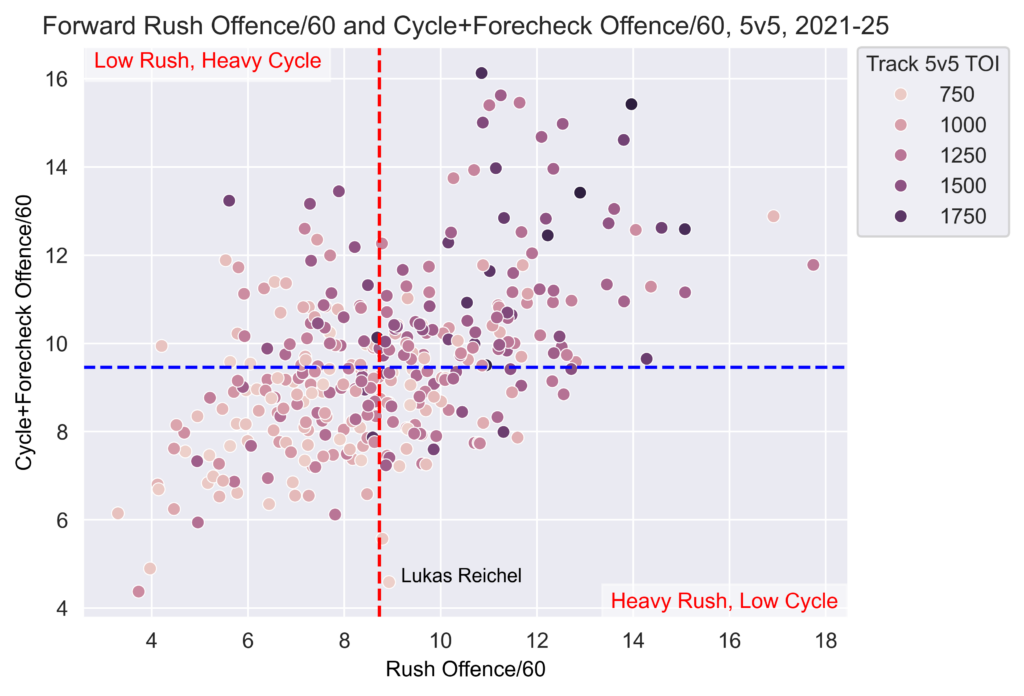
Of the 335 forwards with at least 700 tracked minutes across the four seasons from 2021-2025, including those who changed teams, Reichel ranked 334th by offence off the cycle/forecheck. He was above-average off the rush but created next-to-nothing off the cycle, and his defensive numbers suffered because of it.
What makes him truly different is what he did relative to his team. Going back to the 138-forward sample of those who did not change teams from 2021-2025, here are Reichel’s comparables by rush offence/60 and cycle+forecheck offence/60 relative to the player’s team:
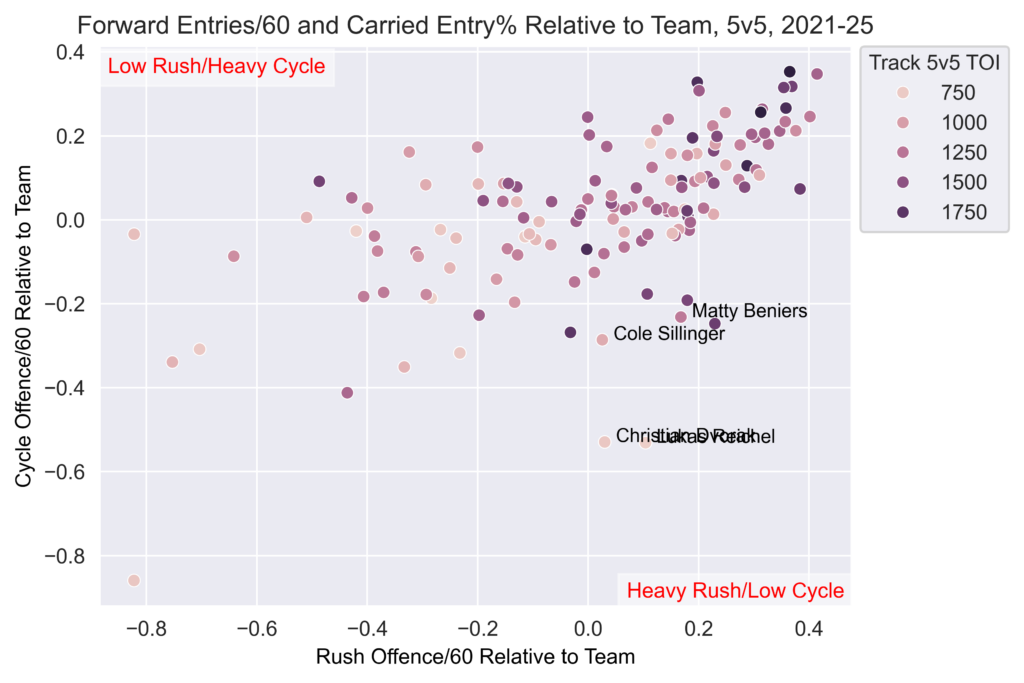
Reichel’s name is overlapped with Christian Dvorak, and above them are Cole Sillinger and Matty Beniers. Reichel’s offence off the cycle is much worse than Beniers/Dvorak, but those are the three names closest to his profile. If we’re looking for high offensive upside, those are not names we want to see.
All this is what makes Reichel such a unique player. Whether we look at his overall zone entry numbers or those numbers relative to his team, the comparable names are fantastic. When we look at his overall offence created off the rush and cycle, as well as relative to his team, the comparable names are not encouraging.
We also have to keep in mind just the exact calibre of player Reichel was playing with. Over his last three full(ish) seasons in Chicago from 2022-2025, he skated 1805 minutes at 5-on-5 (per Natural Stat Trick). His most common line mate in those minutes was Andreas Athanasiou, and Reichel spent less than 25% of his ice time next to him. His next most-common line mate was Patrick Maroon (22%), and after him it was Philipp Kursahev (18%). As of today, Athanasiou is out of the NHL, Maroon is retired, and Kurashev is often a healthy scratch for a non-playoff team. That is not exactly high-end talent to skate with.
To put a bow on this, there is reason to believe it can work in Boston. Here is a plot of how each team’s forwards have created offence this season at 5-on-5 (rush and cycle/forecheck). The red and blue dotted lines are the league average in each stat, and in the bottom-right are teams that focus more on rush offence and less on cycle/forecheck:
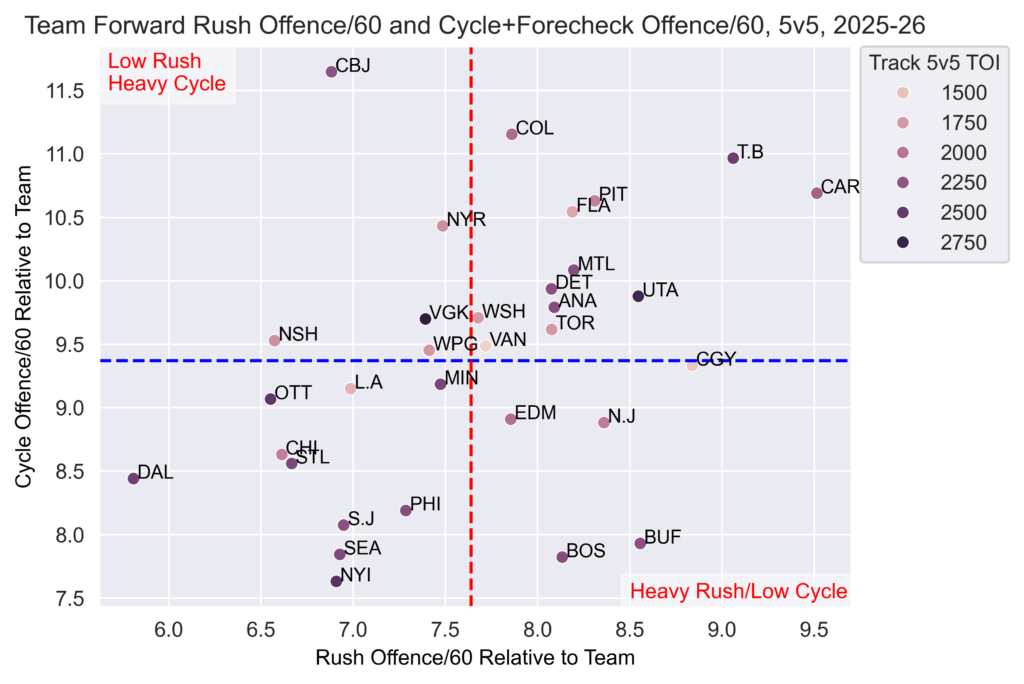
We see how many of the best offensive teams at 5-on-5 – Colorado, Tampa Bay, Pittsburgh, Utah, Carolina, and Montreal – can do both, but Boston is a team finding offensive success creating a lot off the rush and not much off the cycle. Whatever we think of that approach, it’s one that fits Reichel’s playstyle a lot more than Chicago’s (bottom-left quadrant, so little offence in either area). And that doesn’t preclude Reichel just adapting his playstyle to what his new team wants him to do.
Whether Reichel becomes a regular, productive NHLer is very much up in the air, but as outlined with the zone entries and carried entries, players of that ilk not only become NHL regulars, but impact players of varying effectiveness. His big problem was that his offence was very one-dimensional, but now he’s on a team that at least encourages that aspect of his game. And, for good measure, if Reichel stays in the NHL for the rest of the season, he’ll crest the 200-game threshold.
This is a player I still believe in. Across his first two AHL seasons, at the age of 19 and 20, he had the most points of any player age-20 or under and had the same points/game rate as J.J. Peterka. He has a great zone entry profile, is approaching the 200-game threshold, and is finally on a team that is not only good offensively but plays similar to how he likes to play. His fantasy value this season is modest because third line/PP2 minutes don’t mean a lot, but keeper/dynasty owners might want to take a second look this offseason. Everything is finally lining up for him to establish himself.