
CALGARY – A Calgary court has upheld a ticket issued under Calgary’s “bubble zone” bylaw that restricts expression outside of libraries and recreation centres, while at the same time cutting down the scope of the bylaw that the CCF argued was severely overbroad.
Justice S.G. Parker of the Court of King’s Bench upheld a ticket issued to protester Larry Heather for statements he made involving gender identity within 100 metres of Calgary’s Central Downtown Library during a drag queen reading event.
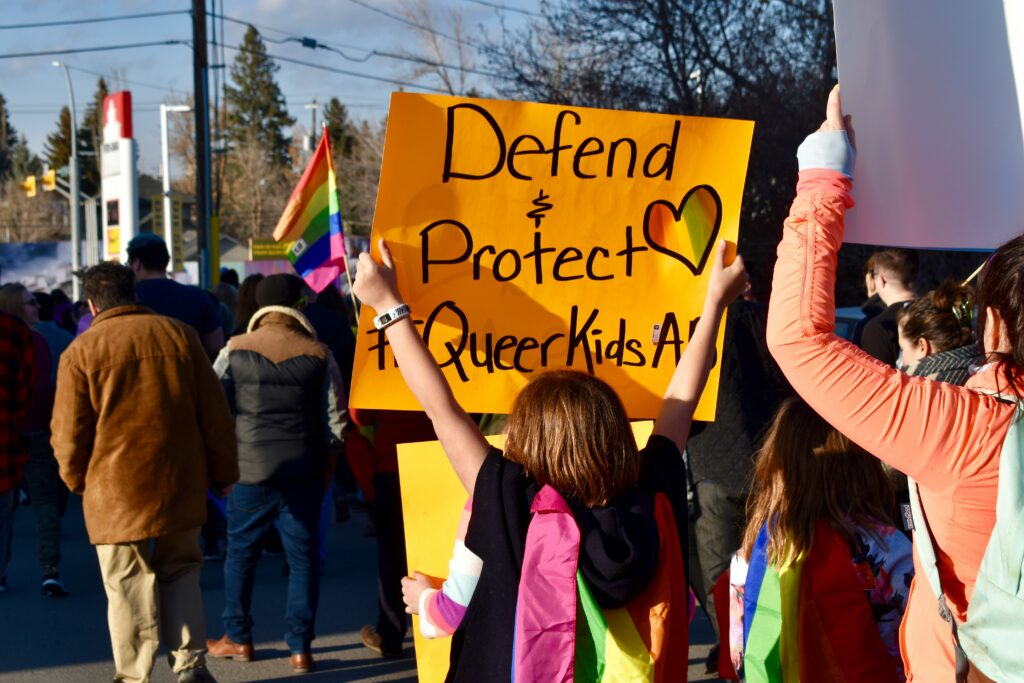
The ticket was issued under Calgary’s Safe and Inclusive Access Bylaw, which was passed in March 2023 at the urging of former mayor Jyoti Gondek. The bylaw restricts protests that express “objection or disapproval” towards ideas or actions related to “race, religious beliefs, colour, gender, gender identity, gender expression, physical disability, mental disability, age, ancestry, place of origin, marital status, source of income, family status or sexual orientation,” on publicly accessible property within 100 metres of an entrance to a recreation facility or a library.
The CCF intervened to argue that this banned a dizzying array of protected expressions based on their content, including holding a protest placard that states “Circumcision is Violence,” shouting “Down with Radical Islam,” wearing a T-shirt that says “Boycott the Binary” or chanting “Calgary Police kill Black people.”
Mr. Heather, who is a Christian, argued that the ticket violated his right to freedom of religion, as it was his religious beliefs that motivated his protest.
Justice Parker agreed with the CCF that the bylaw is overbroad because its purpose was to protect “the Pride Community’s access to libraries and recreational centres,” and so it requires “more tailored drafting to only address grounds based on gender, gender identity, gender expression or sexual orientation.”
Justice Parker also agreed that “adjacent indoor locations incidentally caught within the 100 metres constitute an unjustified impairment on expression and religious freedom.” He said “publicly accessible property” means: “all or any part of a City of Calgary operated building or structure, or parcel of land to which members of the public have access as of right or by express or implied invitation.”
Justice Parker ultimately upheld the bylaw as a reasonable “time, place and manner” restriction on freedom of expression and freedom of religion because the bylaw does not restrict expressions of disapproval at protests occurring outside of the 100 metres bubble zone, online, or outside of specified hours, calling the restriction “not a serious infringement on freedom of expression or religion.”
Christine Van Geyn, Interim Executive Director of the CCF, said she was disappointed that the bylaw was not struck down in its entirety, even though she was pleased to see it reduced in scope.
“I strongly disagree with the judge’s conclusion that banning protests based on their content is not a serious infringement on freedom of expression,” she said.
“Protesters should not be forced to hold their demonstrations blocks away from an event that they wish to protest against,” she added.
Josh Dehaas, Interim Litigation Director with the CCF, called on Calgary’s City Council to repeal the bylaw and instead encourage police to make arrests against any future protester who crosses the line into criminal intimidation or mischief.
“Justice Parker sent a clear message to The City of Calgary that their bylaw went too far in restricting freedom of expression, so they will need to either amend or repeal it,” he said.
“I would encourage Mayor Farkas and council to take this opportunity to put this divisive chapter behind them by repealing the bylaw in its entirety,” he added.
The Canadian Constitution Foundation was represented in this case by Yoav Niv.