
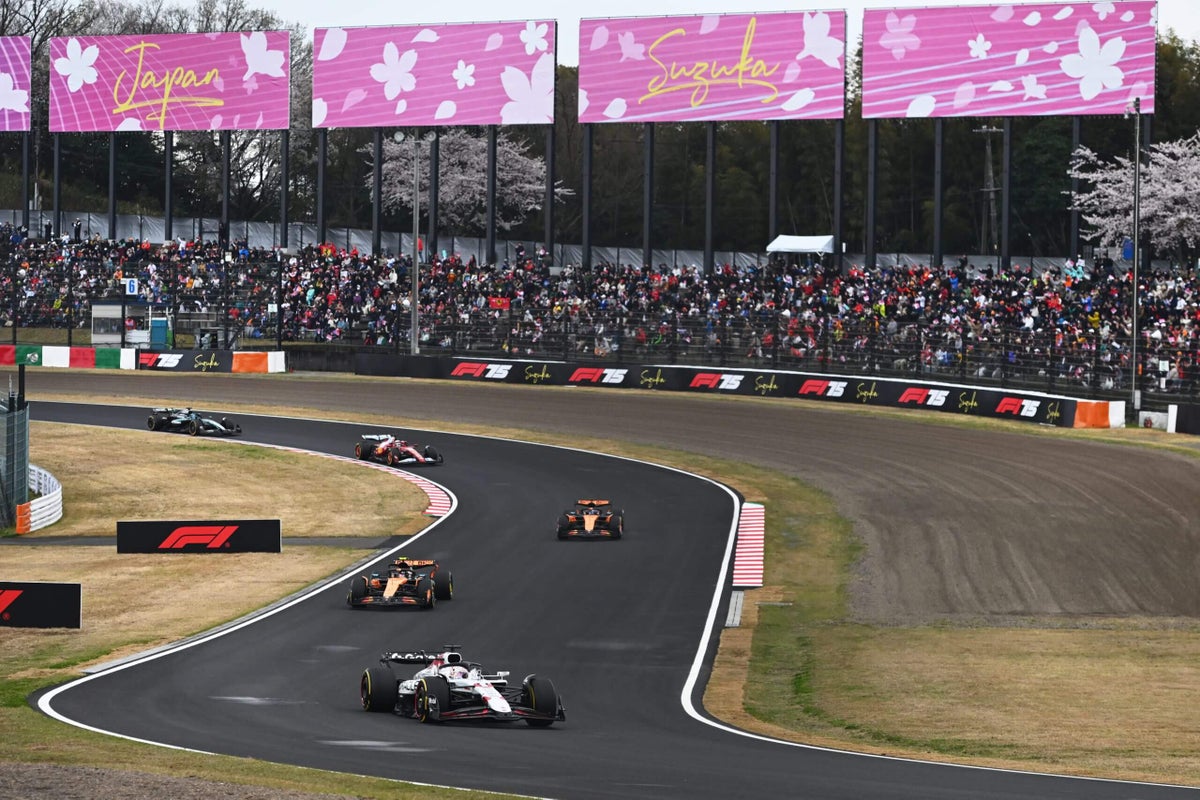
SUZUKA, Japan — If you were to ask any Formula 1 driver to name their favorite track, Suzuka, the host of the Japanese Grand Prix, would be a popular answer.
The figure-of-eight track has long stood as one of the ultimate challenges for drivers. Between the high-speed esses that start the lap, the double-right Degners leading under the bridge, the long, cambered Spoon curve, and 130R (below) — a flat-out left-hander requiring full commitment — it’s a circuit littered with iconic corners.
As such, Suzuka should bring out the very best in F1 drivers. But for 2026, there are fears it might not be quite so enchanting. It’s all down to how the engines work on the new cars.
“I don’t think you can ever ruin this track,” said McLaren driver Lando Norris, the reigning F1 world champion. “Is it going to be as spectacular? I don’t think so. It will not be.”
F1’s new cars have to be driven very differently compared to those used in 2025 due to their heavy emphasis on engine energy usage.
The need to harvest energy to recharge the battery, which now has a near 50-50 overall power production share with the internal combustion engine element, has forced the grid to rethink how to chase lap time.
Tactics such as lifting off into corners that were previously flat out or pulling lower gears than would otherwise be required became the norm through the opening two races in Australia and China.
The experience of qualifying at Albert Park in Australia left many fans and drivers disappointed.
It is one of the most energy-starved tracks because of its few big braking zones, which are needed to quickly recharge the battery. That meant drivers saw their top speed tail off at the fastest points of the circuit, as a process called ‘super clipping’ kicks in — where the engine slows and harvests energy even when the driver keeps the throttle pinned.
Suzuka’s energy management challenge was anticipated to be closer to Australia than China, which is a less demanding track and followed the season opener in Melbourne. Both races were won by the Mercedes team.
The FIA has taken steps to mitigate this issue for this weekend by reducing the amount of energy harvesting that happens at the ends of straights and limiting super clipping. The hope is that it will make the qualifying laps slightly more flat out and therefore more exciting for both drivers and fans.
But, speaking on Thursday in Japan, the drivers seemed unsure that it would totally resolve many of their concerns.
Pushing an F1 car to the absolute limit through Suzuka’s fast, challenging corners is just not the best way to complete the quickest lap with how the new engines work. It is faster to spend engine energy on straights and hold back in corners.
“It’s less about just going as quickly as you can; (more about) trying to understand where to deploy the energy and where to save the energy,” said Audi’s Gabriel Bortoleto. “It’s just going to be quite different.”

Audi driver Gabriel Bortoleto at the 2026 Japanese GP (Andy Hone / LAT Images)
While nothing replicates driving on the track, the drivers had a chance to sample what Suzuka might be like with these new cars in their team simulators in recent weeks. Many quickly noticed a difference.
Ferrari’s Charles Leclerc said in Thursday’s news conference at Suzuka that drivers were “probably not going to have a lot of power through the esses” that dominate the first sector. These corners are typically a high-speed challenge, as the drivers push to the limit of grip.
The overall downforce of F1 cars has also dropped for this year, already making them a step slower in high-speed corners overall. This is why Red Bull’s Max Verstappen said “you’re (still) on the limit of what the car is allowing you to do.”
“But in terms of power, of course in places you’re not,” added Verstappen, who had also sampled Suzuka in the simulator.
Williams racer Alex Albon also thought the first sector would still be “strong” with these new cars. He highlighted Degner 1, Spoon and 130R as being corners — in the second and third Suzuka lap sectors respectively — that will likely be less exciting because of the need to lift and coast on entry to charge the battery.
“What I’m feeling so far this year is there isn’t really any high-speed any more,” he said. “Because you’re arriving so slowly, basically everything is a medium-speed corner now.”
The Degner example is one of several that drivers highlighted as changing with these new cars. Degner 1 is a fast right-hand corner with a curb and gravel close on the outside, before heavy braking is rapidly required into the sharp Degner 2 right just a few seconds later.
Haas driver Esteban Ocon explained that with the previous generation of cars, the goal was to carry as much speed as possible through Degner 1 so they did not need to get back on the throttle before braking into Degner 2.
“(Now) we are going to arrive quite slowly into the corner,” Ocon said. “But you still don’t want to discharge too much (energy) in the small straight and waste it.”
Norris also highlighted Spoon as previously being a full commitment corner on entry, where a driver needed to hook the car left and bravely carry as much speed as possible around the long, multi-apex turn, named after its distinctive shape.
“You’ll start clipping into Spoon,” Norris said. “That’s one of the quickest corners, where you turn in going incredibly quick. Last year, I didn’t even break into Spoon’s entry.”
One of the fiercest critics of the new cars has been Verstappen, the four-time F1 world champion.
He described them as “anti-racing” in preseason testing and has maintained that stance through the first two races. To him, Suzuka is a special place. He secured his second world title here in 2022 and has won each of the last four editions of the Japanese GP.
In 2025, Verstappen produced a magical Suzuka pole position lap to top qualifying, arguably the best of his F1 career, en route to winning the race. A repeat of such heroics this year seems unlikely, as Red Bull has been so far unable to match Mercedes and Ferrari in race trim with its first in-house-built engine.
“Of course it feels very different to last year,” Verstappen said. “But this is the reality we’re in now; you just have to accept that at the moment. There’s not much they can do for this year. I hope bigger changes will be there for next year.
“How does it feel? It feels… as it feels. It’s different. You all know how I think of the situation. That was something that I felt when I was on the simulator as well around here.”
Verstappen said the tweak to the energy rules for qualifying laps would “help a tiny bit, but the basics are the same.” That means there will still need to be great care put into managing energy that could cost Suzuka some of its sheen.
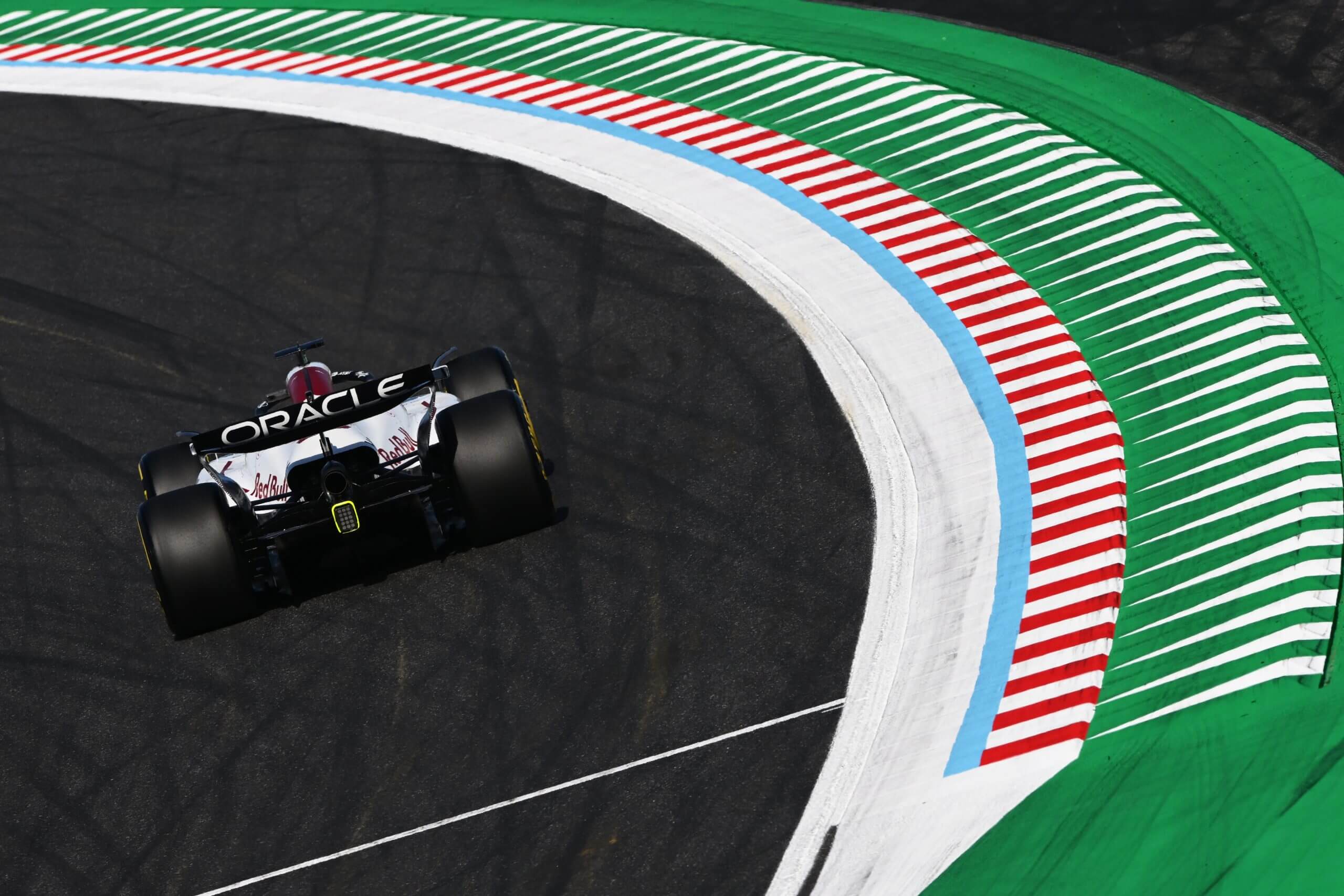
Red Bull driver Max Verstappen races through Suzuka’s 130R corner during the 2025 Japanese GP (Rudy Carezzevoli / Getty Images)
But the counterpoint to many of the concerns about the spectacle in qualifying is the quality of the racing showcased so far in the race events in 2026.
The back-and-forth overtaking action through the first two races, and especially the battle between Ferrari teammates Leclerc and Lewis Hamilton last time out in China, won praise in some corners. It has left F1 stakeholders — the F1 organization, the FIA and the teams — largely satisfied with the overall rating product.
So far, as reported by The Athletic, only rule tweaks such as the new qualifying energy harvesting limit are being considered, rather than wholesale changes.
“I personally find it much more fun,” Hamilton said on Thursday. “(The contest with Leclerc in China was) the most overtaking and best battle that I’ve had since Bahrain years and years ago with Nico (Rosberg, in 2014). That’s how racing should be.”
Suzuka is also a track where overtaking has been notoriously difficult. But if the new cars do help remedy that issue on Sunday, it may go some way to soothing concerns about qualifying.
And the fact remains that Suzuka is still Suzuka. It’s still special. And it will remain a challenge, with driver and machine working in harmony to get the best result.
Or, as Bortoleto put it when cautioning against too much doom-mongering: “Guys, it’s not that we are driving s— cars. We are still driving rocket ships. It’s so much downforce. It’s not as much downforce as we had last year, and the engine deployment is different.
“But it’s still a very fast car. So it’s definitely enjoyable to still drive Suzuka, don’t get me wrong.”