

Listen to this article
Estimated 5 minutes
The audio version of this article is generated by AI-based technology. Mispronunciations can occur. We are working with our partners to continually review and improve the results.
Metro Vancouver’s unwieldy governance structure has repeatedly been highlighted as a thing for the regional government to reform — but the board says it needs more debate and consultation to come up with a solution.
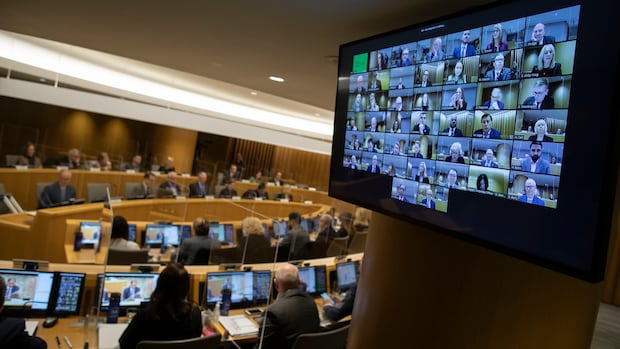
“We can be a successful board whether it’s 32, 34, or 36 members,” said board member and Burnaby Coun. Sav Dhaliwal at a committee meeting earlier this month that ended with no consensus on how much Metro Vancouver’s 41-person board should be reduced.
“We need to focus on how fast we can … concentrate on the business of the organization, rather than being bogged down in this quagmire about numbers.”
On Friday, the board is being asked to approve an engagement plan on potential options that would last until July, followed by a potential recommendation to the provincial government.
But the debate so far has underlined why the independent review said Metro Vancouver’s board was too big to begin with.
LISTEN | Justin McElroy discusses potential Metro Vancouver reforms with Stephen Quinn:
The Early Edition12:00Metro Matters: Metro Vancouver could soon be downsizing
Last year an outside investigation of Metro Vancouver’s governance recommended major changes in how the regional government operates – so where are they in implementing those changes? Justin McElroy shares an update.41 bad, but what number is good?
Last May, Deloitte issued its recommendations for change after a series of spending controversies and accountability questions effectively forced Metro Vancouver’s hands into an independent review.
Many of them have been acted upon, including reducing the number of committees, and eliminating a rule that allowed board members to double their meeting salary once it exceeded four hours.
However, the top finding by Deloitte — that the board “had become large and unwieldy” and a new “structure is required to provide more effective governance and oversight” — has taken longer to come to a conclusion.
Deloitte offered five options in its report, from independently appointed board members with outside expertise — which has gotten minimal support from board members — to a tweaked model with relatively few changes, and the board’s governance committee has been unable to come to a consensus.
“I think most of us agree that growing any larger is just not going to work,” said West Vancouver Mayor Mark Sager at this month’s meeting, a sentiment shared across the room.
But whether to go down to one representative for each of Metro Vancouver’s 21 municipalities — with the power of their individual vote weighted by population — or a hybrid option, divided members.
“I believe [one representative per municipality] deserves further exploration,” said Pitt Meadows Mayor Nicole MacDonald. “You end up with a stronger, more collaborative group where everyone wears their ‘Metro hat’ rather than just a local one.”
But Delta Coun. Dylan Kruger, the vice-chair of the governance committee, argued for a more diverse mix.
“I think there’s always been value in having a conglomeration of elected officials, whether they be mayors or councillors or those coming from different perspectives at the table here,” he said.
The discussion ended with most committee members preferring some option of 34 to 36 directors, a relatively minimal change from the status quo, but no resolution on a preferred option.
Decision before election?
New Westminster Coun. Daniel Fontaine, one of the fiercest critics of Metro Vancouver’s governance in recent years, said he didn’t trust the board to look objectively at how reducing its size could increase efficiency.
“The recommendations made by Deloitte should have been managed and reviewed by people who are not sitting around the board, receiving compensation and benefiting from the very structure that’s there,” he said, adding that anything less than a 50 per cent reduction in board size would be a failure in his mind.
He also criticized the length of time Metro Vancouver was taking with the changes, and accused them of trying to take it off the table as an issue for voters and candidates to consider in this October’s local elections.
“We have an election in six months. There should be some clarity, this should have been completed … I’m not even sure whether this will be completed in time for the voters to see what’s being proposed.”
But Vancouver Coun. Lisa Dominato, who chairs the governance committee that has been taking the lead in working through the Deloitte report, said the process showed Metro Vancouver was attentive to concerns.
“This is exactly what a public sector organization should be doing,” she said.
“When you identify gaps or challenges or things that aren’t working then you take a closer look and you look at how we can fix this … our goal is to bring recommendations to the board so we can endorse a path forward prior to the next civic election.”