

Listen to this article
Estimated 3 minutes
The audio version of this article is generated by AI-based technology. Mispronunciations can occur. We are working with our partners to continually review and improve the results.
Prince Edward Island’s largest power utility says it does not plan to export energy to the United States, despite it seeking permission to do so.
Maritime Electric filed an application to the Canada Energy Regulator to renew a permit to export up to 400,000 megawatts of electricity per year to areas within the Northeast Power Coordinating Council, which includes the U.S..
The utility has had the permit for decades, and said it has never actually exported power south of the border.
The permit is renewed on a 10-year cycle, which is up this year, said Angus Orford, vice-president of corporate planning an energy supply with Maritime Electric.
“There’s really no cost in the process of renewing a licence, but it was something we felt, ‘OK, since we have it, let’s maintain it,'” Orford said.
“The reality is that we’ve never exported, Maritime Electric or Prince Edward Island, to the New England market and it was never acted upon.… We don’t have the energy and we don’t have the capacity to export, but the value of just having the permit in place is such that if things change.”
Orford said Maritime Electric initially got the licence in 2006, when the government of the day had ambitious wind farm plans that would generate more electricity than could be used locally.
‘I’m OK with the application,’ energy minister says
Questions came up in the provincial legislature Thursday about what Maritime Electric plans to do with the licence.
Progressive Conservative MLA Brendan Curran — who’d also put questions to Maritime Electric at committee recently as the utility warned about a significant power shortage by 2030 — asked Energy Minister Sidney MacEwen if he could “justify Maritime Electric’s claim of an energy emergency when the utility is simultaneously seeking federal permission to ship our electricity to the United States?”
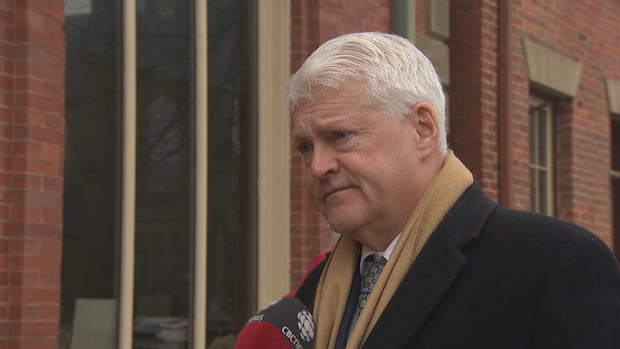
 In the rare instance that Maritime Electric would have excess power to sell, sending it to the U.S. is better than ‘dumping it for nothing,’ says P.E.I. Energy Minister Sidney MacEwen. (Rick Gibbs/CBC)
MacEwen told CBC News after question period that he supports having the permit in place.
“I’m OK with the application. It’s very rare, if ever, that we would have that kind of excess power to sell all the way to the United States,” MacEwen said.
“In the rare circumstance where we’d have an excess of power that we couldn’t use here or sell to the Maritimes, going to the United States [is] better than dumping it for nothing.… It gives them the option in case this was ever a possibility.”
MacEwen said government’s energy priorities include securing new undersea cables as soon as possible, along with creating a battery energy storage system and introducing performance-based incentives for Maritime Electric.