

Nearby WTI crude oil spent the week ending March 27 in a trader’s market, with headlines on U.S.-Iran diplomacy driving sharp intraday swings and keeping risk premium firmly tied to geopolitics.
As of late Thursday, nearby WTI was trading at $94.30, down $3.93, or 4.00%, for the week. That weekly loss, however, hides the real story. Price action was violent in both directions as traders tried to price the odds of a ceasefire against the reality that the Strait of Hormuz remains the key chokepoint in the global oil system.
Reuters reported that WTI settled at $98.23 last Friday, fell to $90.32 on Tuesday on hopes Iran might consider a U.S. peace proposal, then rebounded to $94.48 on Thursday as Iran denied talks and the market rebuilt supply-risk premium.
Crude Oil News Today: Peace Headlines Drove the Biggest Swings
The biggest driver was the market’s shifting read on the U.S. 15-point proposal to end the war. Early in the week, crude sold off hard when reports suggested Iran had not formally rejected the plan and that diplomacy might reopen export flows. That triggered a quick liquidation of war premium, with WTI sliding back toward $90. But traders never got confirmation of a real breakthrough.
By Thursday, Iran denied participating in peace talks, missile attacks resumed, and the market snapped back higher as traders concluded that any settlement remains uncertain and that supply disruptions could last longer than previously hoped.
Oil…
Nearby WTI crude oil spent the week ending March 27 in a trader’s market, with headlines on U.S.-Iran diplomacy driving sharp intraday swings and keeping risk premium firmly tied to geopolitics.
As of late Thursday, nearby WTI was trading at $94.30, down $3.93, or 4.00%, for the week. That weekly loss, however, hides the real story. Price action was violent in both directions as traders tried to price the odds of a ceasefire against the reality that the Strait of Hormuz remains the key chokepoint in the global oil system.
Reuters reported that WTI settled at $98.23 last Friday, fell to $90.32 on Tuesday on hopes Iran might consider a U.S. peace proposal, then rebounded to $94.48 on Thursday as Iran denied talks and the market rebuilt supply-risk premium.
Crude Oil News Today: Peace Headlines Drove the Biggest Swings
The biggest driver was the market’s shifting read on the U.S. 15-point proposal to end the war. Early in the week, crude sold off hard when reports suggested Iran had not formally rejected the plan and that diplomacy might reopen export flows. That triggered a quick liquidation of war premium, with WTI sliding back toward $90. But traders never got confirmation of a real breakthrough.
By Thursday, Iran denied participating in peace talks, missile attacks resumed, and the market snapped back higher as traders concluded that any settlement remains uncertain and that supply disruptions could last longer than previously hoped.
Oil Prices Forecast Hinges on Strait of Hormuz and Infrastructure Risk
For crude traders, the Strait of Hormuz is still the center of gravity. Reuters reported that the conflict has nearly halted shipments through the strait, which normally handles around one-fifth of global oil and LNG traffic. Barclays said a prolonged disruption could remove 13 million to 14 million barrels per day from supply, calling this the biggest geopolitical oil shock since the 1990 Gulf War. The bank expects traffic to normalize by early April in its base case, but warned that if disruption extends into April or May, Brent could hold in a $100 to $110 range. Infrastructure damage across the region adds another layer of support because even a political deal would not instantly restore lost flows, refinery runs, or export logistics.
Goldman Sachs, EIA, and Oil Prices Projections Keep Traders Focused on Tight Supply
Major forecasters have adjusted to that tighter backdrop. Goldman Sachs raised its 2026 average forecast for Brent to $85 from $77 and WTI to $79 from $72, while lifting its March-April Brent assumption to $110 because of extended Hormuz disruption and strategic stockpiling. Goldman also said a severe 10-week disruption with persistent production losses could push Brent to $135.
The EIA’s March Short-Term Energy Outlook similarly assumes that the effective Hormuz closure will cut Middle East production in coming weeks; it now expects Brent to remain above $95 over the next two months and lifted its 2026 WTI forecast to $74. Those oil prices projections matter because they show analysts are no longer treating the current spike as a one-day geopolitical scare.
Global Economy, Inflation and Interest Rates Are Back in the Oil Trade
This week also reminded traders that crude is no longer trading only on barrels; it is trading on macro damage. Reuters reported that higher oil prices pushed global stocks lower, lifted bond yields, and helped erase expectations for U.S. rate cuts this year.
The OECD said the Iran war has already erased a global growth upgrade and is fanning inflation. TotalEnergies CEO Patrick Pouyanne warned that if disruption lasts more than three to four months, it could become a systemic risk to the global economy. In the U.S., EIA data showed commercial crude inventories rose by 6.9 million barrels in the latest week, a bearish domestic input, but that build did little to offset the bigger international supply story.
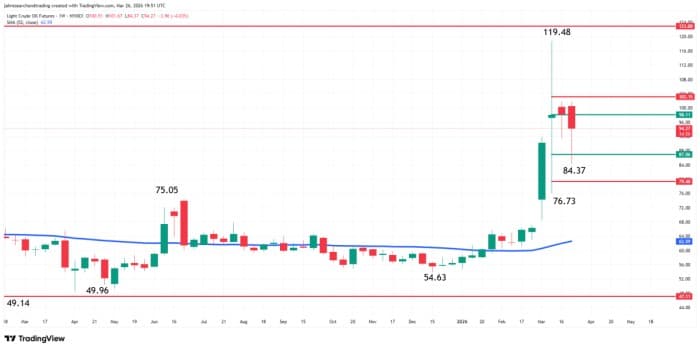
Weekly Light Crude Oil Futures
Trend Indicator Analysis
The main trend is up according to the weekly swing chart and moving average analysis. A trade through $119.48 will reaffirm the uptrend. The short-term range is $54.63 to $119.48. Its 50% to 61.8% retracement zone is $87.06 to $79.40, This is support. It was tested successfully when the market rebounded from a plunge to $84.37 early in the week.
The minor range is $119.48 to $76.73. Its retracement zone at $98.11 to $103.15 is resistance. It is stopping the market from rallying for a third week in a row.
Trader reaction to $98.11 to $103.15 should set the tone next week.
Weekly Technical Forecast
The direction of the weekly Light Crude Oil Futures market for the week ending April 3 is likely to be determined by trader reaction to the 50% level at $98.11 and the 61.8% level at $103.15.
Bullish Scenario
A sustained move above $98.11 will signal the presence of buyers. This move could create the upside momentum needed to test the Fibonacci level at $103.15. This price is potential resistance and the trigger point for an acceleration to the upside, with $119.48 to $130.00 the next major target zone.
Bearish Scenario
The inability to overcome $103.15 will signal the presence of sellers. If the selling is strong enough to take out $98.11, then we could see another plunge into the retracement zone at $87.06 to $79.40. This is the last potential support before the 52-week moving average at $62.59.
The near-term outlook for nearby WTI remains bullish, even after this week’s pullback. Unless traders see a verified U.S.-Iran agreement, a credible reopening of the Strait of Hormuz, and evidence that damaged infrastructure can return barrels quickly, dips are likely to attract buying. The weekly close may end below last Friday’s settlement, but the market still looks structurally supported by geopolitical risk, tighter supply expectations, and a fresh inflation premium that keeps crude highly sensitive to every headline.
Technically, volatility is heightened, but traders are still respecting the key support zone at $87.06 to $79.40. In fact, the price action indicates that they may have bought more when the market gave them a gift with the plunge to $84.37.
The upper line in the sand at $98.11 is still critical. While we saw bullish traders bidding on the sell-off, we’d really like to see traders taking out offers to drive prices higher. This is why some traders are still calling this a “cautiously bullish” trade. This tone will shift to “aggressively bullish” if $103.15 is taken out with conviction.