
The International Olympic Committee’s new eligibility policy that essentially bans transgender women athletes from competing in women’s events has raised as many questions as it has criticisms.
The decision requires any athlete competing in a female category to test negative on a one-time gene-screening test, with rare exceptions, and will apply starting with the 2028 Summer Olympics in L.A., the IOC wrote in its 10-page policy document.
“We know that this topic is sensitive,” IOC President Kirsty Coventry said in an online video statement Thursday.
Sensitive, yes, with hundreds of human rights, sports and medical organizations speaking out against it, many saying the IOC has no right to be the “gender police.” France’s sports minister has called it a “step backwards,” while U.S. President Donald Trump welcomed it, posting his “congratulations” to the IOC on social media.
But it’s also a complex decision, begging questions like how the IOC defines a female athlete and how the genetic testing will work.
Let’s break it down.
How does the IOC define female?
Let’s start with the technicalities, because technically, the policy focuses on “the protection of the female category in Olympic sport.” And in her video statement, Coventry doesn’t use the word transgender at all.
But the policy does explicitly limit eligibility for any female category event at the Olympic Games or other IOC events to what the committee calls “biological females,” a problematic term which, in the end, essentially bans female transgender athletes.
WATCH | IOC bans transgender females:
IOC bans transgender females from women’s Olympic competition
The International Olympic Committee has banned transgender female athletes from women’s competition. Women’s Olympic events are now limited to biological females determined by a mandatory one-time gene test.
The IOC defines women’s and men’s sport categories as those designated for “biological females” and “biological males,” according to reproductive biology, including sex chromosomes, gonads and hormones, “regardless of their legal sex or gender identity.”
The terms “biological males” and “biological females” are problematic because they can be used to deny or undermine the identities of trans, non-binary and gender-diverse people.
The IOC describes male and female as distinct categories, though natural variation exists where a person may be born with, for example, male chromosomes but female physical traits.
The policy acknowledges the variation as “differences/disorders of sex development (DSD),” which it calls “rare genetic conditions that result in atypical sex development.”
It defines transgender as “a person whose gender identity is different from their biological sex.”
 South Africa athlete Caster Semenya, center, answers reporters after Semenya winning a partial victory at the European Court of Human Rights in her seven-year legal fight against track and field’s sex eligibility rules, on July 10, 2025 in Strasbourg, France. (Antonin Utz/The Associated Press)So now what?
All athletes wanting to qualify or take part in female category events from the L.A. 2028 Olympics onwards will have to undergo an SRY gene test to determine their eligibility.
SRY stands for sex-determining region Y gene.
This includes minors.
How does genetic testing work?
SRY gene screening is done via saliva, cheek swab or blood sample and is unintrusive compared to other methods, the IOC said, and will be done only once in the athlete’s career.
It screens for “a segment of DNA typically found on the Y chromosome that initiates male sex development in utero and indicates the presence of testes/testicles.”
Those who test negative “will have lifelong eligibility without further evaluation or examination,” the IOC said.
The now-mandatory screening is already conducted by the governing bodies of track and field, skiing and boxing, according to the Associated Press.
WATCH | Skate Canada pulls events over Alberta transgender law:
Skate Canada pulls major events from Alberta over transgender law
Skate Canada announced it will no longer host national and international-level events in Alberta because of a provincial law restricting transgender athletes from participating in female-only sports.What happens if you test positive?
The IOC states that anyone with an SRY-positive screen, including transgender women and “androgen-sensitive XY-DSD athletes,” will be banned from competing in female categories.
They would continue to be included in all other classifications for which they qualify, the IOC said.
“For example, they are eligible for any male category, including in a designated male slot within any mixed category, and any open category.”
Are there exceptions?
There are exceptions for rare cases of sex development, the IOC said.
This includes athletes with a diagnosis of Complete Androgen Insensitivity Syndrome (CAIS) or other rare differences/disorders in sex development (DSDs), “who do not benefit from the anabolic and/or performance-enhancing effects of testosterone.”
What about people who are intersex?
Intersex people, also known as those with Disorders of Sex Development (DSD), are born with variations in physical traits such as chromosomes, hormone function, and/or reproductive biology, according to interACT: Advocates for Intersex Youth.
And the new eligibility restrictions will “discriminatorily deny many intersex women access to women’s sports,” the organization said in a statement Thursday.
Alun Williams, a professor of sport and exercise genomics at Manchester Metropolitan University, said in an online statement that it seems the point of the IOC’s new genetic testing policy is mainly to identify intersex athletes, since transgender athletes can self-identify.
It targets “athletes recorded female at birth, who have lived their whole lives as girls and then women and who have a rare genetic characteristic that affects the development of their reproductive and hormonal systems,” Williams said.
He added there’s no “convincing direct evidence” that athletes with Disorders of Sex Development have advantages in sport.
Are there transgender Olympians?
It is unclear how many, if any, transgender women are competing at an Olympic level. As Reuters reports, only a handful of openly transgender athletes have taken part in the Games.
This year, Swedish freestyle skier Elis Lundholm made history as the first openly transgender athlete to compete at a Winter Games.
 Sweden’s Elis Lundholm competes during the women’s freestyle skiing moguls qualifications at the 2026 Winter Olympics, in Livigno, Italy, on Feb. 11, 2026. (Gregory Bull/The Associated Press)
Lundholm, who was assigned female at birth and identifies as a man, competed in the women’s category. The Swedish ski team said Lundholm has not undergone any gender-affirming treatment or surgery, meaning there is no discussion of having an unfair advantage.
He ranked 25th in women’s moguls and women’s dual moguls.
New Zealand’s Laurel Hubbard became the first to compete in a different gender category to that assigned at birth when the weightlifter took part in the Tokyo Olympics in 2021.
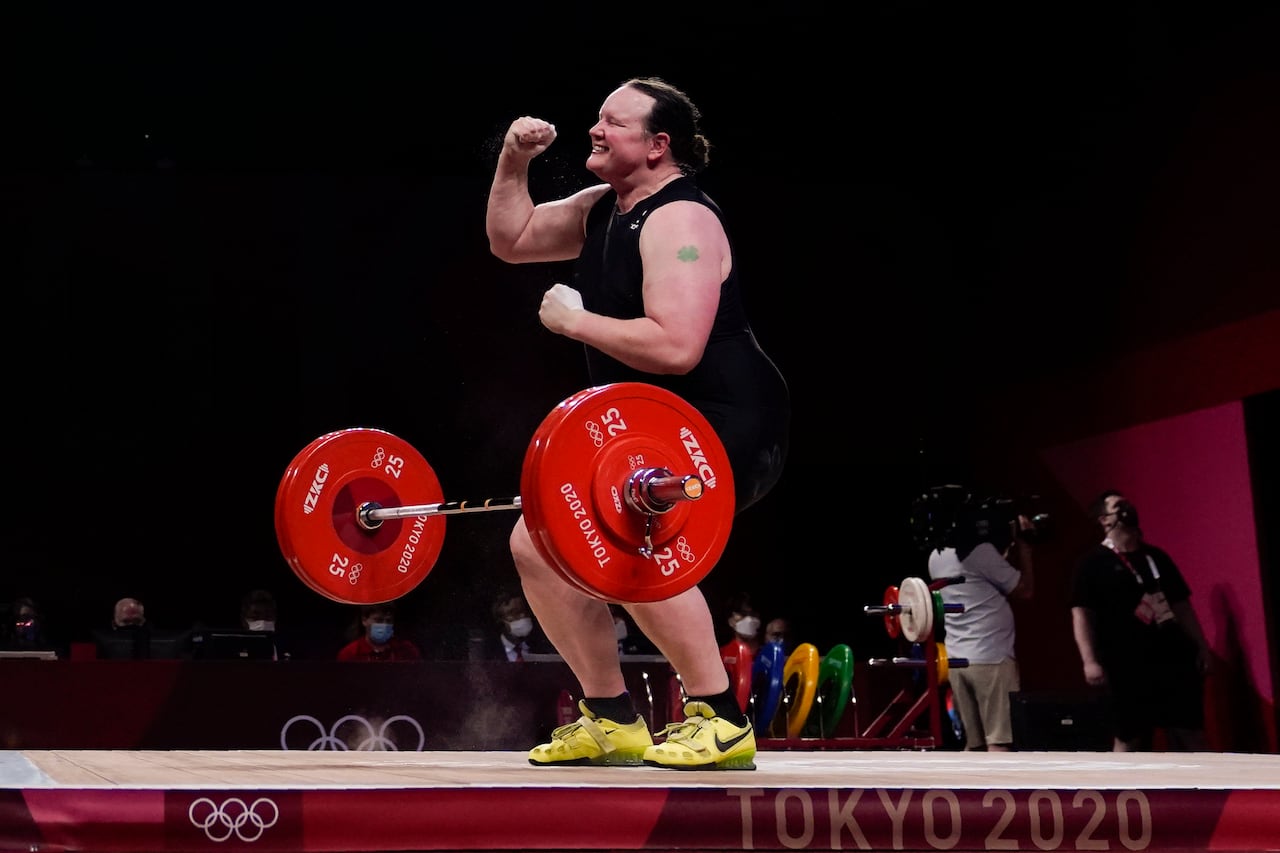 Laurel Hubbard of New Zealand celebrates after a lift in the women’s +87kg weightlifting event at the 2020 Summer Olympics, Monday, Aug. 2, 2021, in Tokyo. (Seth Wenig/The Associated Press)
No woman who transitioned from being assigned male at birth competed at the 2024 Paris Summer Games, according to the Associated Press.
Before the 2024 Paris Olympics, three top-tier sports — track and field, swimming and cycling — excluded transgender women who had been through male puberty.
Olympic champion runner Caster Semenya , who was assigned female at birth in South Africa and has testosterone levels higher than the typical female range, won a European Court of Human Rights judgment in her years-long legal challenge to track and field’s rules, though the ruling didn’t overturn the policies.
Do athletes competing as males require testing?
There is no mention in the policy paper of males being tested to compete in male athletic categories.