

Listen to this article
Estimated 4 minutes
The audio version of this article is generated by AI-based technology. Mispronunciations can occur. We are working with our partners to continually review and improve the results.
The group now in charge of recycling in Quebec says its first year was a success, but critics say there’s more work to be done to protect the environment.
“We can say it’s mission accomplished because there weren’t any breakdowns in collection and sorting services in 2025, nothing changed that much for the citizens,” said Maryse Vermette, president and CEO of Éco Entreprises Québec.
The non-profit organization that represents container and packaging producers took over the collection, sorting and sale of recyclable material at the start of 2025 under a new producer-led recycling program.
Under this model, businesses foot the bill for recycling costs — and are charged higher fees for products that aren’t deemed eco-friendly. They’re encouraged to reduce packaging weight, use single-material containers and avoid over-packaging.
Meanwhile, more items can be recycled. All containers, packaging material or printed items were made eligible for recycling. That includes all kinds of plastics, as well as cardboard, paper and glass.
In a 2025 internal review released last week, the group said 99 per cent of Quebec’s population was served and nearly 791,000 tonnes of material were recovered during the year.
WATCH | More work to be done, critics say: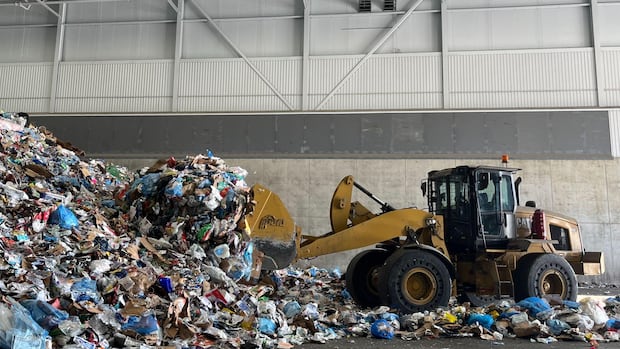
Does Quebec’s new recycling system really work?
The group now in charge of recycling in Quebec says its first year was a success, but critics say there’s more work to be done.
The report says about 80 per cent of collected materials were sent for recycling, with 63 per cent processed within Quebec — a five per cent increase from previous levels. It also notes a contamination rate of roughly 13 per cent and says four out of five recovered items were directed to recycling streams.
The organization said it worked with 2,800 producers in 2025, generating $457 million in contributions under the extended producer responsibility model. It also cited what it described as difficult market conditions, including falling prices for plastics, paper and cardboard due to oversupply and global uncertainty.
Vermette said the priority in the first year was to maintain uninterrupted service.
Other solutions needed
The government’s goal was to place the burden of recycling on producers that make containers and packaging. But some say other solutions need to be explored in order to have a true impact when it comes to reducing waste.
Karen Wirsig is with Environmental Defence, a group of policy experts, scientists and community advocates that strives to protect Canada’s environment. She said there should be a focus on reducing the amount of wasteful packaging that is used.
Packaging should be changed so it can be refilled many times and recycled afterwards, she said, because as it stands now, the process is far from perfect.
Wirsig said some of the paper collected, for example, is being exported outside of North America. Paper bales laced with plastic end up polluting other countries like India, she said.
She also said burning some of the materials in the name of recycling is not a good sign.
“It’s really disappointing to see that, you know, a certain amount of flexible plastics are being burned,” Wirsig said.
Transportation comes at a cost
Myra Hird, Queen’s University environmental studies professor, said the environmental impact of transportation can remove the benefit of recycling.
“So the government needs to track exactly what companies are doing with the recycling, how far away they are and how much waste they are producing, because all recycling produces its own waste,” she said.
In many cases, Hird said, it’s less wasteful to landfill material than it is to recycle. Hird said instead of focusing on recycling, companies should be designing smarter packaging — eliminating those that can’t be easily collected. She said it would help to encourage reusable packaging that companies take back, wash and reuse.
“This works for things like personal care products, shampoos and cleaners,” she said. “But it also works for jams and soups, especially things that are filled locally — milk and other beverages.”
Provinces need to start requiring companies to invest in these systems that eliminate single-use packaging, she said. Reusing containers is not a new concept, she noted, as that was the way for many products, like milk, before plastic became the norm.