
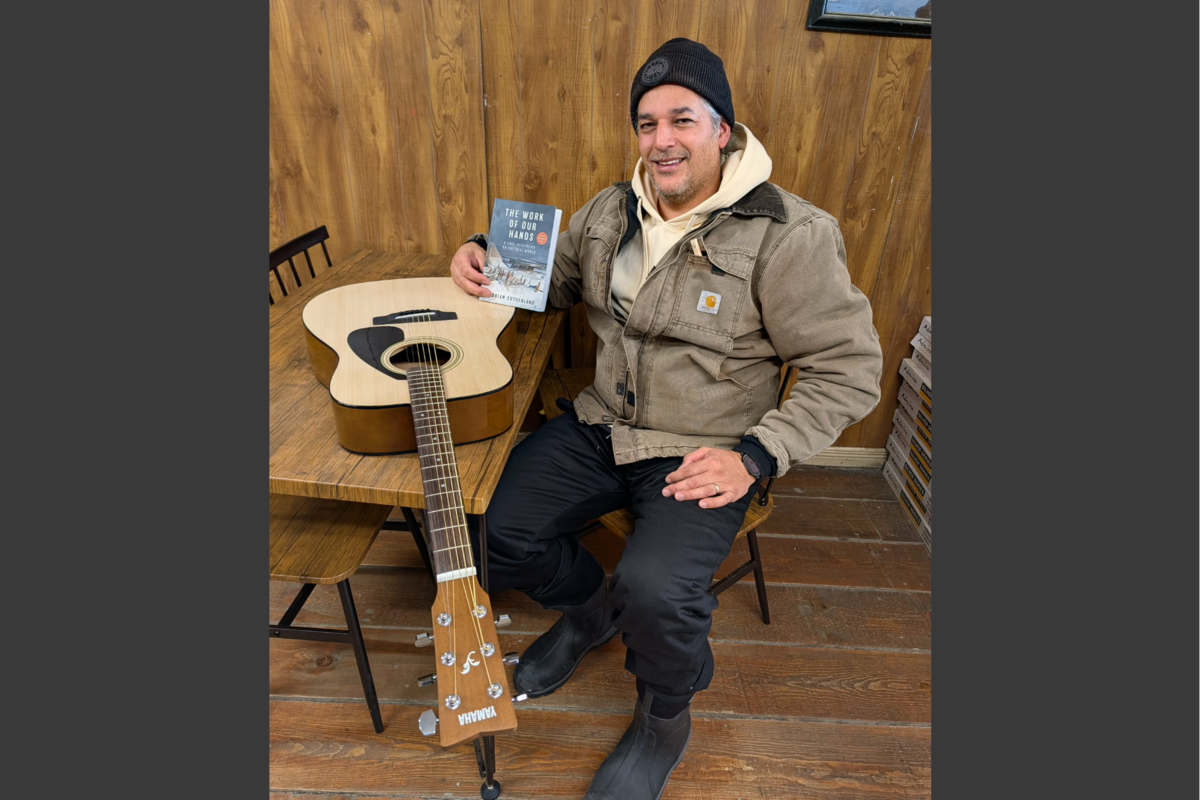
Adrian Sutherland is a Juno-nominated Cree singer-songwriter from Attawapiskat who has built a national audience without leaving home. After a winter-road journey along Ontario’s James Bay coast and a packed Toronto concert, Back Roads Bill found that one theme kept surfacing in Sutherland’s music and memoir alike: belonging isn’t comfort—it’s connection to the land
“To know someone, you must meet them on their turf.”
It is an idiomatic expression – to truly understand a person, you must observe them in their own environment.
Not stalking, but I am following someone. I think it is a back roads connection.
On the James Bay coast, he is a celebrity; everyone knows of Adrian Sutherland.
He is one of their own. In context, someone who is like them. And he is.
He is a Juno-nominated Cree singer, songwriter and author from Attawapiskat, one with the land and very entuned with his culture.
This third story was saved beyond the other two James Bay winter road stories.
There was a profound interest generated in this Indigenous talent when listening on January 19, The Current with Matt Galloway on CBC Radio.
A winter road trek to the James Bay hinterland was not yet a thought.
So, I listened to the interview and then listened to his music.
Hmmm…there’s more than something here, I was intrigued. Here’s a sincere person who combines passion with his past and present. Someone who tells cultural stories about what matters through music and prose.
So why does he stay?
What we don’t know
It was a long way to go for the answer. It is their environment.
It was a winter road round trip from Moosonee, about 600 km, a long day, it is the “turf.”
But along the way, you start to comprehend by observation.
Living in a remote James Bay community – such as Attawapiskat, Fort Albany, Kashechewan (Kash) – is defined by a cultural alliance to the land with an intense isolation that is not familiar to us.
But it is the home environment of these three coastal Mushkegowuk (western Cree) communities.
This place is a blend of traditional Cree culture with modern challenges created by colonialism. Life is dictated by the seasons, with extreme weather conditions and significant reliance on winter roads, air or water transportation in the other three months of the year.
Climate change is increasingly impacting travel, with shorter windows for winter roads.
What we don’t know. Communities often feature similarly designed, close-together prefabricated housing. There are no malls, traffic lights or Tim Horton’s (there is a small Tim’s outlet in the Northern Store in Kash, but it has remained closed for months because of the water quality crisis.) While there are schools, band offices, and sportsplexes, many communities face challenges with housing quality and access to clean water or high-quality healthcare.
Their life involves balancing modern demands with traditional ways. Young people are conflicted between the desire to explore the ‘outside world’ and their home community. The local economy often lacks diverse opportunities, leading many to depart for education and work.
I need someone to explain this context.
Adrian’s home
We met at The Moose restaurant, which his family owns.
I find him to be genteel and forthcoming.
Adrian describes the geography – the sense of his place, that’s important to me – to him.
“People often ask me where I come from and what it’s like living in a remote community, “he elaborates. “I live in the Far North of Ontario. That’s 1,054km away from Toronto, and 501km away from Timmins. To travel out, I fly Air Creebec to Timmins, and then board connecting Air Canada flights to shows in other cities.
Adrian loves his geography.
He says the Cree people rely on James Bay for fishing and travelling, as well as the freshwater rivers that flow into the bay. I look at the map – Attawapiskat, La Grande, Eastmain, Rupert, Broadback, Nottaway, Harricana, Moose, Albany, and Ekwan.
I have written about projects undertaken without consultation. The Harricana was another. It was a grandiose water diversion scheme, commonly known as the Great Recycling and Northern Development (GRAND) Canal proposal. A massive engineering concept designed to capture fresh water flowing into James Bay and divert it southward into the Great Lakes and the United States. Believe it. Proposed in the 1950s, the project aimed to create a freshwater bay or reservoir by damming the mouth of James Bay, reversing the flow of the Harricana River, and creating a 533-kilometre southward canal system.)
He describes the largest island in James Bay, Akimiski Island, about 80 km away from Attawapiskat. It is a sanctuary for migratory birds like snow geese, as well as other wildlife, and plants used for herbal medicines. In the spring, snow geese live in the southern parts of James Bay until the northern part thaws. Seals, polar bears, and beluga whales also live in the same area.
“Hunting and fishing are a big part of life that help sustain local families. My family and I fish for trout, northern pike, and walleye. In the fall, we head up to the tundra, about 225 kilometres north of Attawapiskat. The tundra can be a harsh place year-round. It has frequent snowstorms, temperatures as low as -60°C, and fog patches from the Hudson Bay coast. It’s also the birthing ground for barren-land caribou, and thousands of waterfowl migrate there each year to nest.”
There are local politics, which I try and stay apart from.
“Although it would be easier to move to the city and live the “city-life,” I have chosen to stay in my ancestral lands to stay close to my roots. I believe it’s important to pass on hunting, fishing, and outdoor knowledge to the younger generations. The knowledge I carry with me was passed down by my grandparents and their grandparents. I’m committed to sharing it with future generations so they can keep our traditions alive.”
And this is the segue to his book and music.
The music
He is one of the only professional recording artists in all of Canada who resides on a remote fly-in First Nation, fluent in his native language.
How to describe his singing voice as a unique texture.
From his website. “His melding of folk, rock, roots, and blues draws inspiration from his northern life, traditional lands, and Cree culture. His music touches hearts, with soul-stirring songs rippling far beyond stages and airwaves.”
It is why I eventually journeyed to his concert.
He released four albums with his band Midnight Shine before turning to solo projects.
Since 2021, he has been nominated twice for the Juno Awards and won Best Americana Album for the World Entertainment Awards.
Another example of staying home.
In 2025, he proudly released the music video for I’m Not Afraid, an uplifting new song co-written with youth from Kashechewan First Nation as part of the community’s Choose Life Program. This Nishnawbe Aski Nation (representing 49 First Nations) program advocates for and promotes the mental, emotional, and behavioural well-being of youth.
Sutherland travelled to Kash on three separate occasions to work closely with a group of local youth, writing a song rooted in resilience and connection. He says the result is a heartfelt anthem paired with a music video that captures the spirit of hope and collaboration behind the project.
The Work of Our Hands
The Work of Our Hands – A Cree Meditation on the Real was released in 2025.
If you order the book, you will appreciate this assessment: “It is an easy read, but it isn’t.”
It is a memoir that explains a once-troubled life and a way of life that we can’t relate to.
“It was challenging to confront the past and express my thoughts.”
It starts and ends with a relationship with a “natural to supernatural” polar bear experience and his relationship with the Creator.
There are stories of the land – from the wisdom of the Elders. He recounts the real and unreal environmental factors of lifestyle, of addiction, despair, and suicide. There are familiar dysfunctional relationships, siblings being taken away by CAS. He became a schoolyard bully and fighter.
On page 63, “On the sidewalk near my house was a large plastic box where the municipality (Ottawa then) stored the sand and salt used to keep the sidewalks clear of ice. That was where I slept. I could keep watch there for my mom to come home…I managed to stave off freezing to death in that box by burning cardboard boxes…so I ran again.”
Reading the book brings the reader closer to the distant reality.
The reasons behind the book.
“In a world yearning for meaning, the path to spiritual renewal may lie through the discipline and freedom that only hard work can show us.”
He explains, “Life is hard in Attawapiskat. Outsiders see poverty and despair, the sagging, mould-filled houses with generations packed into each one. The substance abuse and the suicides. The decaying water system, that has come to symbolize the everyday injustice faced by First Nations’ communities.”
For him, everyday life in the community means choosing a difficult path.
“We learn from the contours and hard edges of the world and striving to do what is right. That is freedom. How many of us can say we are free?”
He explores his James Bay world through the experiential use of his hands. He says, “Stories come from holding a guitar, a hammer, a rifle, or a canister used to carry water to his family home, and the materials from which the traditional Cree sweat lodge is constructed.” These are the symbols of his stories and songs.
He paints a portrait of a world that we are not familiar with. He said there’s a way the world itself can teach us right and wrong, “As clearly as we can detect a musical note that is off-key.”
He knows the answer to the question in a stoic way that is part of knowing the intimate sense of place.
“Why do I choose to live here? is misleading. I don’t choose to live here any more than I chose to be born here. This is where the meaning is, whether I liked it or not. We are all shaped by our encounters with the world around us. I was shaped by this world. It’s not a question of comfort. Many parts of the world are more comfortable than Attawapiskat. But being part of a place and merely living somewhere are two different things. I am part of this place.“
He is married to Judy, a father of four, grandfather of seven. His book is dedicated to her. He is a fluent speaker.
He is a master corporal with the Canadian Rangers. The Canadian Rangers are a specialized sub-component of the Canadian Army Reserve providing a military presence in remote, coastal, and northern regions. Comprised of about 5,000 part-time reservists, often from Indigenous communities, they act as the “eyes and ears” on the land.
He gives back by leading young people on wilderness initiatives.
There is a testimonial for the Penguin Random House book from Jim Cuddy of Blue Rodeo, the iconic forty-year-old Canadian countrified rock band.
“Adrian has written a powerful and heart-wrenching memoir – a story of struggle, addiction, resilience, and ultimately, spiritual awakening. With unflinching honesty and hard-won wisdom, this book invites the reader not only to witness his journey but to cheer for him along the way. Deeply inspiring, this book lingers long after the final page.”
Toronto
You can listen to an artist’s music on mainstream platforms, but the real vibe is in person.
It is not so far from the big city to undertake another road trip from north to south.
Tickets were purchased for the Allied Music Centre, a smaller venue but part of the major expansion and renovation of the historic Massey Hall, for Friday, March 20.
The audience was enthusiastic.
His musical lyrics mimic the book and life stories. His stage presence brings people together through his stories.
He sang Politician Man. He introduced the Canadian protest song with a short retort, “Politicians in Ottawa telling us how to live.”
The seeds of the lyrics were sown when Attawapiskat declared a state of emergency over contaminated water in 2019. At the same moment, insensitive comments from an Ottawa politician sparked public outcry and national media coverage.
It reached #1 on the Indigenous Music Countdown in May 2020. There was also a connected, award-winning video created by animator Justin Stephenson (Gord Downie’s The Secret Path). It speaks to Canada’s troubled relationship with First Nations in a visually impactful way.
Another memorable lyric in ‘Diamonds,’ a life song of being present in the moment…. “We’re like diamonds, diamonds, diamonds made from the sun.” “Here today and you’re gone tomorrow…Wash it down with a glass of sorrow.”
He sang Precious, a cultural acknowledgement of the Cree on James Bay and the importance of continuing to love the land.
Come on now people. Come on now people.
Come on now people come on
Woah now sinner’
Where are you going to run to now
There ain’t now hiding in here
Woah now sinner
Where are you going to run to now
This land is precious
(Chorus repeated)..Hey eh ow (hey) get ey ow (hey)
There was an attentive audience of about 150 people, very diverse by observation. I canvassed the nearby seats of the appreciative crowd.
A younger 22-year-old Chandini Pulchart from Toronto related to “how the lyrics related to the land. I need to know more about this.”
Jennifer Nadean and Rick Fernback were at Adrian’s book signing at the Another Story Bookshop in Toronto early in the New Year.
Jennifer is originally from the Soo and attended White Pines Collegiate and Vocational School. They were “drawn to the concert because of the words within his book.”
Post performance, they were not disappointed, “…fantastic…”
Nazeen Mehdi is a locum nurse who has worked in many isolated First Nation communities. She described his stage presence. “He has a peaceful but impactful voice. It is an Indigenous voice with a heartbeat. His lyrics have deep sounds that accompany the drum beats that pay homage to the land, the people and our shared history.”
She said he is playful. He unites everyone through knowledge and shared awareness.
Then there is Back Roads Bill’s favourite, James Bay is calling my name. The words mean something because of the recent winter road trip. There is imaging.
James Bay is calling my name
James Bay is running through my veins
James Bay will always be my way
James Bay is who I am today
Home of the Mushkegowuk Cree
That’s where I wanna be
Sitting at camp, sipping on tea
Every time I go out on the land
I become a new man
Makes me so alive inside.
There is a relationship with “sense of place,” a reference to this often-referred-to natural link.
That’s why he stays.
Just before this Horizon Tour of five southern Ontario stops, he performed at community schools along the coast called the Ice Roads Tour, three years running.
(Except for Kash, where most of the community has been evacuated because of the ongoing water crisis.) These were funded by the Ontario Arts Council.
My book was signed. Dedicated to my daughter, he said, “This land is the great equalizer!”
It is so.
This is underlined in this book passage.
“If you talk to an Indigenous person, you will hear about the land. They will acknowledge that things aren’t perfect in town, but they will be very clear – things are different on the land.
Their place.
Within the book’s acknowledgements, he ends with an offering: “I hope you find something within it that resonates with you.”
So many takeaways.
His grandfather told him, “People are not meant to be indoors.” “Real life,” Adrian states, “Is lived outside.”
I can relate.
This connection for Adrian is a profound one – with the land, naturally, on the back roads.
This circuitous pursuit of someone now made sense.
I am a follower.