
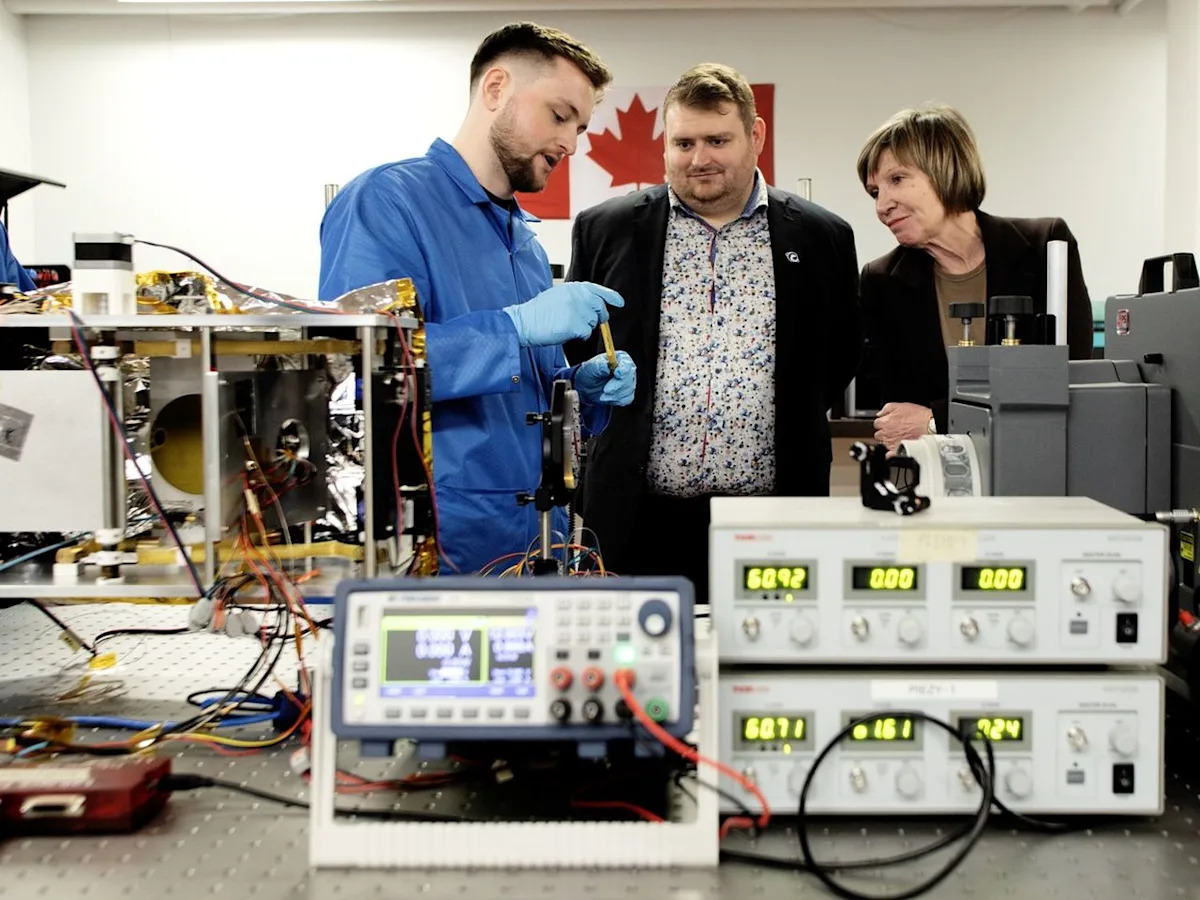
Canadian technology will soon be detecting maritime evader vessels by their ‘fingerprints’ thanks to an Edmonton aerospace company and an infusion of federal investment.
Edmonton’s Wyvern Inc. uses hyperspectral imagery to go light years beyond what other satellite imagery can achieve.
Wyvern’s CEO and co-founder Christopher Robson described the ground-breaking technology Friday at the company’s northwest Edmonton headquarters where $6 million in federal investment for defence-related firms in the region was announced.
“In maritime law enforcement and security, one of the things that you’ll see a lot in the news today is about, for example, Russia’s shadow fleet trying to evade oil sanctions,” Robson said, citing vessels using hacks like disabling automatic identification systems, spoofing them to pretend to be someone else, and transferring oil and gas between ships.
Wyvern designs, builds and operates instruments that fly on the company’s satellites — and now they can uniquely identify ships at sea in ways that conventional sensors can’t, Robson said.
“The thing that hyperspectral does, and something that we discovered, is that every ship has its own unique spectral signature. It’s like a fingerprint, and so just like a fingerprint, you can associate that unique fingerprint with individual ships,” he said.
“And by doing that, we can actually identify a ship from space regardless of whether or not they have their AIS on whether or not they’ve done some other weird things to avoid detection.”
Satellite imagery, ‘essential infrastructure’
While a standard satellite photo shows what something looks like, five satellites, for example, can show customers and partners from 30 countries incredible detailed imagery obtained from the bird’s-eye view of space.
Wavelengths of light reveal what an object is made of, can measure nitrogen in agricultural crops, and even determine wildfire risk — and environmental compliance.
“Satellite imagery is essential infrastructure. Governments rely on it to monitor borders, manage resources and respond to disasters. Canada has enormous territory, the longest coastline in the world, vast forests, Arctic sovereignty obligations — and space-based intelligence is how we keep track of it,” Robson said.
About $3 million in federal dollars will advance Wyvern’s ship identification capability, accelerating data delivery and advancing next-generation sensor technology. It’s an investment to strengthen Canada’s defence readiness with dual-use infrastructure that benefits all Canadians, Robson said.

Christopher Robson, CEO and co-founder of Wyvern, in Edmonton Friday, March 27, 2026.
$3M to establish defence centre at the U of A
Another $3 million in federal dollars will establish Dual-use Ecosystem for Future Engineering National Defence and Sovereignty (DEFENDS) at the University of Alberta.
The centre will help prairies-based companies test and design and bring defence technologies to market for defence and civilian applications, said Bill Flanagan, president and vice chancellor of the University of Alberta.
“It will help bridge a critical gap, moving innovation from research to real world deployment and ensuring Canadian ideas are developed, validated and scaled very carefully,” said Flanagan, at Friday’s announcement.
“Alberta and the prairies more broadly, have enormous potential to contribute to Canada’s defence ecosystem; we are home to some of the brightest minds in the country, and through programs like DEFENDS, we are creating a hub that brings together industry, researchers and government to unlock that potential, supporting military readiness while driving economic growth and job creation.”
It aligns with Canada’s broader defence strategy, strengthening domestic supply chains, reducing reliance on foreign technologies, and building a more resilient and self-sufficient economy, he said.
A broader shift recognizes technology is shaping the future, from an artificial intelligence to advanced materials to space-based systems — all increasingly dual-use in both civilian and defence applications, he said.
“Canada must be positioned not only to develop these technologies, but to deploy them strategically and securely,” Flanagan said.
Flanagan beamed as he showcased the Wyvern HQ, the machines at workstations around the large room that all started as a student club at the Faculty of Engineering, eventually becoming the first investment from the U of A’s Innovation Fund.

Bill Flanagan, president and vice-chancellor of the University of Alberta, in Edmonton Friday, March 27, 2026.
Millions part of Canada’s GDP commitment
The $6 million for Edmonton region defence projects came in the wake of Prime Minister Mark Carney’s announcement that the country had met Canada’s main defence investment target of 2 per cent of GDP for the first time. The funding reiterates a commitment to increase that investment to 5 per cent by 2035, said Edmonton Centre MP Eleanor Olszewski, the minister responsible for Prairies Economic Development Canada.
“Recent geopolitical events have really highlighted a fundamental truth: we’re living in a more dangerous in a more uncertain world. Canada’s government is focused on what we can control, and that means recognizing and acting on another fundamental truth, and that is that economic strength and national security go hand in hand,” Olszewski, at the Friday news conference, said.
“This is a changing time for us, and we can no longer rely on our neighbors the way that we used to.”
The Regional Defence Investment Initiative (RDII) will help businesses across the country scale up while strengthening Canada’s new Defence Industrial Strategy, expected to help guide investments in the industry “by equipping our Canadian Armed Forces, creating good jobs in the meantime, and also positioning Canadian firms to compete in a rapidly expanding global defence market,” Olszewski said.
Alberta’s well-positioned to help lead and strengthen Canada’s defence industrial base while building on long term economic growth, she said.
“You are building a stronger Alberta, and a strong Alberta means a strong Canada.”
Overall, the funding’s expected to jumpstart 80 careers and help businesses compete globally, and strengthen Canada’s domestic supply chains, building solutions to solve big challenges, Olszewski said.
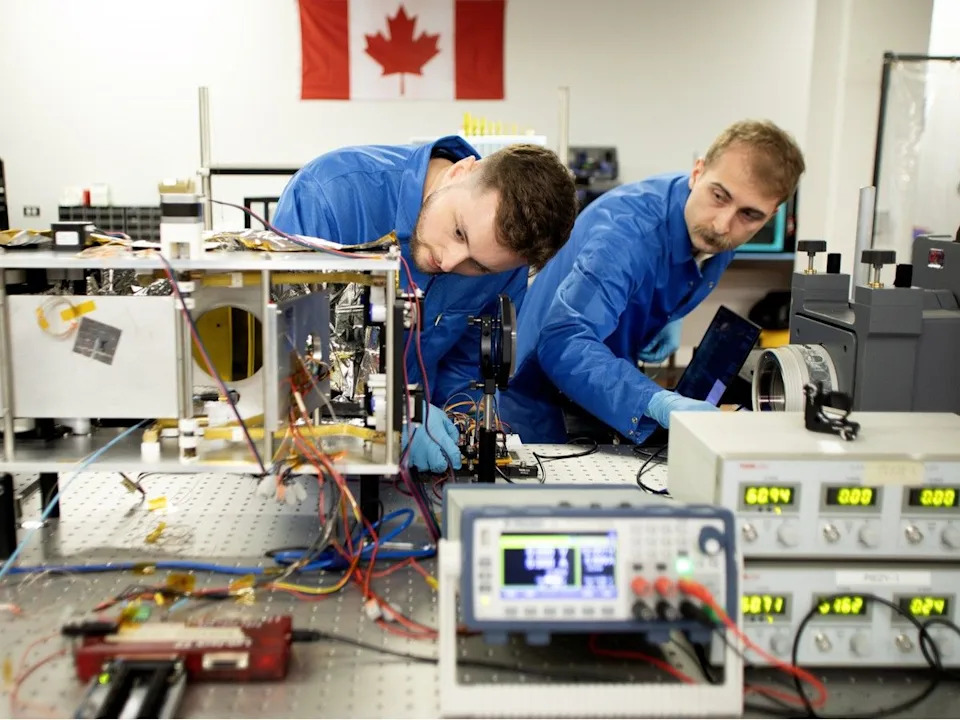
(left to right) Junior mechanical engineer in training Brandon Hodge and optical engineer in training Elliot Saive work on a deployable optics prototype, an advanced hyper spectral imaging telescope system for satellites, in the Wyvern laboratory, in Edmonton Friday, March 27, 2026.
CANDO boost for Indigenous pilot program
The federal funding also provides $149,000 for the Council for the Advancement of Native Development Officers (CANDO) to launch an Indigenous defence supply chain pilot program.
The program takes 30 Indigenous suppliers, putting them through a “supply chain boot camp,” teaching everything from security clearances, industrial technical benefit, and how Indigenous participation plans can be used.
CANDO communications director Paul Macedo hailed the announcement.
“We prepare Indigenous suppliers and First Nations Indigenous communities to position themselves to really take advantage of the opportunity that’s before us,” he said.
When the group goes to CANSEC, Canada’s leading defence event, in Ottawa this May, they’ll have a full slate of meetings at the largest security and defence trade show, and they’ll know how to connect.
“With PrairiesCan support, we’re going to have a special focus on Alberta, Saskatchewan and Manitoba,” Macedo said.
Related
Bookmark our website and support our journalism: Don’t miss the news you need to know — add EdmontonJournal.com and EdmontonSun.com to your bookmarks and sign up for our newsletters here.
You can also support our journalism by becoming a digital subscriber. Subscribers gain unlimited access to The Edmonton Journal, Edmonton Sun, National Post and 13 other Canadian news sites. Support us by subscribing today: The Edmonton Journal | The Edmonton Sun.