
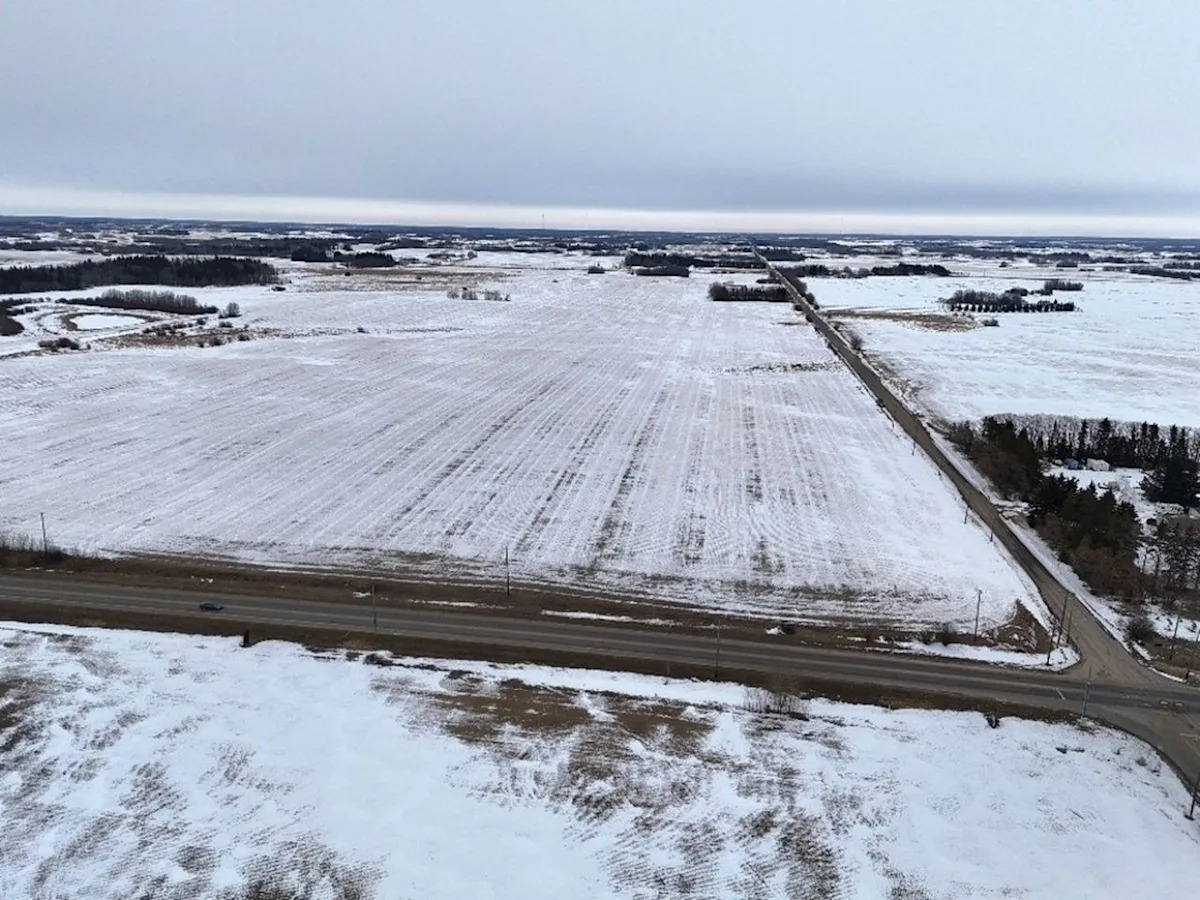
One of Edmonton’s newest neighbourhoods is still on the drawing boards.
But if all comes to pass, Snowberry in southeast Edmonton could one day be home to more than 21,000 residents.
The proposed community, bounded by 28th Avenue S.W. to the north, 17th Street S.W. to the east, 41st Avenue S.W. to the south, and 50th Street S.W. to the west, encompasses approximately 385 hectares (950 acres) of land and could play a key role in Edmonton’s future growth.
With Edmonton’s population heading to a target of two million people — it grew 18.3 per cent in the last five years according to Alberta government figures and was at 1.2 million residents last year — new home subdivisions in the popular southwest, and neighbouring west, are just about completed. Development is now shifting to the southeast.
The southeast, according to Brookfield Residential, is one of the last growth areas to commence development in a meaningful way and it’s also an area that has one of the strongest market demands, said Mike Kohl, Brookfield’s senior vice-president, communities.
Snowberry 101
Located in Decoteau, Snowberry is one of three overall zones the city gave a green light to back in 2015 to handle future residential demand; the others were Horse Hill in the northeast (think neighbourhoods like Marquis and Marquis West that have recently come online) and Riverview in the west-southwest (Rivers Edge and The Uplands, for example).
But while Alberta’s population growth is slowing — it should hover around one per cent this year and next, according to provincial government predictions, and Edmonton will welcome around 26,000 new residents this year, said the city — planning must begin years, even decades before, to ensure a proper housing supply.
If you refer to the Decoteau Area Structure Plan, which takes a big picture view and guides growth, that was approved by Edmonton city council in mid-2015. In it, you have the basics for future growth in Edmonton’s southeast, and a road map to future city neighbourhoods.
Decoteau, as envisioned then, included Snowberry, a Decoteau subdivision, Kettle Lakes and Meltwater, all of which are at various early or potential development stages, although it also includes Alces, where homes are now being built and sold.
Focusing on Snowberry, which developers Brookfield Residential, NAC and the Rohit Group hope to bring to life, this neighbourhood has reached a point where it is in the early stages of the Neighbourhood Structure Plan stage — drilling down to more specific items about the neighbourhood itself.
Snowberry’s NSP is currently awaiting a timeline for a public hearing — possibly towards the end of this year — with public engagement on it recently closing on March 1. Should the NSP be successful or should it be amended and a future version be approved, it will still be some time before shovels are put into the ground.
Envisioning Snowberry
What will Snowberry look like? The quick answer is that it’s too early to say.
Postmedia spoke with all three developers, as well as Stantec Consulting Ltd., engaged by the developers to submit the Snowberry NSP, and did find out the following.
According to the proposed NSP, Snowberry will have about 8,600 dwelling units, although the final breakdown and types of units has yet to be finalized. But it will be denser than other portions of the city, said Stantec’s Yolanda Lew, community development practice lead. There will be 45 units per hectare instead of the 35 units per hectare that the city has seen in the past 10 or so years.
Two school sites are being proposed as well as a fire station. But a defining feature may well be Edmonton’s Emerald Crescent, a mix of natural areas and wetlands that will be preserved. The Emerald Crescent spans the equivalent of 75 city blocks — over 10 kilometres — and could bridge together all the planned Decoteau neighbourhoods as well as being unique to this part of the city.
Each developer said they do plan to take the Emerald Crescent into account when planning out their sections of Snowberry but that at this stage, it is too early.
Speaking to NAC, which may be the first developer to bring its Snowberry land online, should the development be approved by council, it would likely be late 2027 or into 2028 when residential development begins, said NAC president Chris Nicholas.
“It’s much too preliminary, we’re broad-brushing right now,” said Nicholas, when asked which builders NAC would look to include in its segment. “What kind of land use, what kind of services, what kind of roads, that’s what we’re looking at now. I’m hoping in this case, because it’s part of an approved ASP and because we have to go to committee and council, I’m hoping it will be looked favourably with this council as in the south land supply is very constrained and it’s much, much needed in order to have proper supply and choice.”
Rohit, meanwhile, said that should approval for Snowberry come later this year, possibly as early as the fall, it would still be 2027 or 2028 before they foresee work moving forward on their portion of Snowberry as even with an approved NSP there are still further steps such as zoning, development and building permits, among other items, that will need to be done.
“We have to be thinking four to five years ahead, it is a long process,” said Chris Dulaba, manager of placemaking and entitlements for the Rohit Group. “We acquired our piece several years ago knowing that this land was in the area of growth at the point the Decoteau Area Structure Plan, I think, was approved. Much like any land acquisition … you make assumptions and you take risk.”
Brookfield considered this part of Edmonton even longer ago, looking at acquiring its stake as far back as the mid-2000s.
“If you want to build, and we want to build large master-planned communities, to do so you really have to look that far in advance,” said Mike Kohl, Brookfield’s senior vice-president, communities.
And even with a trend toward slower immediate population growth, Kohl said that doesn’t mean development plans stop.
“There’s still so many people that moved into the province over the last three years that haven’t bought a home, that will want to buy a home,” said Kohl. “Our economy for Alberta is still very strong across, not just Canada, but across North America. The amount of people that have moved to the province that are going to continue to look at buying a new house — that will put continued pressure and demand and ensuring we have (sufficient) housing supply. Then, there’s so many people that have moved to Canada in other provinces and will move to Alberta because of our affordability advantage and because of our economic opportunity. So we think that there will be great demand for a number of years to come in Alberta, in Edmonton, and specific to this market as well.”
Comparing Communities
Snowberry, as currently envisioned and awaiting a green light from the City of Edmonton, would occupy 950 acres in the city’s southeast. To get an idea of what that would be like, consider the neighbourhood of Chappelle Gardens in southwest Edmonton. Chappelle Gardens is 490 acres and will house 4,500 people when fully built out. Snowberry, if approved, is almost close to double Chappelle’s size but will house more than four times as many residents, should it be completed as planned.