
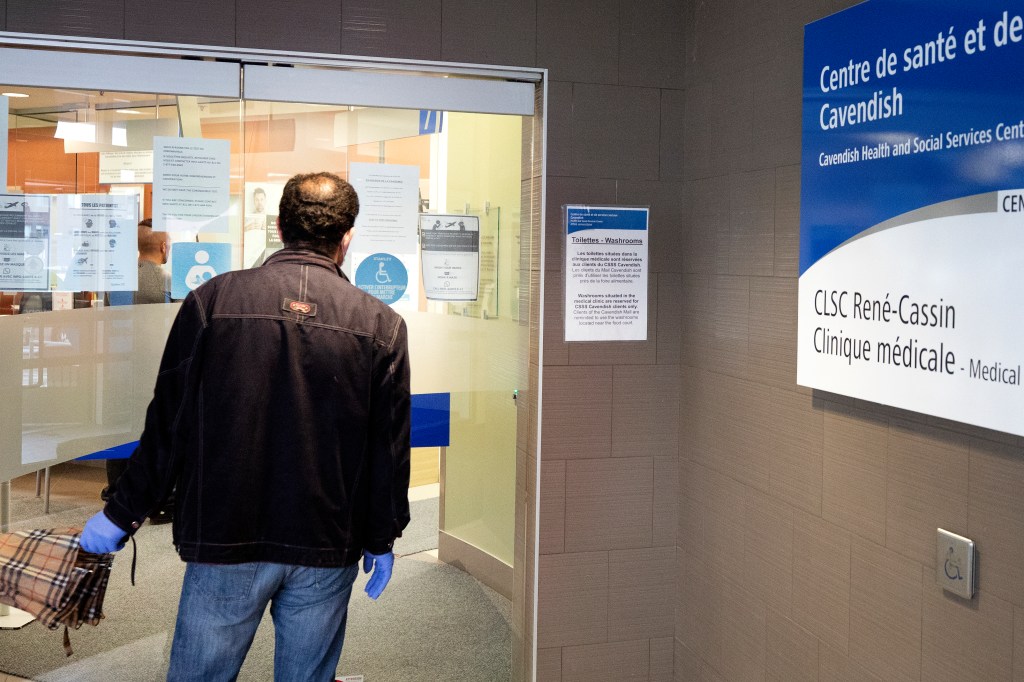
The CAQ government has unveiled its new policy governing first-line care in the province.
The policy will transform the multitude of CLSCs into access points for first-line services, and all Quebecers will be assigned to a CLSC close to their homes, where they can turn in order to get the appropriate care.
The CLSCs will operate much like school boards and school service centres in the field of public education, where each family is assigned to a specific CLSC, according to where they live.
The policy aims to improve outcomes for patients and to reduce the strain on emergency rooms in the province. The plan will be rolled out gradually and, within five years, there will be a total of 205 CLSCs that have been converted as part of the new policy. The first 88 CLSCs will be implemented across nine regions of the province. They are: Capitale-Nationale, Estrie, Montréal, Abitibi-Témiscamingue, Côte-Nord, Nord-du-Québec, Îles-de-la-Madeleine, Laval and Lanaudière.
Social Services Minister Sonia Bélanger announced the policy Friday, saying it came after more than a year of co-operation and consultation with the partners in the health-care field.
The CLSCs will have family medicine groups, medical clinics and nurse practitioner clinics. Each of the CLSCs will have responders in place to assure proper care for each patient according to his or her needs, the CAQ government said in a news release issued Friday.
In addition to this, the Votre Santé platform will be progressively rolled out, and allow Quebecers a digital entry point to the health-care network, to work as a complement for the 811 Info-Santé phone line.
“This profound transformation of first-line services takes time, commitment and a mobilization of all the partners in the health-care field,” Bélanger said. I look forward to rallying everyone around this forward-looking project in the coming months.”
The Quebec Provincial Association of Users’ Committees (RPCU) said Friday the government’s intention is positive, but the timeline is far too long. “Users of the network can’t afford to wait a decade before seeing concrete results,” the committee said in a press release.
The Fédération interprofessionnelle de la santé du Québec (FIQ), representing nurses and other health-care professionals, also responded positively, saying in a press release the organization has been pushing to better integrate care into local areas for a long time. But the federation questioned how the objectives will actually be achieved in practice, and said it was concerned about plans to use online chatbots, as opposed to humans, to direct users to medical services.
The Ordre des infirmières et infirmiers du Québec (OIIQ), representing nurses, said it, too, welcomed the new direction the government was plotting, but “we still have many questions regarding the implementation of this vision,” president Luc Mathieu said.
Guillaume Cliche-Rivard, health critic for Québec solidaire, said the CAQ’s decision to focus on the CLSC system was long overdue.
“After eight years of dismantling local services, centralizing the network, working in close collaboration with Quebec Health, and allowing primary care to weaken, the CAQ has suddenly discovered CLSCs,” Cliche-Rivard said. “It’s good they’re finally admitting the failure of the current Family Medicine Group (FMG) model, which has been predicted for years, but we have the right to ask why they did the exact opposite all these years.”
For the shift to be successful, Québec solidaire said investments must be made to increase staffing in CLSCs, particularly for psychologists, social workers, physiotherapists and administrative personnel, “to stem the exodus to the private sector.”
The Parti Québécois was also skeptical.
“After eight years in power promoting Family Medicine Groups, notably in the recent agreement with family physicians that encourages Quebecers to register with these facilities, the CAQ has made a complete about-face by finally rediscovering the existence of CLSCs,” PQ health critic Joël Arseneau said. “The CAQ has lost all credibility on health issues.”
Québec solidaire criticized the CAQ’s proposal to use chatbots to supply medical information, particularly given the costly difficulties the province has faced with digital transformations. “Quebecers want to be able to speak to real people when they’re sick, not be redirected to a dehumanized medical system.”