
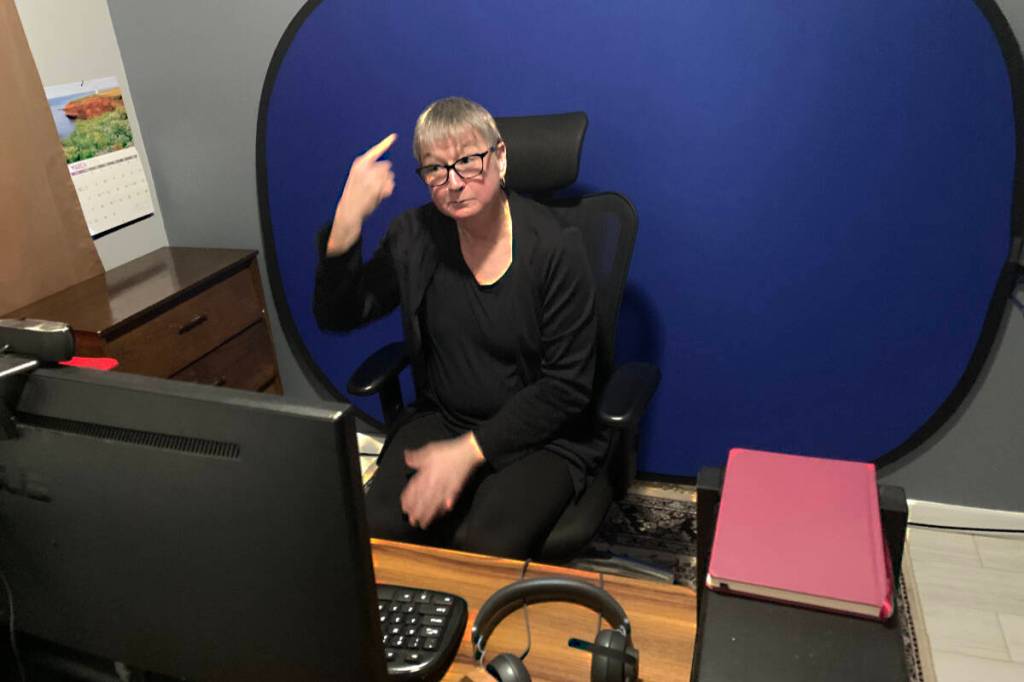
From births to deaths, a Shuswap interpreter has signed it all
Published 5:00 am Monday, March 30, 2026
From weddings to 911 calls, the prime minister and coroner’s conversations, Sicamous interpreter Tracy Hetman has signed them all.
A sign language interpreter for the deaf community, Hetman entered the field after taking an early and immediate interest in the language.
“I was young, like around six years old, the first time I saw someone using sign language, and from that moment I thought, ‘that’s cool, how can you speak a language with your hands?” she said. “I didn’t have a chance to learn much at the time, but it stuck with me.”
It kept finding her from there.
A few years later, her class read a book about Helen Keller that had pictures of the finger alphabet at the end, which she worked to learn. Then, in Grade 12, another student did a presentation on sign language further igniting her interest.
Facing graduation Hetman knew she didn’t want to pursue the careers typically open to women, but “I knew I wanted to learn sign language, or at least be exposed to it a little bit more.”
From there she studied interpreters at conferences, immersed herself in the deaf community – which really supported her – and was taken under the wing of a mentor. With no interpreter training programs in Canada, the two would cross the border from Ontario into Detroit where there was a sign language studies program to further her education.
“I was really in the right place at the right time,” Hetman said of the United Nations, having just made the Declaration on the Rights of Disabled Persons in 1975. “So there was a little more awareness of being accessible, and what that would mean to different people with disabilities.”
In 1981, Hetman got hired as an interpreter and has been doing it ever since, seeing a lot of changes and advancements in that time.
“When I started out, the world was really different; I mean, there wasn’t even captions on TV. They came in the early ‘80s and there were only two shows that had captions – Dynasty and Dallas.”
She said those two shows were aired on Wednesdays, which was the same evening the deaf clubs would have meetings. That, however, soon changed.
“As soon as those shows came on, no more meetings on Wednesdays. Everybody stayed home because that was the only access to TV they had.”
While the interpreting profession was just emerging at that time, Hetman said the real breakthrough was in 1982, when Chrysler’s 10,000 Canadian workers walked off their jobs. She was working in Windsor, Ont. at the time, and said deaf workers came to her for help with an upcoming union meeting where she was able to go translate for them.
Through that, a photo of her signing with other officials on stage was put on the front page of the Toronto Star.
“The story was about the strike, but that picture… it got a lot of exposure for the agency that I worked for, and the idea of interpreting services being accessible,” she said. “So it really raised public awareness.”
Hetman now works remotely but interacts with people across Canada through three kinds of services offered, the Video Relay Service (VRS), Video Remote Interpreting (VRI), and VRI On-Demand. VRS is for phone calls where a deaf person video calls the interpreter who then speaks to the hearing person, while VRI connects two people who are in the same room with an interpreter who videos in. On-Demand involves a deaf person going into a businesses with the establishment then linking in an interpreter on video call to translate between the two.
Hetman said calls, particularly the VRS ones, range from “A to Z,” with everything from doctor’s appointments, ordering food, calling family, therapy, and even 911 calls.
“I’d say the most unique call I’ve had was for a deaf couple talking to the chief coroner because their son had died under suspicious circumstances,” she recalled.
Having also done in-person interpreting throughout her career, Hetman has talked people through pre-natal classes and births right up to funerals and everything in between. That included translating a call for a deaf person calling the prime minister’s office, and a wedding where a deaf couple eloped to the U.S. and she translated the call to help the justice of the peace marry them over the phone.
“Anything in life that happens, we interpret,” she said. “It’s pretty unique.”
Read more: Calgary author to discuss Chinese Exclusion Act book in Revelstoke
Read more: Salmon Arm Men’s Shed looking for a shed to call home to aid mental health