

Listen to this article
Estimated 5 minutes
The audio version of this article is generated by AI-based technology. Mispronunciations can occur. We are working with our partners to continually review and improve the results.
A panel reviewing the future of N.B. Power says the Holt government should take over a large part of the utility’s debt to reduce the pressure to raise rates for customers.
The panel is also recommending that a second large nuclear power plant be built next to the existing Point Lepreau generating station — but that the troubled plant be split off from the Crown corporation and become a separate operation.
But the report released Monday warns there is no single, easy solution to fix the troubled corporation.
“Let us start with the bad news: there is no silver bullet or easy answer to achieve the overriding goal to have affordable, reliable and sustainable electricity while meeting New Brunswickers’ expectations,” the report says.
N.B. Power’s debt is now estimated at $5.9 billion.
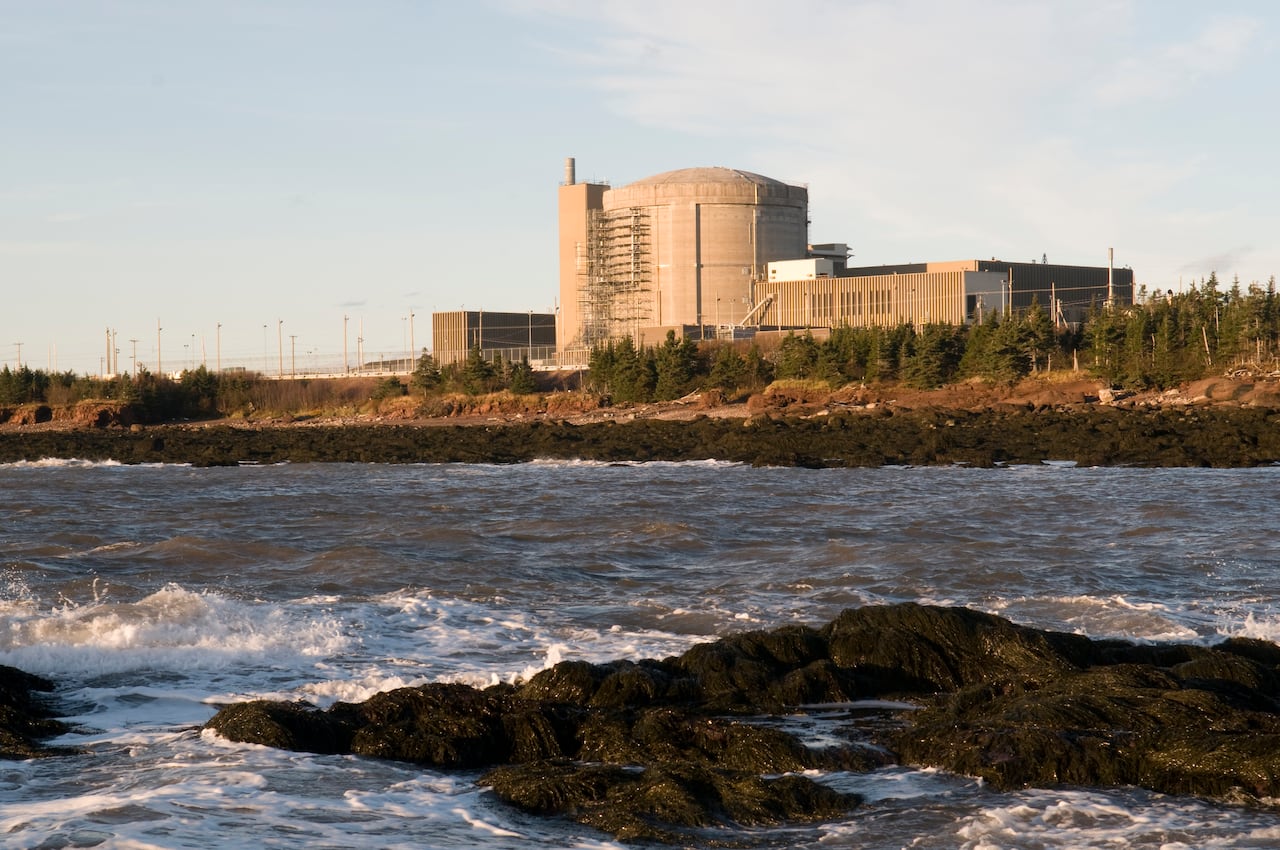 The panel is recommending that a second large nuclear power plant be built next to the existing Point Lepreau generating station (Submitted by N.B. Power)
The panel says about $1.5 billion of that is the result of a series of politically motivated rate freezes and caps between 2011 and 2022 that prevented the utility from fully recouping its costs.
Point Lepreau’s cost overruns and performance problems are also responsible for part of that debt, and the report says the province should write down that debt, now held in a variance account that the utility is recovering from ratepayers through surcharges.
“This would be a measure that could be done in the near term to help reduce a portion of N.B. Power’s current debt load and provide some rate relief,” the report says.
WATCH | ‘Get the politics out’: panel releases N.B. Power report: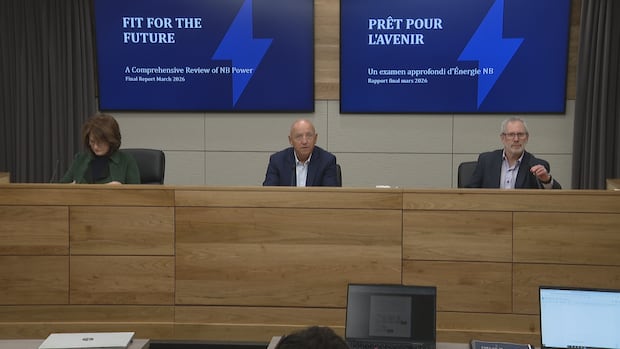
Less debt, more nuclear: report charts new path for N.B. Power
Review panel says government should take on large share of utility’s debt to lower pressure on rates
It estimates the utility’s debt would drop to $5.6 billion.
The panel also recommends the province take over the $1.5 billion in debt caused by rate caps and freezes, further lowering the utility’s overall debt to $4.1 billion.
The Lepreau recommendations will likely spark a new debate about the wisdom of nuclear power, which has proven costly to ratepayers but which can provide reliable, clean, zero-emissions power.
“We recommend that the Government of New Brunswick consider initiating the planning assessment phase for an additional large scale, proven technology nuclear plant to be sited alongside the Point Lepreau facility,” the report says.
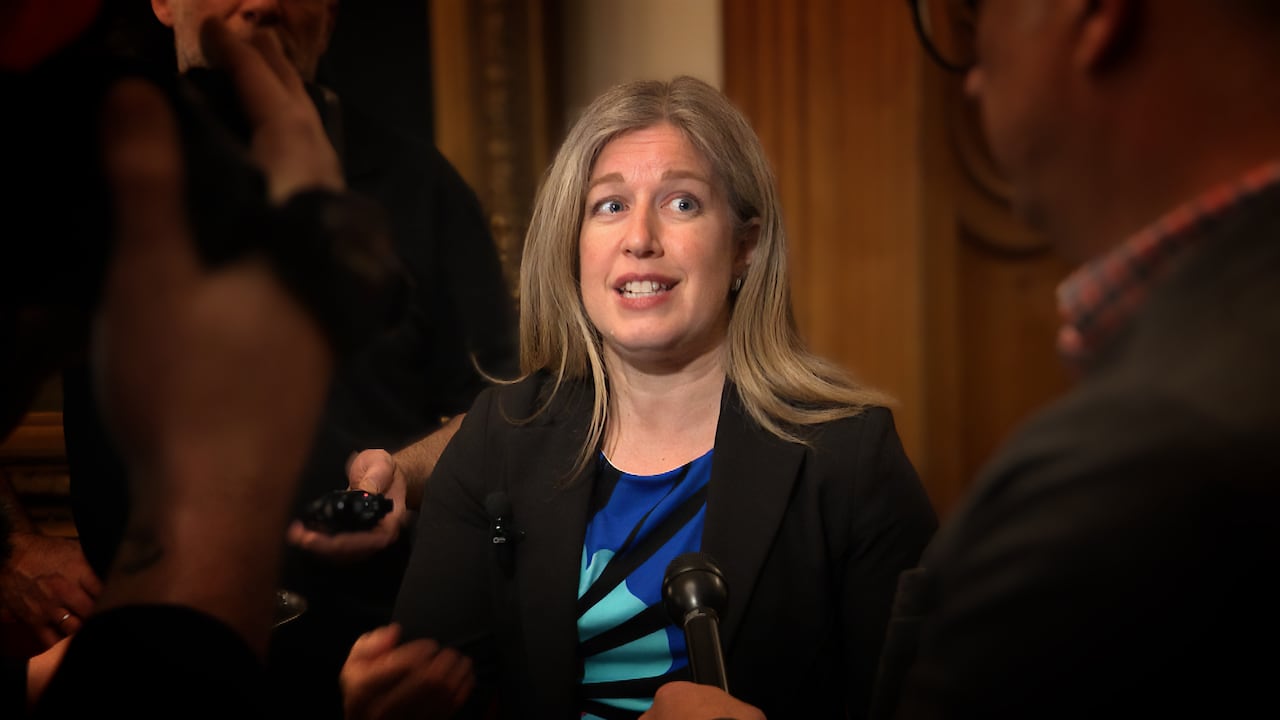 The panel says the Susan Holt government should take over a large part of the utility’s debt to reduce the pressure to raise rates for customers. (Mikael Mayer/CBC)
It also recommends a closer relationship with other operators of the same CANDU 6 reactor technology, including the Cernavodă generating station in Romania.
That plant, the report says, operates at 95 per cent capacity — a better performance than Lepreau.
Energy Minister René Legacy was not available to comment Monday, but in a statement he said the government will announce “next steps” by the end of May.
He said last week that the Holt Liberals would not do nothing.
“It is not going on the shelf. I can guarantee that. There is no shelf for that report,” Legacy said.
N.B. Power said in a statement it was committed to making necessary changes and would co-operate with the government to “act with urgency” on the report.
The report does not call for the privatization of N.B. Power but says a hybrid model, “corporatization,” would require the utility to do its own borrowing on capital markets.
Panel member Michael Bernstein said the utility’s indebtedness would probably mean a low price if the province sold it, and a new owner would need to increase rates to make a profit.
“The private sector would require higher returns, which would be putting pressure on rates, and that’s already a significant issue,” he said.
The report says, however, the Crown corporation should also be “nimble” enough to sell assets and strike partnerships when they can benefit the bottom line.
Other elements in the report include:
Ending the practice of keeping electricity rates “artificially below” the actual cost of power for industrial companies, “a very blunt and not particularly effective” economic development tool.Letting large, export-driven industrial players generate their own electricity, as J.D. Irving Ltd. proposed last year.Bringing back performance bonuses for N.B. Power executives if they meet targets. “There is not a performance-based culture within the organization,” the report says.
The report also laments a pattern of political interference and changes in direction coming from various governments over the years.
“In practice, NB Power has received seven mandate letters in the past 10 years,” it says.
“We noted that there is also a stream of unofficial, sometimes daily, contacts with government officials, as well as with other elected officials including municipal leaders, which can divert N.B. Power’s executives from their responsibilities and agreed priorities.”