
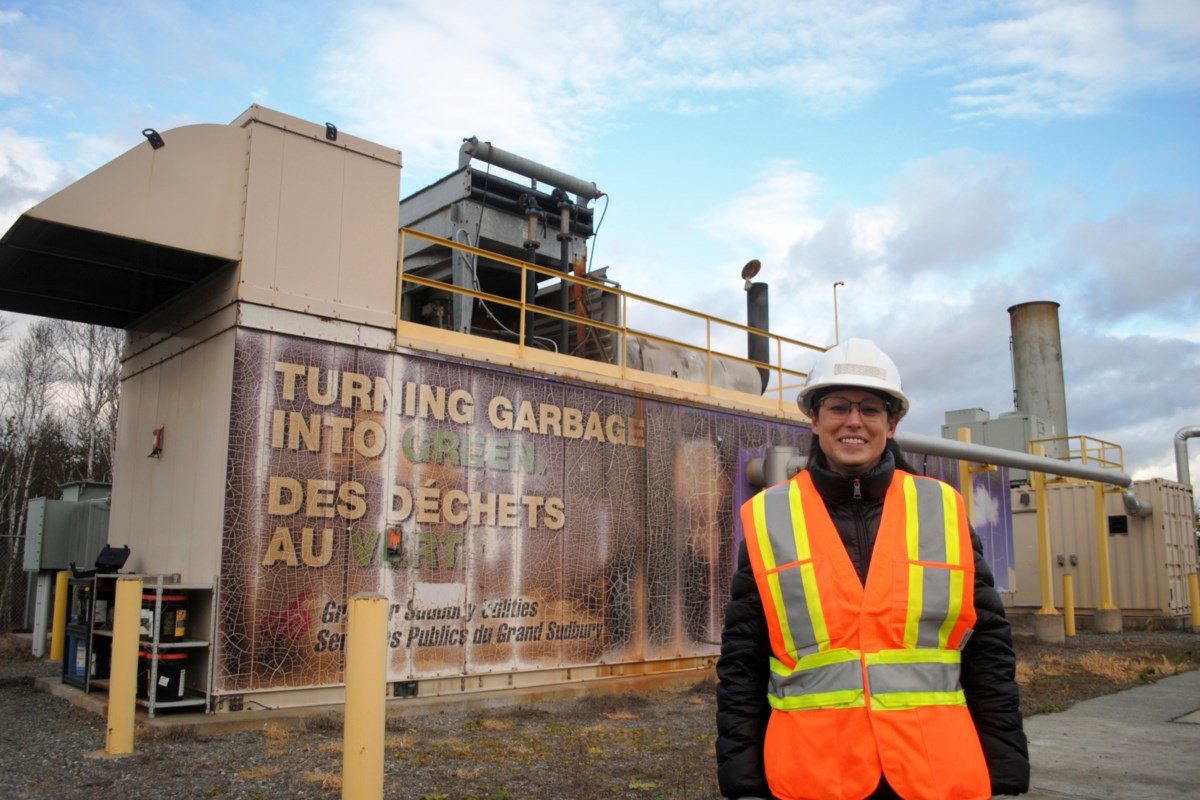
More than 63 per cent of City of Greater Sudbury CO2-equivalent emissions come from city landfill sites, and improving green cart organics curbside pickup is key to lowering emissions
When it comes to tackling city environmental goals, municipal landfill sites offer the greatest potential impact in reducing CO2-equivalent.
The biggest thing residents can do to lower these emissions is use the city’s green cart organics curbside program, city Environmental Services director Renée Brownlee said.
Numbers which support this point jumped off the page during a city council meeting earlier this month, when the city’s latest Climate Action Annual Report was presented.
It was the first such report to include the CO2 equivalent which city landfill sites pump out.
During the meeting, city Climate Change co-ordinator Jennifer Babin-Fenske cited an estimated 27,673 tonnes of CO2 equivalent generated by municipal operations last year, including such things as buildings and vehicles.

A City of Greater Sudbury slide which shows greenhouse gas emissions (tonnes of CO2). Image: City of Greater Sudbury
On top of this is approximately 5,847 tonnes due to wastewater operations and 58,306 tonnes via solid waste — city landfill sites.
As such, city landfill sites make up more than 63 per cent of the city’s annual CO2 equivalent, a greenhouse gas credited as the primary driver of climate change.
“It’s so much more than both the heating of municipal buildings and the equipment and vehicles we’re using,” Ward 9 Coun. Deb McIntosh said during the meeting. “This is a big player in our emissions.”
Mayor Paul Lefebvre later reiterated this point in promoting the city’s green cart program.
Following the meeting, Sudbury.com sought additional context through a phone interview with Brownlee, who enthusiastically cited the green cart program as an important means of lowering the city’s CO2-equivalent emissions (greenhouse gas).
In short, wet material such as organic waste (food waste, yard trimmings), experiences anaerobic conditions at landfill sites, meaning they’re piled up and deprived of oxygen. This leads to longer decomposition processes which produce methane gas approximately 30 per cent more potent as a greenhouse gas than carbon dioxide.
Meanwhile, organic waste diverted from the landfill sites via such efforts as the green cart program are processed in an aerobic environment which produces less CO2 equivalent.
Although the Sudbury Landfill Site has an energy generation plant which converts landfill methane into electricity, it doesn’t capture it all. Further, the city’s other two landfill sites do not have plants, and Brownlee noted the city also has three closed landfill sites which continue to emit methane for at least 25 years after they’ve been shuttered.
While most residents use curbside waste and recycling pickup, a recent survey of 3,026 households in Chelmsford, Hanmer, Minnow Lake and Sudbury’s South End found that 45 per cent of households put green carts out at least once during a four-week study period.
“We need residents to use it and maximize their use of that program in order to help support these kinds of initiatives that are going to reduce our emissions,” Brownlee said.
If the entire Sustainable Waste Strategy were followed, city landfill sites would conservatively reduce their carbon footprint by 12 per cent, she said.
“The better we do at implementing the plan and the more (efforts) we add … will continue to add to that 12 per cent,” she said.
Although city emissions have plateaued in recent years, the population has also increased, and Brownlee noted that certain steps the city has taken to reduce emissions have helped.
Shifting to every-other-week and reduced bag limits for curbside garbage pickup diverted waste to green carts and blue bins, Brownlee said, noting, “By the end of that change, we saw the amount of tonnes of organic waste doubled that we were collecting and diverting.”
Brownlee also credits last year’s adoption of a mattress diversion program as also helping divert waste from landfill sites.
The city’s environmental impacts have been well studied through the development of such documents as the Community Energy and Emissions Plan and the city’s Sustainable Waste Strategy, both of which help map a path toward the city’s net-zero emissions target by 2050.
The Sustainable Waste Strategy includes 18 recommendations, which Brownlee said staff would continue to bring forward via business cases during annual budgets, including the 2027 budget which a newly elected city council will tackle shortly after the Oct. 26 civic election.
Two key goals that stick out when it comes to the green cart program, Brownlee said, is making it more available to residents of high-density (seven units or more) buildings and non-residential buildings, and constructing a preferred system for organics processing.
The green cart program is currently open to residential buildings up to six units and at a cost to residents of buildings with seven units or more, but Brownlee said nobody has opted to pay.
As for a preferred system for organics processing, Brownlee said the city currently uses a temporary facility, and a proper system would help them expand operations to accept more organics waste.
Among the 18 recommendations within the Solid Waste Strategy projected to yield the greatest results is also the most controversial. A clear garbage bag mandate, wherein residents would be required to use clear garbage bags which can be checked at the curbside to ensure green cart and blue box compliance, received mixed reviews from city council members and was deferred to the end of 2026, when staff will return to city council with a fresh report.
In the meantime, Brownlee said residents can help the city reduce CO2 emissions and prolong the life of municipal landfill sites by using the programs already in place — namely, the green cart program.
Promoting this, she said, is “our lowest-hanging fruit to divert more organic waste. … The program is already there, just use it.”
Tyler Clarke covers city hall and political affairs for Sudbury.com.