
As political leaders in Ottawa and Quebec welcomed the announced retirement of Air Canada CEO Michael Rousseau, the fallout from his English-only video also drew international attention, including from one unexpected voice: Elon Musk.
The billionaire chief executive of Tesla and SpaceX, who in recent years has increasingly commented on political issues abroad — particularly over free speech and immigration — waded in, further amplifying a language debate all too familiar in Quebec.
Rousseau had spurred anger by delivering a nearly four-minute condolence video in English only following last week’s crash at LaGuardia Airport in New York, when an Air Canada Express flight from Montreal collided with an airport fire truck while landing. Capt. Antoine Forest and First Officer Mackenzie Gunther were killed, and more than 40 people were injured. Forest, 30, was a francophone Quebecer.
As the investigation into the crash got under way in New York, days of backlash followed for Rousseau in Canada. Prime Minister Mark Carney said it showed “a lack of compassion.” Quebec Premier François Legault said outright Rousseau should resign — Quebec’s National Assembly ultimately voted 92-0 (with one abstention) in favour of a motion calling for his resignation.
In response to a post Monday about the Air Canada chief’s retirement, Musk wrote: “That’s crazy.”
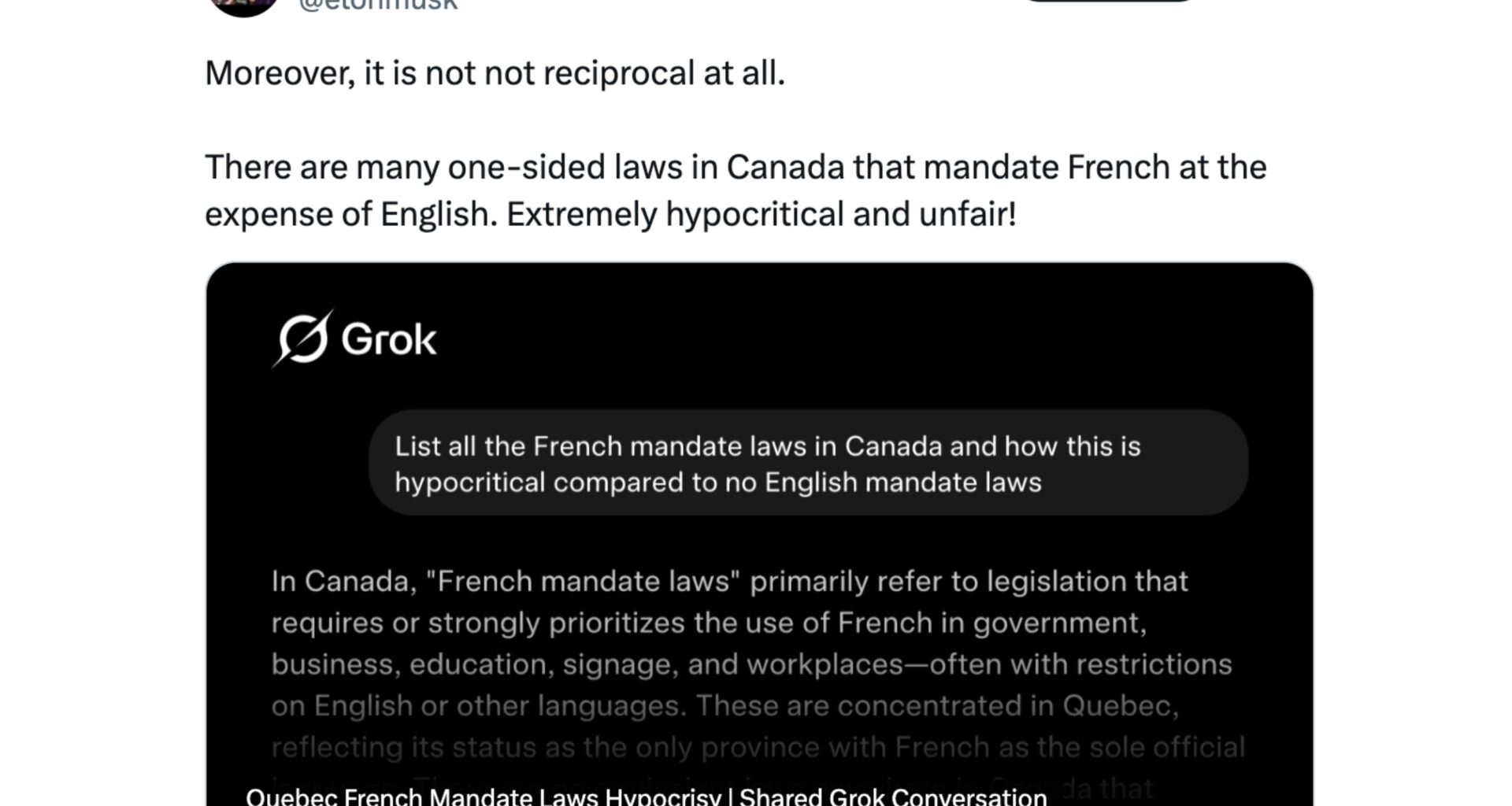
“There are many one-sided laws in Canada that mandate French at the expense of English,” Musk wrote, adding: “Extremely hypocritical and unfair!”
Before Musk, who was born in South Africa, settled in the U.S., he briefly emigrated to Canada in the late 1980s, reportedly arriving in Montreal. His mother, Maye, was born in Canada.
Attached to Musk’s post on Monday was linked query on Grok, the AI chatbot integrated into X, which Musk acquired in 2022, asking it to list French-language mandates in Canada and “how this is hypocritical compared to no English mandate laws.”
Grok’s lengthy response pointed to Quebec’s Bill 96, requiring French in areas ranging from government services and workplace communications to signage, education and consumer contracts.
It also referenced newer federal rules extending French-language rights in federally regulated businesses operating in Quebec.
The expansion of language laws in Quebec has been driven by Premier François Legault’s government, which has cited stronger language rules to protect French in the province.
For Rousseau, it wasn’t the first time his respect for the French language has been called into question.
Back in 2021, when Rousseau took the helm at the airline, he admitted that he didn’t speak French, despite having worked in the Montreal headquarters for over a decade.
According to Legault, he promised at the time that he would learn the language. But more controversy followed.
Later in 2021, Rousseau gave a largely English speech to a Montreal business audience that prompted anger from Quebec’s politicians.
In 2022, he told a parliamentary committee that he was studying French intensively but was not yet comfortable using it under pressure.
Air Canada maintained to shareholders – between the years 2023 and 2025 — that he continued to work on the language .
With files from The Gazette’s Jack Wilson.
Do you have a story tip? Write to me at hnorth@postmedia.com

I write for the Montreal Gazette, covering the biggest stories I can find (and sometimes tennis). I studied economics and computer science at McGill. I now live in the city’s Plateau where I can never keep up with the fashion trends of the hipsters strutting the sidewalks. I wear Doc Martens to blend in. If you have a story tip or just fancy a chat over an espresso, write to me at hnorth@postmedia.com